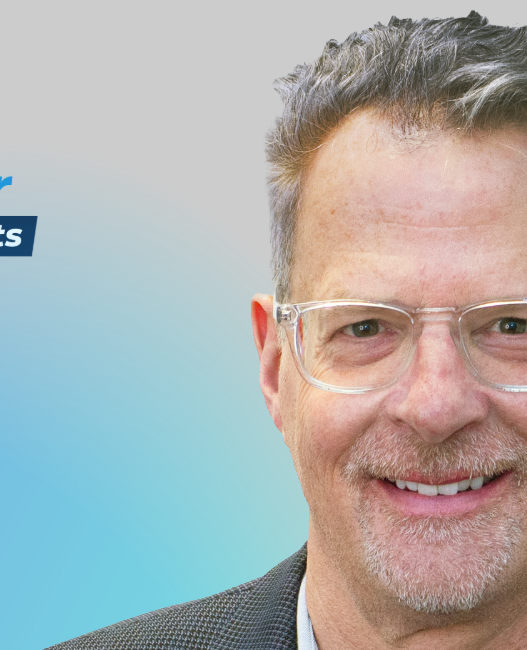


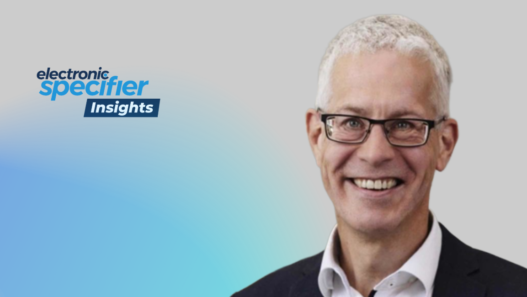


In a recent episode of Electronic Specifier Insights, host Paige Hookway spoke with Peter Wiese, EMEA Managing Director at Calterah Semiconductor.
Calterah was founded in 2014 by CEO Jiashu Chen, who holds a PhD from UC Berkeley, and Wiese is fond of the origin trivia: the company was incorporated, “by accident,” on Valentine’s Day. The name itself is a technical manifesto – ‘CAL’ for Berkeley, “Tera” for terahertz-class ambition, right down to the final ‘h’ standing for hertz.
The mission statement is: “Make Millimetre-Wave Serve Everyone.”
Wiese arrived in early 2025 from a career spent at Motorola, Freescale, and NXP – including the former Philips Semiconductor – beginning as an RF design engineer on keyless entry systems in the 1990s before moving into marketing, sales, and business development.
What he found on arrival was a company with far deeper market penetration than its European profile suggested. In China, Calterah holds “roughly the same market share than our biggest competitor in the region in radars,” so is also known with the German joint ventures. Those relationships did the rest of the work: Chinese-built parts went into cars for export, then into the German JVs, and Tier One customers in Europe began asking for local support. “We felt then the strong desire and need from our customers to also open office here [in Europe] to have less travel and quicker, shorter interaction.”
The Munich office started operations two years ago, and when Peter joined, there were just three of them. It now has nine, along with frequent customer visits and an on-site laboratory.
The flagship mmWave products transmit and receive at 77GHz – a wavelength of roughly four millimetres, delivered in standard CMOS rather than specialised process technology. Wiese offers a nice piece of perspective for the non-RF reader: FM radio once demanded the metre-long antenna rods people remember on older cars. “When you put the same to 77GHz, we are at four millimetres wavelength, and this is what we do in a single piece of silicon.”
The automotive use cases are the familiar ADAS trio: adaptive cruise control, automated emergency braking, and blind spot detection. Alongside that sits a 60GHz line for indoor and industrial monitoring – seat occupancy, forklift safety interlocks, and child presence detection, the last of these driven by Euro NCAP requirements.
Asked what actually differentiates Calterah’s SoCs, Wiese returns repeatedly to IP depth and its thermal consequence. Tailor-made IP yields very low power consumption, and low power consumption means less heat to dissipate – which in turn removes cooling cost from the system.
The second differentiator is the digital back end. Rather than leaning on a standard DSP, Calterah built what it calls the Radar Signal Processor (RSP). “We are not going standard [DSP], for example, we are going radar signal processor, which is more than standard to allow really highest efficiency,” Wiese says. The RSP’s job is to process the maximum number of channels efficiently enough that Tier One customers can then run their own classification algorithms – deciding whether a given cluster of echoes is “a car, a cyclist, a pedestrian, a guardrail, a curb, the bridge, or whatsoever.”
Three years ago Calterah moved into Ultra-Wideband – a technology known in Europe primarily for secure car access. The rationale is that UWB, viewed through a radar engineer’s eyes, is simply a very wide-band pulse system. Where FM radio needs roughly 100kHz of channel bandwidth, UWB needs a minimum of 500MHz – “so the channel bandwidth is already 5,000 times wider.”
In its primary mode, UWB does secure ranging: a key (or, increasingly, an Android or iOS handset) exchanges pulses with at least three anchors on the vehicle, and the car triangulates. “This gives you precise positioning, and it’s adopted by … every major European car brand now for entry,” Wiese says.
“We are a small company, but we are super effective, and I’m really happy to get into contact with people of target applications,” Wiese concludes.
Engineers can reach the company online, connect with Wiese on LinkedIn, or visit the stand at electronica 2026 in Munich.
To hear more from Peter Wiese, you can listen to Electronic Specifier’s interview on Spotify or Apple podcasts.