
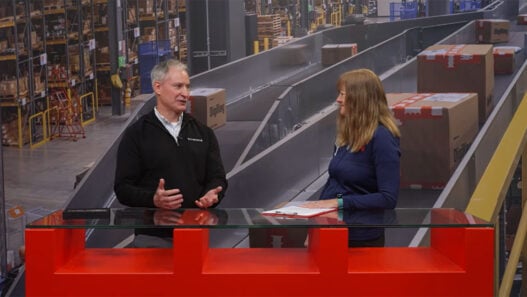



At electronica 2026, Lucy Barnard spoke to Robert Taylor, Sector General Manager, Power Design Services and Power Delivery, at Texas Instruments (TI), at the DigiKey booth about how advances in packaging technology are helping engineers deliver more power in smaller spaces, and how integration can simplify power supply design.
Taylor’s team is responsible for creating custom reference designs for customers around the world, across a wide range of markets and sectors. Talking about TI, Taylor describes the company as “a foundational semiconductor manufacturer” focused on analog and embedded processing chips, mostly targeting automotive, industrial, and data centre applications.
Innovating intelligent systems
TI’s presence at electronica this year was built around the theme of innovating intelligent systems, with four pillars:
- Embedded systems, where the company is debuting a new real-time operating system to accompany its microcontrollers
- Industrial automation, where humanoids and robots are “booming” across the industry
- Automotive, where TI is architecting intelligent vehicles through processors such as the TDA5 family, alongside power distribution for 48V and 12V systems
- Data centre, where TI is working “from the grid to the gate” for AI data centres, covering 800V systems and every power conversion step in between. Power modules are one of those steps
What is a power module?
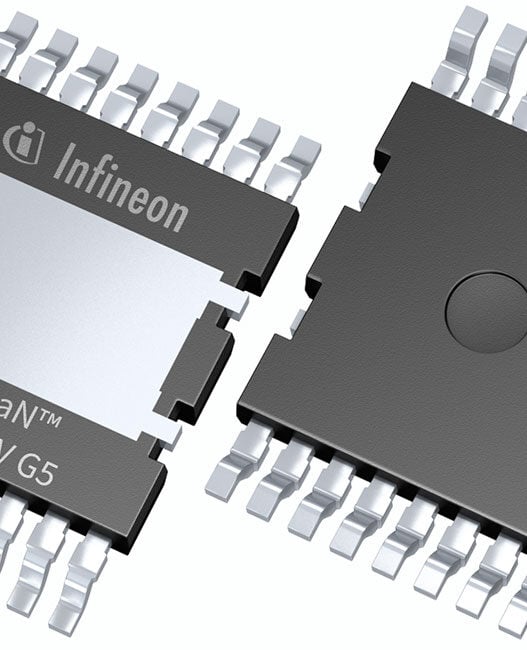
At its simplest, a power module brings many components together into a single package: “Power modules … take many discrete components, put them together onto some sort of substrate or PCB, package them together to make design much easier for the engineer,” Taylor explained.
By integrating components, TI can increase power density and efficiency while making designs easier to use, helped by technologies such as IsoShield and MagPack. Size is a major reason modules are growing in popularity, and TI’s IsoShield products are a good example.
IsoShield: isolation in a thin package
IsoShield integrates the power switches, the passive components, and a transformer in one package, reducing height and increasing power density.
“What’s really cool about this is we’re able to take not only the power switches, but also the transformer and the passive components, put it all into a single laminated package,” said Taylor. “Some of these packages can be as thin as 1mm. So, in space-constrained applications where height is a problem, this really helps the end user.”
The shielding addresses a familiar problem with magnetic components. “Whenever you have a magnetic field or any type of transformer, inductor, something like this, the stray fields can cause problems for nearby electronics,” he said. “And so, we’re able to add shielding inside of the device as well in order to contain all of those magnetic fields that are happening.”
MagPack: magnetics in the mould compound
MagPack is TI’s latest packaging technology, integrating the magnetics directly into the power supply using a magnetic mould compound. Where semiconductors are usually encapsulated in plastic, MagPack takes a different approach.
“What we’ve done is we’ve put a coil inside on top of the switching regulator and then overmould that with a magnetic material. So that allows us to get higher inductances, better efficiency, smaller size, more power density, all those things which are needed in the industry right now.”
Keeping cool
Smaller packages raise the obvious question of heat. TI tackles this in several ways. “One of them is called HotRod, where we actually pull a lot of the heat out of the bottom through these thermal slugs into the PCB. We also have some packages where we have topside cooling, where you can attach a heat sink,” said Taylor.
Integration helps too. “By integrating everything together, we’re able to get higher efficiencies. So we reduce the amount of thermal stress on the packages to begin with,” he said.
What’s on the horizon
Looking ahead to the next year or two, Taylor looked to data centres, where TI is working from 800V right down to the point of load. “We’re innovating from the 800 volts all the way down to the point of load for the CPU and the GPU. And these power modules are becoming more and more important because the space is super constrained.” MagPack-type devices, he said, allow TI to fit more power into a smaller space.
In automotive, IsoShield is finding plenty of use. Isolated gate drivers need a bias voltage, and Taylor said IsoShield allows TI “to create products that are able to supply up to 3 watts of power,” supporting applications such as single-stage onboard chargers and many other areas within the vehicle.
More broadly, he expects integration to keep growing. “As time goes on, engineers are looking to integrate more and more things together to make their lives simpler. If I could just go and pick one power module off the shelf instead of having to put down 30 or 40 different components to create the same power system, of course I’m going to choose that. It just makes life much easier.”
Watch the full video interview here: