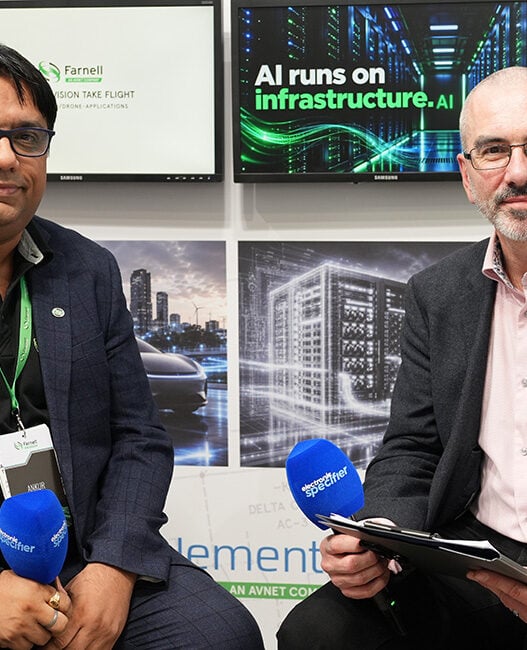

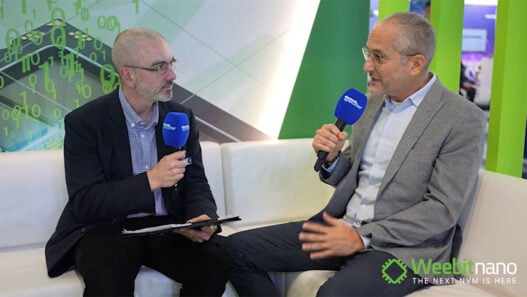




For years, the standard recipe for a clean power rail has been a switching regulator followed by a low-dropout regulator (LDO). But as power demands soar in AI data centres and beyond, that recipe is starting to show its limits. On the DigiKey booth at electronica 2026 in Munich, Electronic Specifier’s Paige Hookway caught up with Mingyue Zhao, Senior Power Application Manager at Analog Devices (ADI), to find out how the company’s Silent Switcher 3 technology is making the LDO optional rather than essential.
Signal chain expertise, built into power
ADI is a global semiconductor company bridging the real and digital worlds, with a broad portfolio spanning RF, sensors, data converters, and power. Its power portfolio brings together technologies from Linear Technology and Maxim Integrated. For Zhao, what sets ADI apart is having expertise in both signal chain and power under one roof.
“So we know exactly what’s the problem in the signal chain so we can design the power to fix it,” he says.
Why noise is now a high-power problem
Conversations about power usually centre on efficiency and power density, Zhao explains, and noise rarely comes up. That is changing fast. Data centre communication is moving from 800G to 1.6T, with 3.2T on the way, and those rising data rates are driving power consumption up dramatically. As a result, low-noise power is no longer just a requirement for low-power rails; high-power rails need it too.
The trouble with the switcher-plus-LDO approach
A conventional switcher produces two kinds of output noise. Switching ripple can be handled fairly easily with an LC filter. Low-frequency noise, roughly in the 10 Hz to 100 kHz range, is far harder to filter, needing a very large inductor and capacitor. Since an LDO has no switching element, it excels at cleaning up that low-frequency noise, so designers have traditionally placed one after the switcher.
Zhao is candid that switcher designers have, in the past, leaned on that arrangement: “We just rely on the LDO, we assume that LDO will take care of the job for us.”
That approach struggles at higher currents. An LDO dissipates the voltage difference across it multiplied by the load current, so as current rises, so do heat and power loss. Space is a problem too, as there simply isn’t room for an LDO plus a switcher in ever-smaller designs. His conclusion: “we need to supply clean power with a switcher.”
How Silent Switcher 3 matches an LDO
The key lies in the reference and the control loop. Traditional switchers use a low-voltage reference, then scale it up to the desired output with a resistor divider, and any noise on the reference is multiplied along with it. Silent Switcher 3 devices instead use a highly accurate current-source reference. The output voltage is programmed with a single resistor to ground, so there’s no divider gaining up the noise, and the result is a very clean output.
So where can engineers drop the LDO? “…more than most people can expect actually,” says Zhao. Even noise-sensitive clock and PLL rails, traditionally powered by LDOs, can reach the same noise floor as a low-noise LDO when powered by Silent Switcher 3 parts with a small filter. On one of ADI’s own data converter boards, the team replaced 10 rails with Silent Switcher 3 devices and small output LC filters. They achieved essentially the same performance, with a dramatic reduction in size and a boost in efficiency.
There is still a place for ultra-low noise LDOs in some high-end instrumentation, where the very lowest noise is essential. But, as Zhao puts it, “… I think that that will be a option to have, not a default.”
Low EMI, built in
Silent Switcher technology also tackles electromagnetic interference (EMI) at source. Most switcher EMI comes from the hot loop, where current is switched in nanoseconds. ADI addresses this inside the silicon and package, with a symmetrical power stage layout and the most critical components integrated next to the die to keep the AC loop as small as possible.
For board designers, that means far less time and effort spent optimising layout for EMI. “You can pass EMI test… maybe with your first board,” Zhao says, adding that it can “… speed up your design cycle and make your life much easier.”
A natural fit for optical modules and AI networks
Optical modules and line cards show these benefits particularly clearly. With each generation, module power keeps increasing while the form factor stays the same. AI networks add to the pressure: laser drivers have moved from four channels to eight and 16, pushing up power and tightening requirements for low noise, high efficiency, and compact size. Adding an LDO after every switcher is no longer practical. “It has to be addressed from a switcher itself,” says Zhao.
The approach reaches well beyond optical networking, too. PLLs, data converters, DSPs, and other noise-sensitive analog rails that were once powered by a switcher plus an LDO can all benefit, as ADI continues to design power around the needs of the signal chain.
Watch the full interview
To hear more from Mingyue Zhao, watch the full video interview:DigiKey at electronica 2026 with ADI