



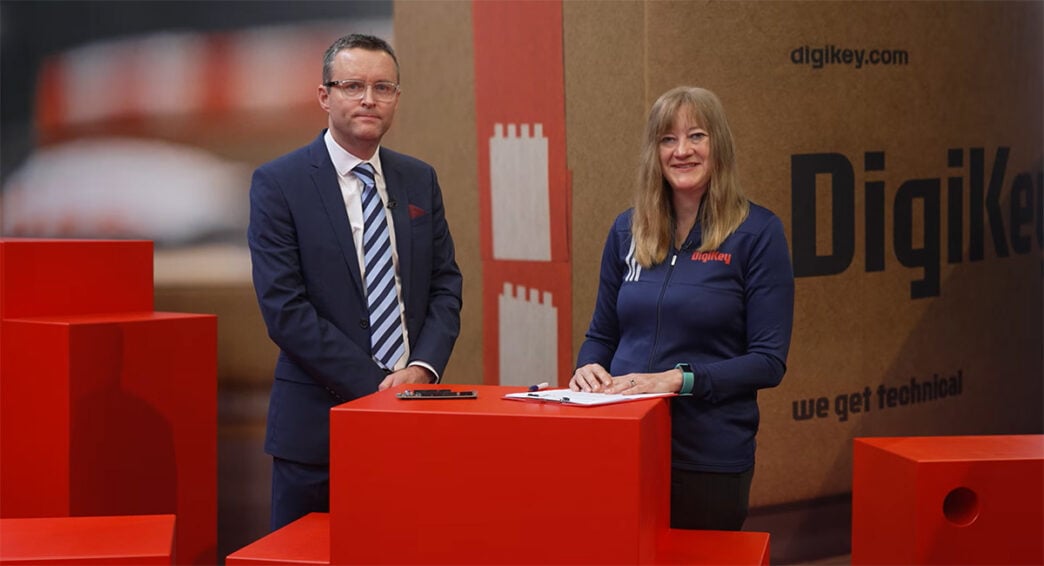
At electronica 2026, Lucy Barnard spoke to Daniel Basler, Global Distribution Marketing Manager – BL Analogue & Automotive Embedded Systems at NXP, at the DigiKey booth. They talked about trusted Physical AI, the changing demands of automotive and mobility applications, and how NXP’s FRDM development platform helps customers get started faster.
Bringing AI out of the Cloud and into the vehicle
NXP is a global semiconductor company that builds products and solutions for the automotive, industrial, and IoT markets. It operates in more than 30 countries and has over 30,000 employees. The company recently marked 20 years as NXP, although its history goes back much further.
Speaking on what physical AI actually means, Basler described it as AI moving down from the Cloud and into the real world: “AI has come through the Cloud and has now effectively come down into embedded devices or embedded systems.” In his part of the business, that means vehicles and vehicle management. “The car is already intelligent. We’re now enabling it to sense, think, connect, and act with the additional layer of AI on top of it.”
Why trust comes first
Adding AI to a vehicle brings big engineering challenges. “Fundamentally, a car or any vehicle or safety-critical system must perform safely, securely, reliably, and predictably. The challenge really is to implement AI without in any way compromising any of those foundational elements,” said Basler.
He stressed that intelligence alone isn’t enough to justify an action: “Just because the AI is intelligent doesn’t mean that the action should be taken; there needs to be appropriate checks in place and controls so that the system can respond to that AI output in the right way at the right time.”
For NXP, trust starts with functional safety, which has been built into its automotive portfolio for many years. If something fails, the system should react predictably, either by failing safe or, in some cases, by carrying on. Security has become just as important. “You could arguably say that if it’s not secure, it’s not safe in many contexts,” he said. Vehicles are increasingly connected, both internally and to the Cloud, and their systems depend more and more on each other. For example, automatic emergency braking in an ADAS system may also be linked to the seat belt pre-tensioner.
Real-time performance is also a crucial factor. “Things have to happen quickly in a car. Latency is incredibly important. Data paths have to be short, and you have to get the result that you expect.” To support this, NXP processors include safety mechanisms that monitor outputs, memory, clocks, temperatures, and voltages, so faults can be detected quickly and handled properly.
FRDM is lowering the barrier to entry
Basler leads a team that supports mass-market automotive customers. Many of these customers have little direct field application engineering support and rely heavily on the quality of NXP’s tools and software. In the past, he said, such customers were often given “a large, fairly expensive evaluation board, a bit of software, and some documents and left to their own devices.”
FRDM (pronounced “freedom”) is NXP’s answer to that. The small-form-factor boards pair an NXP microcontroller with complementary NXP analogue parts, such as power management ICs and vehicle networking transceivers for protocols like CAN, LIN, and Ethernet. They cost around $30 or less, and expansion shields can be attached to add functions such as sensing.
The software matters just as much. NXP offers a full suite, most of it free and production-grade, developed under a functional-safety-assured process so it can be used in safety-related applications up to the appropriate ASIL levels. It includes the S32 Design Studio IDEE, Real-Time Drivers (RTD), security firmware, and safety software. A single installation package can get developers up and running in around 10 to 20 minutes. The Application Code Hub also offers ready-made examples for body control, sensing, ADAS, and more.
From prompt to spinning motor
NXP’s newly added agentic AI toolkit lets developers use large language models and common AI agents to access NXP’s tools through an MCP server. Basler explained: “In no code writing whatsoever, you can get a motor spinning within maybe two to five prompts and in the order of about 10 minutes.” He pointed out that engineers still need to validate and verify the result against their requirements, and further development is usually needed. Still, it is a big speed-up for getting started, especially in motor control, where tuning can be tricky.
There are currently around nine FRDM boards for NXP’s automotive processors, including the S32K3 family, and many more for its industrial microcontrollers. They are available through NXP’s website and its network of franchise distributors, including DigiKey.
Looking to the software-defined vehicle
Looking three to five years ahead, Basler looked to the software-defined vehicle (SDV). Today, vehicles contain many single-function ECUs, and OEMs are now consolidating them. This reduces component counts, housings, and wiring, and wiring is typically the second-heaviest element in a car after the powertrain.
NXP addresses three tiers of this new architecture. The first is Edge-node microcontrollers that sit close to sensors and motors. The second is zonal controllers, where one processor handles several functions in one area of the vehicle. Basler said: “You might be running lighting and seat control, but also safety-critical functions, braking and steering … on one single microcontroller, whereas previously you would have multiple independent ones.” The third is high-performance compute with gateway functions, which coordinates the whole vehicle. All three tiers are functional-safety and security enabled, and they come with NXP’s software, tools, and AI enablement.
Watch the full interview here: