







At Embedded World 2025, Dukosi’s contactless Cell Monitoring System (DKCMS) received the Electronics Excellence Award for its innovative approach to battery management. With increasing pressure on the battery industry to deliver on performance, safety, and sustainability, Dukosi’s system has emerged as a solution poised to reshape how battery packs are built, monitored, and reused.
DKCMS is designed around a core idea: move intelligence directly to the cell. It uses a chip-on-cell architecture that enables precise measurement of voltage and temperature at each individual cell. Notaro explained: “We put a cell monitor on each series cell in a battery pack… it also does all the diagnostics and the cell balancing functionality.”
Unlike traditional battery management systems (BMS) that rely on wired or far-field wireless communication, DKCMS employs a proprietary near-field communication protocol called C-Synq. This enables synchronous, secure data transmission and electrical isolation, simplifying system design and enhancing safety.
“C-Synq is our patented protocol,” Notaro added. “It delivers deterministic latency and synchronised measurements from each cell, which is key for accurate state-of-charge and health estimates.”
This granular and time-aligned data provides the BMS with a real-time, high-fidelity snapshot of every cell in a pack. Notaro likened it to imaging technology: “It’s like the difference between a rolling shutter and a global shutter. We’re taking a snapshot of all the cells at the same time, even in dynamic conditions.”
By avoiding complex wiring harnesses and enabling direct-on-cell monitoring, the DKCMS also improves scalability. It suits a wide range of applications – from electric vehicles (EVs) and energy storage systems (ESS) to airport ground service equipment, marine vessels, forklifts, and heavy-duty machinery.
But perhaps most significantly, DKCMS addresses the growing demand for sustainability and end-of-life traceability. With on-chip memory included in every cell monitor, the system stores vital cell-level data throughout a battery’s life. This supports compliance with evolving regulatory frameworks such as the EU’s battery passport.
“As long as the cell monitor is attached, you have that information,” said Notaro. “It allows for reuse and recycling – enabling second life in a more feasible way.”
Looking ahead, Dukosi aims to evolve its offering further.
“We didn’t want to just iterate on legacy designs used in laptops or phones,” said Notaro. “We took a step back and asked: what does the industry need for the next 10 years?”
By delivering synchronised, secure, and high-resolution data at cell level, DKCMS supports not only current requirements but also the needs of future battery platforms, including those built around centralised computing and software-defined architectures.
Reflecting on the Electronics Excellence Award, Notaro said: “It’s a validation milestone. To be recognised by experts – especially when competing against a major industry player – confirms that we’re on the right path. And this is only the beginning.”
With a roadmap focused on improving cost, safety, and sustainability, Dukosi’s DKCMS is positioning itself as a cornerstone technology in next-generation battery systems.
To hear more from Joseph Notaro, you can listen to Electronic Specifier’s interview on Spotify or Apple podcasts.
Electronic Specifier Insights





















Series 18 – Episode 10 – Women in tech takeover: an AI mindset
In this special Women in Tech takeover, Sheryl Miles speaks with Jeana Bolanos, Founder and President, SalesE about her unique career journey from nuclear engineer in the US Navy to semiconductor industry professional and now tech entrepreneur.

Series 18 – Episode 9 – Nanusens’ new approach to MEMS integration
Paige West speaks with Dr Josep Montanyà i Silvestre, CEO at Nanusens about the company’s MEMS-in-CMOS technology.

Series 18 – Episode 8 – optimising Edge AI with low-power FPGAs
Paige West speaks with Hussein Osman, Marketing Director, Lattice Semiconductor about the company’s role in enabling Edge AI.

Series 18 – Episode 7 – modern manufacturing needs modern profiling
Paige West speaks with Chris Williams, Head of European Sales, Solderstar about thermal profiling.
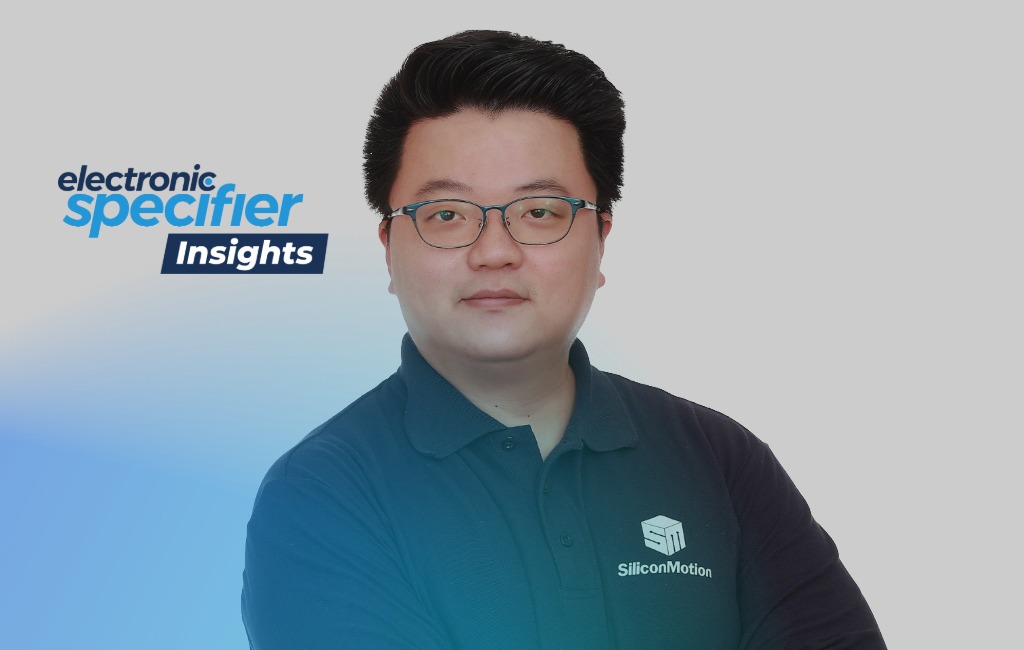
Series 18 – Episode 6 – memory at the core of innovation
Paige West speaks with Steve Shih, Automotive and Embedded Product Manager, Silicon Motion about memory being at the core of innovation and, in particular, how it’s transforming the industrial and automotive sectors.

Series 18 – Episode 5 – re-launch of the Systems Change Lab
Paige West speaks with Ellie Carey, Elected Trustee at Engineers Without Borders UK and Eva Fernandez, Strategic Sustainability Consultant at Ramboll about the launch of the 2025 Systems Change Lab.

Series 18 – Episode 4 – shaping IoT’s next chapter with antenna innovation
Paige West speaks with Dermot O'Shea, Co-Founder and CEO, Taoglas about the Internet of Things (IoT) and antenna innovation.

Series 18 – Episode 3 – security for embedded systems
Paige West speaks with Roland Marx, Product Manager, swissbit about the critical world of cybersecurity and swissbit’s Security Upgrade System.

Series 18 – Episode 2 – PXI, LXI, & the modular test puzzle: finding the right fit
Paige West speaks with Tom Sarfi, Business Development Manager, Pickering Interfaces about the differences between LXI & PXI and where each is best suited.

Series 18 – Episode 1 – the future of battery management
Paige West speaks with Joseph Notaro, Vice President Global Sales & Marketing, Dukosi about its cell monitoring system, the DKCMS with C-Synq.