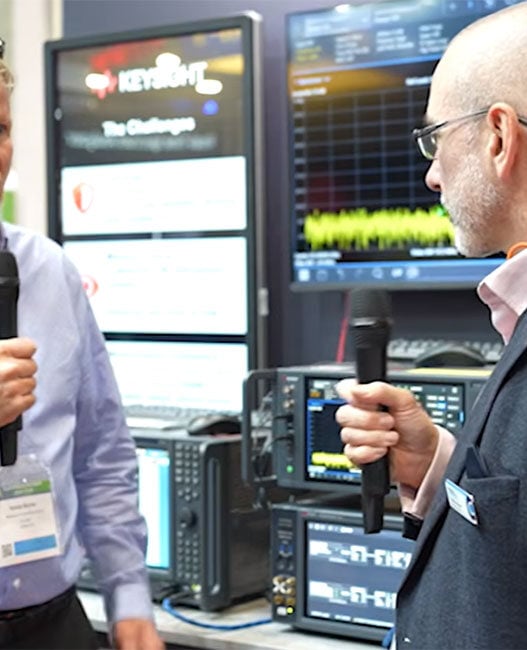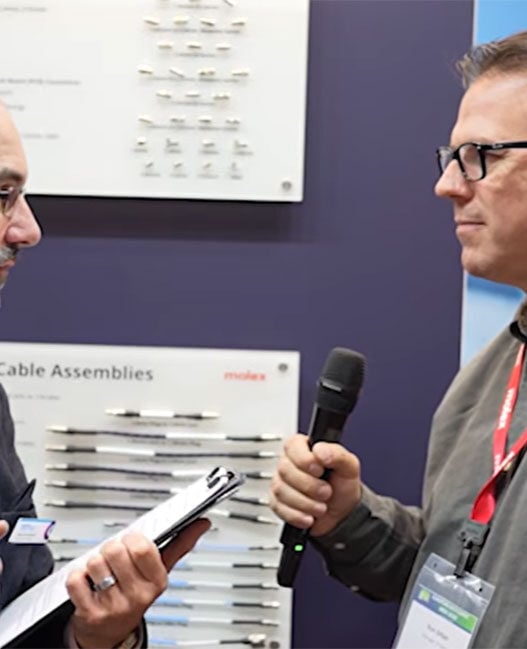



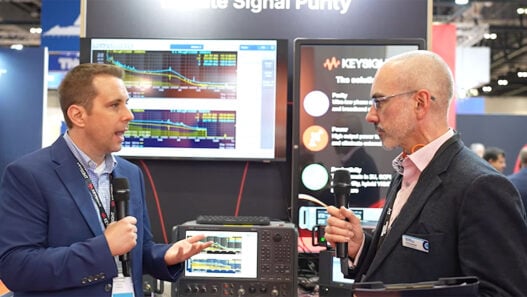


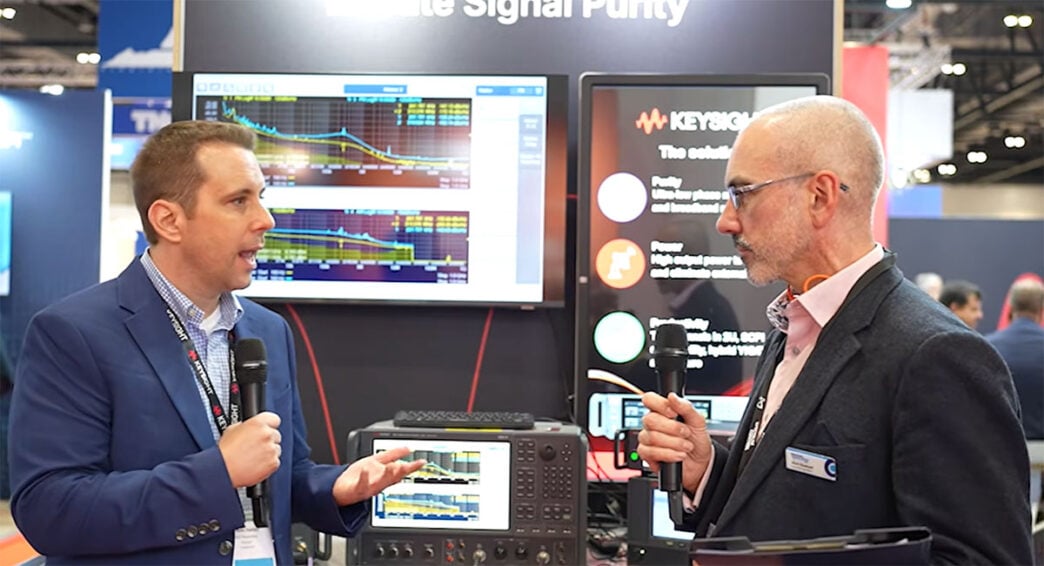
At European Microwave Week 2026, Brooks Hanley of Keysight Technologies introduced Electronic Specifier‘s Mark Gradwell to the SG6311A, the newest generation of the company’s long-running PSG signal generator and set it side by side with its predecessor to show where the gains lie.
The PSG name carries some weight at Keysight. Short for performance signal generator, the line has run through several versions over the past two decades. “It’s a bit of an institution at Keysight,” Hanley said. The new generation, the SG6311A, launched at the show, where it was demonstrated alongside the previous-generation E8257D.
According to Hanley, there are three things to know about an analog signal generator: “That’s purity, power, and productivity.” Much of the demonstration focused on the first of these.
Signal purity
“Signal purity is really all about phase noise, AM noise, and harmonics and spurs,” Hanley explained. With both instruments set to a 10GHz centre frequency and 10dBm output power, he plotted phase noise and AM noise for the two generations on the same screen.
The new instrument showed a clear margin across all offsets, from 100Hz all the way out to 1GHz. “This is the world’s purest tunable analog signal generator right now,” Hanley said.
The improvement was particularly marked in two places. In the pedestal region around 300kHz, the SG6311A was about 15dB better than the previous generation. At far-out offsets it was around 10dB better, reaching approximately -170dBc/Hz.
Half the jitter for high-speed digital
Those far-out offsets matter most to high-speed digital engineers, Hanley said, particularly “people that are clocking DACs and ADCs or PCIe reference clocks”. These users often care about phase noise at offsets of a gigahertz or more, and sometimes integrate it all the way out to the second harmonic.
Integrating phase noise produces a jitter figure, and that, Hanley explained, “directly translates into the effective number of bits of an ADC or a DAC.”
Integrated from 100Hz to 1GHz, the new generator’s jitter came in at about 6fs, compared with roughly 13.5fs for its predecessor. “This phase noise is giving us about half the time jitter and giving us much better performance for these high-speed digital applications,” he said.
Radar and residual phase noise
Radar has traditionally been one of the most phase-noise-sensitive applications, and those engineers generally care about offsets inside about 1MHz. That is where the pedestal-region improvement comes in. “That’ll matter a lot for radar engineers,” Hanley said, adding that the gains extend down to 100Hz offsets and below.
AM noise plays a different role. Engineers measuring the residual phase noise of components such as amplifiers and mixers depend on it, because it feeds directly into the measurement. Phase noise analysers use cross-correlation to remove their own instrument noise, but that technique has a blind spot. “They cannot remove the AM noise,” he explained. “So that’s where the AM noise comes in.”
Cleaner signals for digital communications
Phase noise and AM noise both contribute to error vector magnitude (EVM), the measure of a digital signal’s quality. Engineers are generally targeting better than 1% EVM, or -40dB. Missing that target has a direct cost: “You end up with symbol errors and bit errors, and then you can’t get high throughput in your digital communication system,” Hanley said.
Here too, the far offsets are increasingly important. “In today’s day and age with satellite communications, they’re using one gigahertz wide modulated signals,” he said, “and so it’s really that far offset phase noise that contributes the most to the EVM.”
Half the size, twice the channels
The difference between the two generations was visible before either instrument was switched on. The previous-generation PSG occupies 4U of rack space, while the SG6311A is 2U.
“We’ve shrunk it to half the size,” Hanley said. The demonstration unit had a single RF output, but the instrument is also available with two. “Essentially in that same 4U space, we’re able to have two RF channels,” he said. “So it’s essentially a quarter of the size for two RF outputs.”
For test engineers working on high-speed digital, radar or satellite communications, the SG6311A promises cleaner signals in a much smaller footprint. That combination could make it easier to scale up multi-channel test setups without giving up more of the rack.