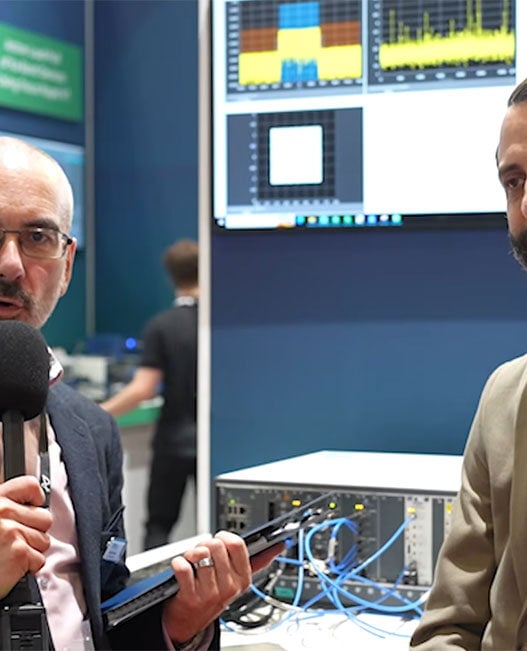








At European Microwave Week, Electronic Specifier’s Mark Gradwell caught up with Walt Strickler, Product Line Director for fibre optics and RF components at Molex. They talked about the pressure on designers of radio frequency (RF) equipment, and about two ways Molex and Smiths Interconnect are trying to ease it.
Faster demands, tougher conditions
Aerospace and defence customers have always wanted better performance. What has changed, says Strickler, is the speed: “The difference today is it’s happening at an unparalleled pace.”
Whatever they build has to keep working in harsh conditions such as high temperatures, heavy shocks and vibrations, and electromagnetic radiation. That’s why designers are turning to firms with a long track record in mission-critical work, and ones that can keep up with demand.
Why one assembly beats lots of separate parts
The traditional way to boost performance is to use separate, individual components. However, that approach has limits. Instead, Strickler says, RF designers are asking for companies with a broad range of skills in handling and shaping signals, who can build several functions into a single unit.
Turning the whole circuit together gives better results than turning each part alone. The finished unit is also smaller, which helps with size, weight, and power, all of which everybody is trying to minimise.
A look inside the demo
Looking at demos, Strickler explained that the signal comes in through a standard SMA connector and moves to a waveguide filter. “A waveguide filter allows us to provide the lowest insertion loss.” This means that less of the signal is lost on the way through.
Next comes a power divider, which has a test port so engineers can sample the signal. After that is an isolator, which protects the rest of the circuit by stopping signals from bouncing back into it.
The clever part is that these pieces connect directly, with nothing in between. “We’ve removed the different interfaces, so that takes away some of the insertion loss and some of the mismatches,” says Strickler. Each join in a chain of separate parts is a chance to lose or distort the signal, so cutting out the joins gives the best possible performance.
EasiCoax: no solder, less fuss
Speaking about EasiCoax, a new product from Smiths Interconnect, Strickler said that it is attracting plenty of attention: “It’s a unique solderless design” built for high-speed test boards and development boards.
Unlike a traditional SMP connector, it’s made from a single spring-loaded piece. “Once incorporated into an interposer, [it] provides a reliable, self-aligned RF connection.”
The practical upsides are:
- It’s easy to put in and take out
- It “virtually eliminates any rework which can damage your board”
- It’s very lightweight, with a lower cost of ownership
- It performs up to 40 gigahertz
Strickler showed a real one next to the 3D model. It’s tiny, with a very fine pitch, which makes it a good fit for crowded, high-density designs.
For aerospace and defence customers, its appeal is a mix of strong RF performance and easier manufacturing. Strickler says everyone is trying to ramp up production right now, and anything that makes building quicker and simpler is a big help. But speed isn’t enough on its own. “It has to be high reliability,” he says, and EasiCoax aims to deliver both.
Where to find out more
Strickler advises starting with the Molex website. If you need help choosing a solution, application engineers are on hand. For something more specialised, they can put you in touch with design engineers who will build a custom solution around your needs.
You can watch the full interview here: