





During an eclipse, a lunar night, or a long cruise far from the Sun, only active heating keeps batteries, propellant lines, and optics within their temperature limits. What makes a flexible heater so reliable – and how does an ESCC 4009/006-qualified, etched manganin heater achieve this?
A temperature window for every subsystem
A spacecraft faces direct sunlight on one side and radiates heat into the cold of deep space on the other. Between these extremes, every unit on board has its own permissible temperature range. Batteries lose capacity or age faster once they leave that range. Monopropellants such as hydrazine freeze well above the temperatures a cold structure can reach. Optical benches distort as thermal gradients build up.
Passive measures such as coatings, multilayer insulation, and radiators handle much of the thermal load. What they cannot do is keep a subsystem above its lower limit through an eclipse, a lunar night, or a cruise phase with little sunlight. Electric heaters close that gap, typically switched by thermostats or by on-board software based on thermistor readings.
What a space-grade heater has to deliver
Technically, a heater is the simplest component in the thermal subsystem. Yet several requirements pull in different directions:
- Bendability: surfaces are rarely flat – tanks, battery housings, and small-radius fluid lines all require the heater to conform to them and bond reliably over its full area
- Mass and envelope: the heater should add as little as possible to either
- Predictable power: because P = U²/R, resistance tolerance and temperature dependence translate directly into deviations in heating power
- Custom geometry: catalogue parts with fixed dimensions are often of limited use. Shape, size, and resistance need to be tailored to the application
- Qualification and traceability: European programmes generally procure EEE parts against ESCC specifications
Construction: etched Manganin foil in polyimide
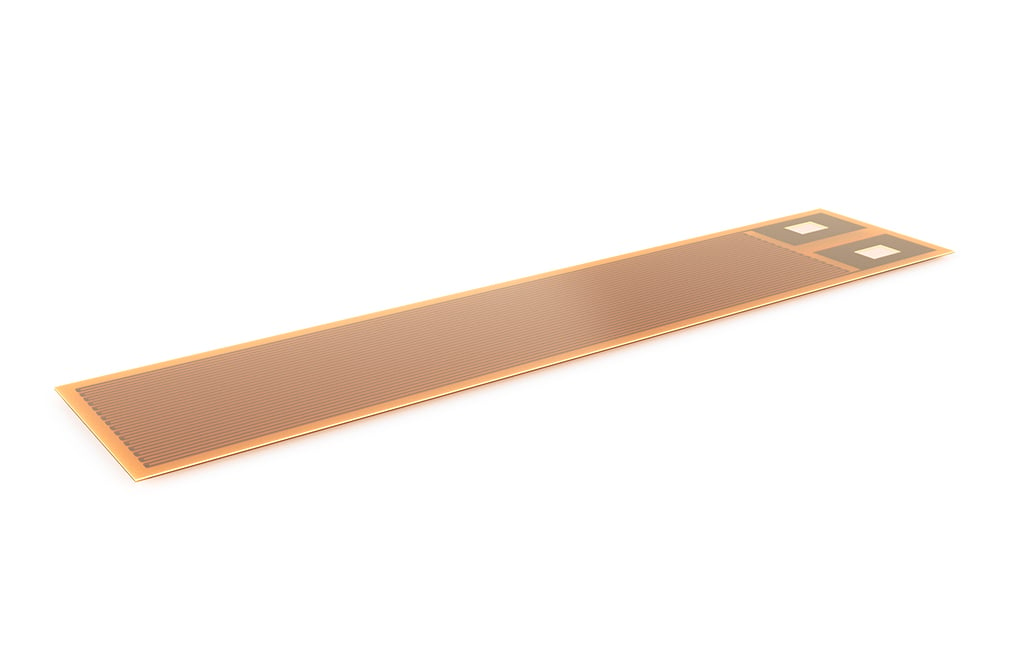
Isabellenhütte HFF flexible heaters use a resistive track made of MANGANIN, a copper-manganese-nickel alloy (Cu86Mn12Ni2). The track is laminated between polyimide (Kapton) films with an acrylic adhesive. Outside the pad area, the heater body is no more than 0.25mm thick and weighs at most 50mg/cm², excluding the leads – a thin, light laminate that conforms to curved surfaces.
Because the track is photo-etched rather than wound, its width and spacing can be chosen to set the resistance and distribute heat evenly. Nominal resistance ranges from 1 to 2,000Ω, with a tolerance of 5 or 10%. The temperature coefficient of resistance (TCR) is ±50ppm/K between +22C and +60°C, excluding the leads. The terminal leads are multistrand, silver-plated copper wires compliant with ESCC 3901/012, supplied as unjacketed twisted pairs from AWG 18 to AWG 26 and soldered to the pads with Sn/Pb solder.
One qualified construction, many geometries
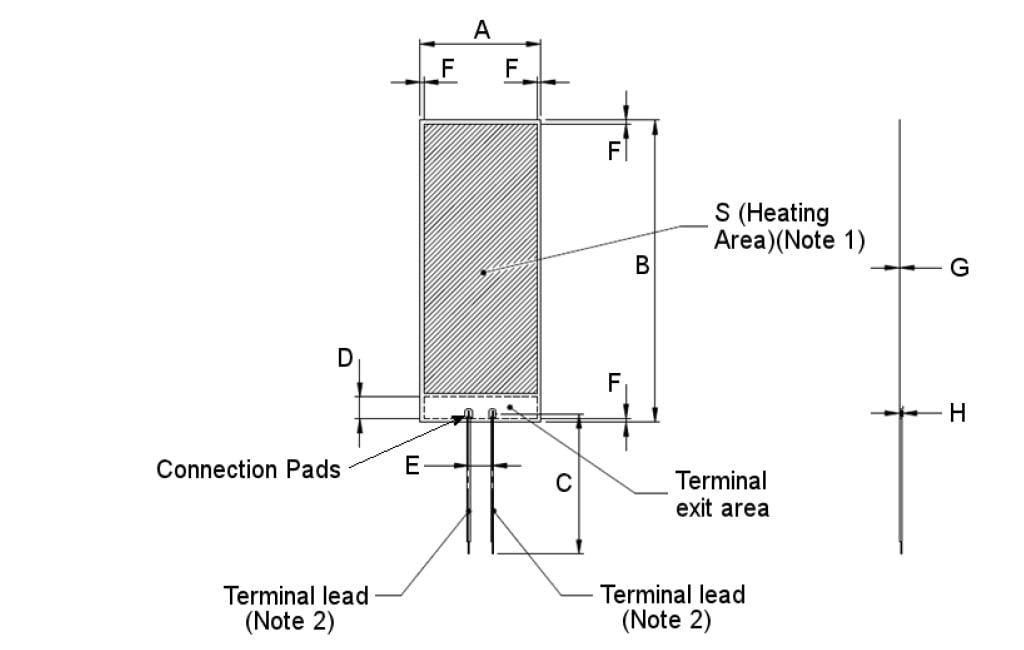
A heater designed for one bus rarely fits the next. ESCC 4009/006 accounts for this by defining a qualified construction rather than fixed part numbers. Each heater is manufactured according to a drawing agreed between the manufacturer and the customer. The drawing specifies the heater outline and dimensions, the resistance value and tolerance, and, optionally, a pressure-sensitive adhesive (PSA).
Within this framework, the width can be set between 5 and 265mm and the length between 40 and 385mm, giving a heating area of 3 to 1,020cm². Not every combination of dimensions and resistance is feasible, so Isabellenhütte checks each design against material and process limits during the technical clarification that precedes the actual order confirmation.
The heater has a rated power density of 0.38W/cm² under the reference conditions defined in the specification.
As part of lot screening under the ESCC Detail Specification, the heaters undergo rapid temperature change testing, electrical measurements at high and low temperatures, and burn-in at a heater temperature of +120°C.
A second qualified European source
Technology is only half of the story. As the first article in this series – Why Europe needs a second source for flexible heaters – explains, the number of suppliers holding ESCC qualification for flexible heaters is limited. For a given construction or programme, the choice sometimes comes down to a single source – a dependency that constellations, with heaters needed by the hundreds at a repeated build rate, make even harder to accept.
With the HFF, Isabellenhütte adds a further ESCC-qualified European source and gives primes and agencies more choice. Thermal engineers can discuss outline, resistance, and power density for their application directly with Isabellenhütte: HFF product page or sales@isabellenhuette.com.