





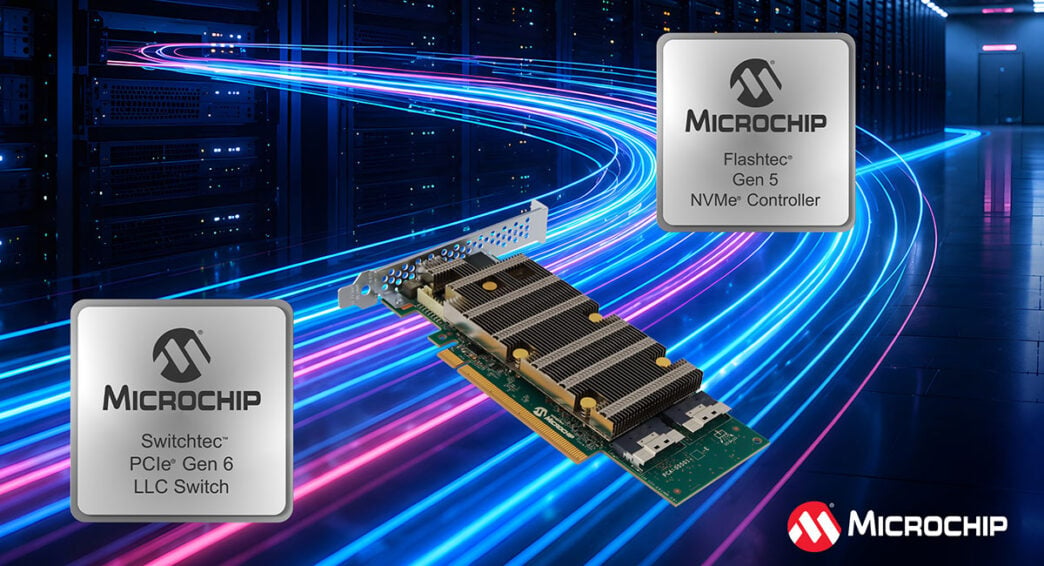
As AI workloads drive demand for more scalable and flexible data centre architectures, organisations are looking for faster, more efficient ways to move, store, and protect data. Microchip Technology is helping to address these needs by expanding its portfolio of data centre solutions with new innovations in PCIe connectivity, NVMe storage, and acceleration that support high-performance computing infrastructure.
“Customers are looking for technology partners that can address multiple challenges across the infrastructure stack while helping simplify design and accelerate deployment,” said Brian McCarson, Corporate Vice President and GM of Microchip’s data centre solutions business unit. “By continuing to expand our portfolio, we’re providing the building blocks needed to create more efficient, secure, and adaptable platforms for today’s increasingly distributed and data-intensive computing environments.”
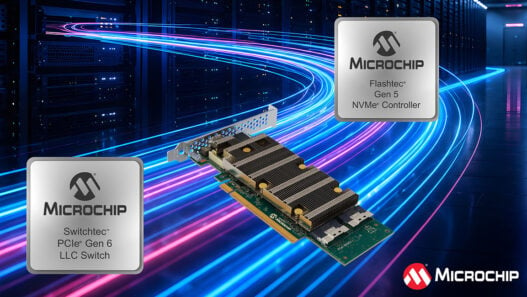
Designed to bring PCIe Gen 6 connectivity to space- and power-constrained platforms, the Switchtec PCIe 6.0 Low-Lane-Count (LLC) switch provides up to 64 PCIe Gen 6 lanes, 32 ports and flexible x2, x4, x8, and x16 bifurcation options. Integrated Direct Memory Access (DMA) supports efficient peer-to-peer data movement between connected devices while reducing host CPU involvement. Like Microchip’s larger Switchtec Gen 6 devices, the LLC switch features PCIe Multicast and partitioning capabilities along with robust security through hardware root of trust and secure boot technologies. The new device delivers PCIe Gen 6 capabilities with a smaller, lower power footprint to extend support to a broader range of data centre and intelligent Edge applications.
To address the industry’s requirements for secure, scalable, and AI-optimised storage infrastructure, Microchip is updating its Flashtec SSD controller portfolio with an enhanced version of the PCIe Gen 5 NVMe 5016 controller. Building on the controller’s high-performance, power-optimised architecture, the updated device adds support for Commercial National Security Algorithm Suite (CNSA) 2.0 to help customers prepare for emerging post-quantum security requirements. Dual-port capability enables highly available storage architectures through redundant data paths and load balancing, while advanced virtualisation, Quality of Service (QoS) management and flexible programmability help optimise performance.
Together, these enhancements extend the Flashtec platform’s ability to address evolving NAND technologies, high-capacity SSD designs and next-generation enterprise, hyperscale, and AI deployments.
Microchip is also expanding the capabilities of its Adaptec SmartRAID 4300 family of NVMe RAID storage accelerators with a series of enhancements designed to address practical operational needs. The updates are focused on strengthening storage security, minimising downtime, expanding data protection and simplifying deployment across a wider range of environments. Self-encrypting drives (SEDs) with both local and remote key management, and RAID 6 and RAID 60 options have been added for increased resiliency and security. Broader platform compatibility is enabled through support for Linux, Debian, Ubuntu, and Microsoft Windows 11 environments. Additional updates such as dynamic NVMe configuration for in-service management, persistent event logging and peer-to-peer rebuild support for greater CPU offload help reduce management overhead while minimising service disruption. StorageCore API support further expands integration flexibility, enabling customers to incorporate SmartRAID management into third-party tools through in-band host applications as well as customised out-of-band BMC management frameworks.