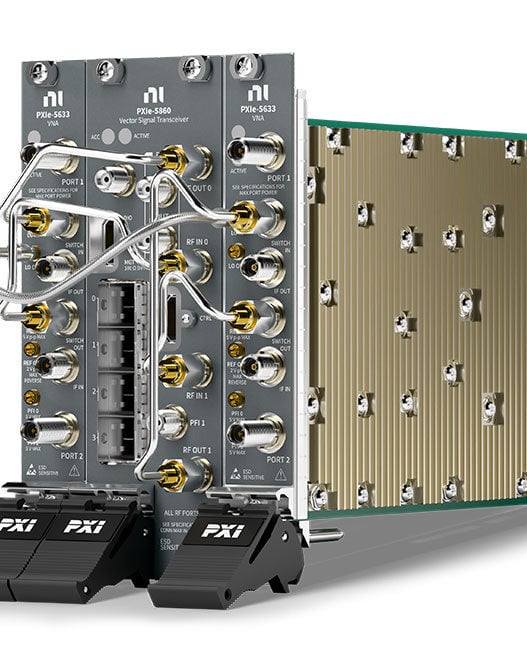



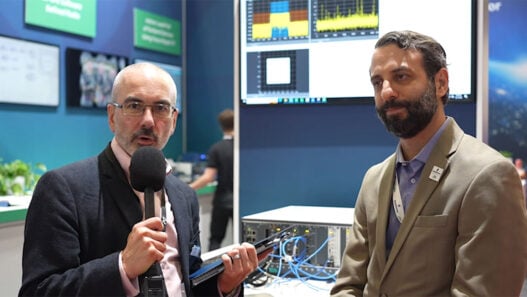

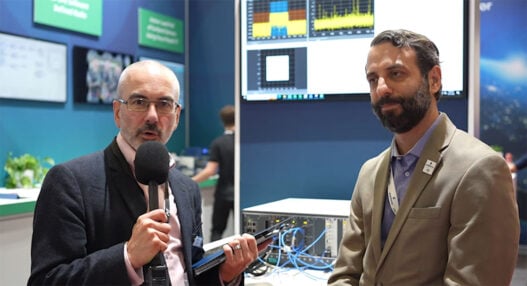
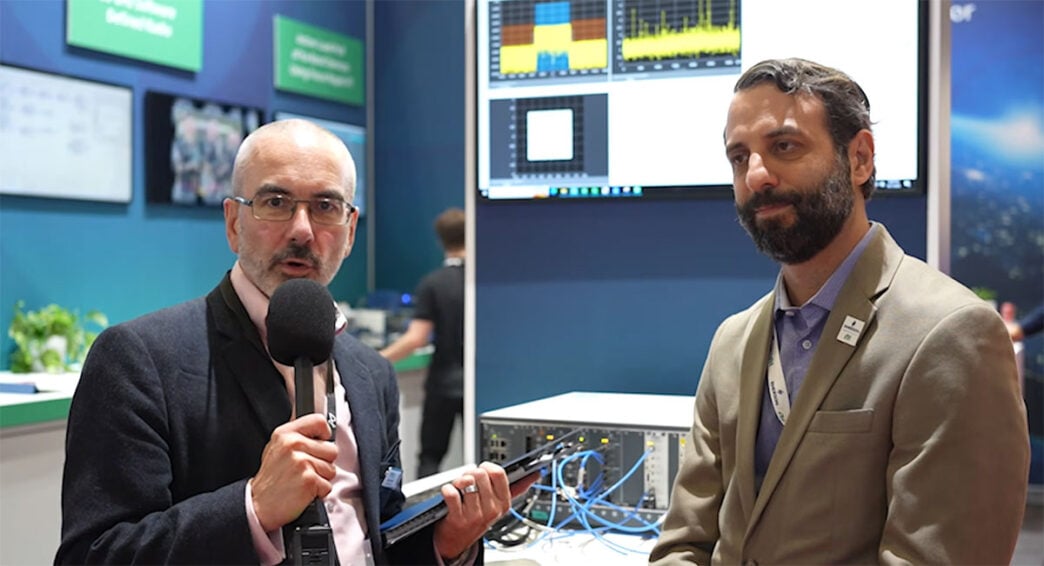
At European Microwave Week 2026, Electronic Specifier Contributing Editor Mark Gradwell visited the Emerson Test & Measurement booth, where Kyle McCoy, Technical Marketer, demonstrated how the company’s vector signal transceiver (VST) can emulate communications and radar conditions on the same signal, in real time.
Integrated sensing and communication (ISAC) is one of the more intriguing ideas moving through the RF world: rather than building separate systems to carry data and to detect objects, a single signal does both. That promise brings a testing headache with it, because the two jobs place very different demands on the same waveform. Emerson’s answer, shown at European Microwave Week, is to validate both at once.
One signal, two jobs
“ISAC is an emerging technology where we’re using a signal to both communicate and sense, like a radar signal,” explained McCoy. “What this allows us to do is validate that signal in both domains.”
The distinction matters. A typical communications signal is a continuous stream of modulated data. A radar system, by contrast, sends out pulses and gathers information from how those pulses are affected by a target. “Those are two different uses for the same type of RF signal,” McCoy said. “So what we’re trying to figure out is how we can use our IP and our tools to emulate both those scenarios for a customer that’s interested in doing research or validation in those areas.”
Inside the demo
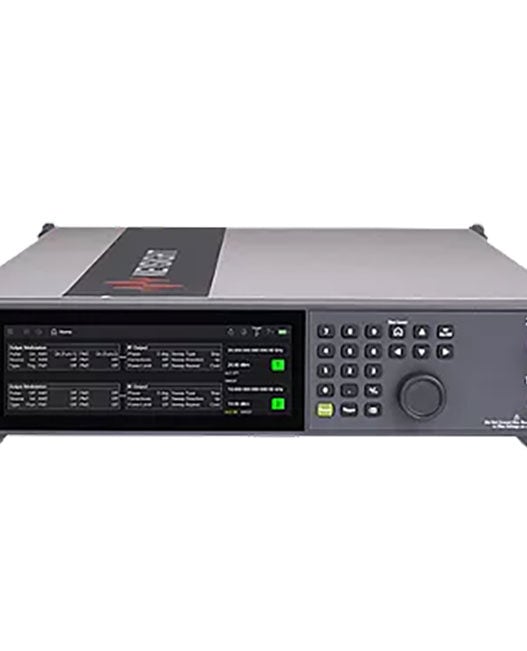
At the heart of the setup is the VST, which combines a vector signal generator and a vector signal analyser with an FPGA that enables real-time data streaming. That real-time capability is what makes the approach possible, allowing engineers to inject channel impairments or radar targets as the signal is running.
In the demonstration, a single 5G signal was generated and then split into two paths. On one path, the signal was received as a radar return, with emulated radar targets added. On the other, noise was introduced to show how channel impairments would affect a communications link.
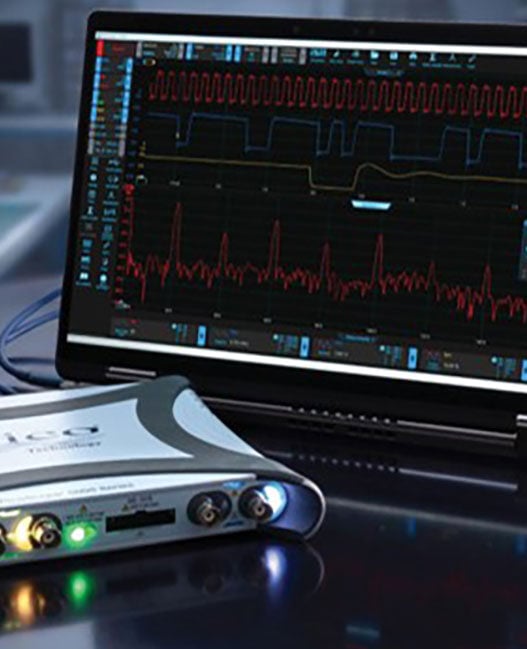
The results were visible on screen side by side: the 5G signal being demodulated on the communications side, and two radar targets emerging on the radar spectrum analyser. “I’m able to sense both communications and radar,” McCoy said, “and so I can troubleshoot issues in my system, whether it’s for the communication side, the radar side, or the interaction of both of those.”
Testing together, not apart
That last point – the interaction between the two functions – is where McCoy sees the biggest change from established practice.
“Historically, you would test both these scenarios independently and hope that you could correlate that data somehow on the back end,” he said. “We’re able to emulate both of those scenarios in real time, so that you can see how both sorts of effects are affecting the same signal and your ability to receive it as a radar target or a communications signal.”
For a technology whose whole premise is that one waveform serves two masters, seeing those effects together, rather than stitching them together after the fact, gives engineers a far clearer picture of how a system will behave.
Shifting validation left
Asked whether this ultimately saves engineers time, McCoy was clear that the benefits go further. “It’s saving time, it’s saving cost, and most importantly, it’s moving what would perhaps be an expensive range test into the lab.”
By pulling that validation earlier in the development cycle, he argued, teams can get products to market faster – “ultimately helping the engineers deploy systems that are either cutting edge or updated current configurations for field operations.”