

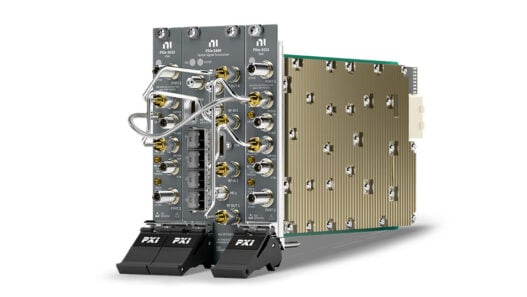


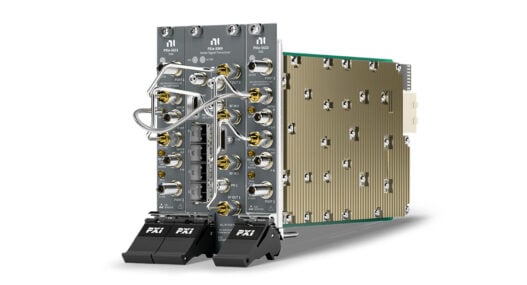
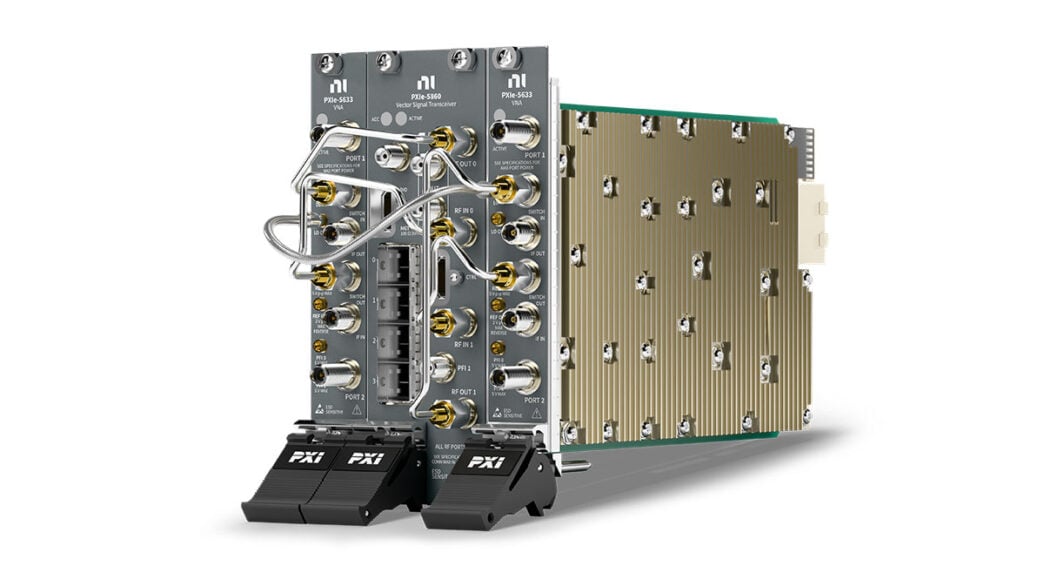
Emerson has announced new radio frequency (RF) test capabilities that help engineers characterise increasingly complex devices and scale automated measurement workflows. The new NI PXIe-5633 four-port vector network analyser (VNA), together with synchronisation-focused software enhancements for the NI PXIe-5860 vector signal transceiver (VST), expands RF validation capability to new multiple-input multiple-output (MIMO) and multiport S-parameter applications within the scalable, software-driven NI PXI platform.
New capabilities will enable engineers to:
- Expand RF validation capacity with four-port vector network analysis capabilities that address more complex device architectures and emerging multiport measurement requirements
- Address next-generation wireless test challenges through enhanced NI PXIe-5860 synchronization capabilities that support advanced MIMO, multichannel and timing-sensitive RF applications
- Consolidate measurements within a single system by combining network analysis and modulated RF measurements in one PXI architecture, reducing system complexity and simplifying test workflows
- Build adaptable test systems for growth with a scalable, software-connected platform that extends automated measurement workflows from design validation through production
“RF test is no longer only about validating individual components in isolation. As wireless systems become more distributed, software-defined and antenna-intensive, engineers need test architectures that evolve as quickly as the technologies they are validating,” said Kevin Schultz, NI Chief Technology Officer with Emerson’s Test and Measurement Business. “These capabilities reflect our commitment to helping engineers build adaptable test infrastructure that supports system-level validation and future wireless innovation.”
The NI PXIe-5633 extends NI’s existing vector network analysis capabilities to four ports, helping engineers characterise more complex RF devices. As wireless systems increasingly rely on multiple RF paths, synchronised radios and distributed architectures, engineers must characterise interactions across entire systems rather than individual components in isolation. NI PXIe-5860 software enhancements support synchronisation-focused and MIMO workflows for increasingly complex wireless test requirements.
Engineers can also perform S-parameter characterisation alongside modulated RF measurements through a single RF connection. Combining these measurements in one software-driven PXI system can reduce the need for separate instruments and test setups while maintaining a consistent path for automation.
Applications span semiconductor validation, advanced wireless research, aerospace and defence systems and other RF-intensive technologies increasingly built around multi-antenna, multichannel and software-defined architectures.