




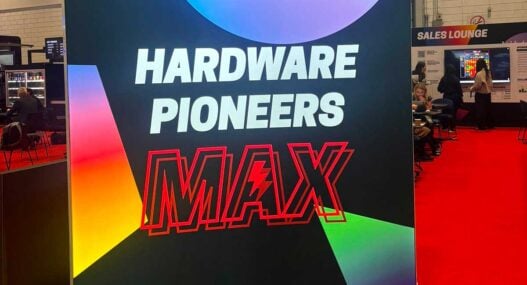
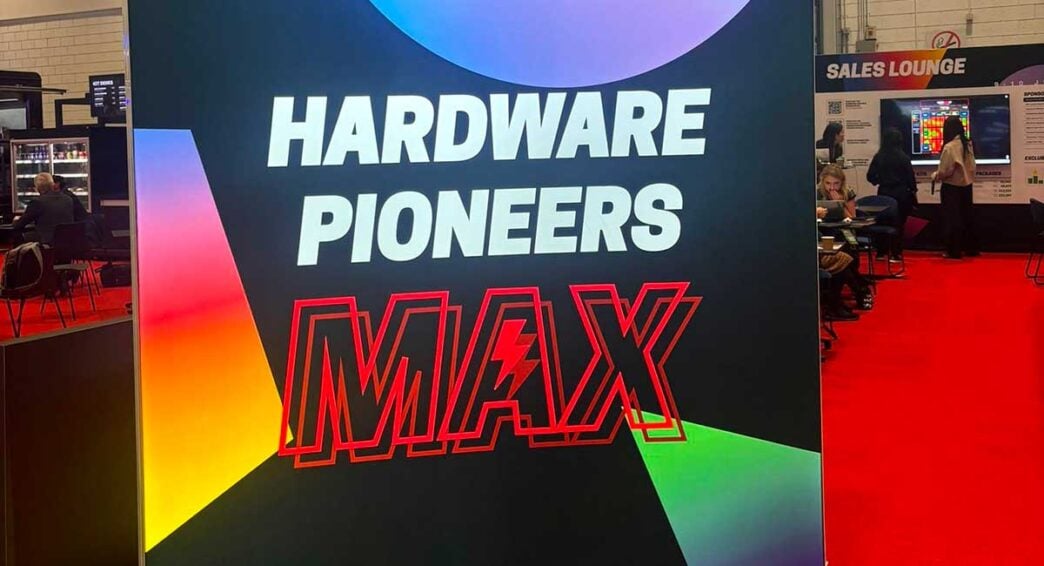
Hardware Pioneers Max made its debut at London’s ExCeL this week, having outgrown its previous home at the Business Design Centre, bringing together engineers, distributors, and hardware companies from across the industry.
I took the opportunity to ask attendees a simple question: what are the biggest challenges engineers are facing right now? The answers covered everything from supply chain pressures to incoming regulation.
Complexity and time to market
The most immediate pressure many engineers are feeling is the squeeze between rising design complexity and shrinking delivery windows. Sarah Keane, Account Manager at Analog Devices, put it plainly: “Some of the challenges that our customers are facing is increasingly complex designs, both hardware and software, and having to deliver those in very tight timeframes … the changing world, the changing environment, the pace that things are changing. It’s very difficult to deliver these products.”
It’s a tension that runs through much of the industry: the products being asked for are harder to build, but the expectation of how quickly they arrive hasn’t softened.
The EU Cyber Resilience Act
For companies selling connected or embedded products into Europe, regulatory compliance is emerging as one of the dominant concerns of the next 18 months. David Pashley, MD, Direct Insight described the EU Cyber Resilience Act as “one of the big challenges facing engineers right now.” The Act becomes fully enforceable in December 2027, at which point all products with digital elements – including IoT and embedded devices – must meet its cybersecurity requirements.
“It means you have to go through a whole process,” Pashley explained. “Your products have to have secure boot, free over-the-air updating. You have to analyse the vulnerabilities in your products and mitigate them, and all that has to be documented and proven before you affix the CE mark to your product and export it to Europe.”
For many hardware teams, that represents a significant compliance overhead on top of already stretched development schedules.
Supply chain: the AI cycle effect
Memory and component supply is creating its own set of pressures – and increasingly, AI investment is a factor shaping what’s available and at what price.
Nick Florous, Global Product Marketing Director at Memphis Electronics, a specialist memory distributor with over 35 years in the market, explained the dynamic: “The cycle has changed a little bit nowadays. You can say it’s a superposition of an AI investment cycle plus the regular memory cycle. It seems that the AI cycle prevails these days, and therefore a lot of people are focusing where the great profits are, leaving a little bit of a scarce supply chain for the legacy platforms.”
For companies building products on established, non-cutting-edge architectures, that scarcity has real consequences – longer lead times, higher costs, and greater uncertainty around availability.
Component shortages and supply chain fragility came up repeatedly across conversations. James Ricketts, Business Development, BEC Group, also speaking at the event, noted the challenge of sourcing specific materials from suppliers, with delivery timescales adding further unpredictability to product development.
Getting to market quickly
Mike Burday, VP of Sales at Red Pitaya, framed the market challenge in terms of speed: “The ability to bring products to market quickly has never been more important. We’re living in a world where there’s component shortages, supply chain challenges.”
His company’s focus, he said, is helping customers rapidly prototype and navigate those conditions – using FPGA-based development platforms to compress the path from concept to shipping product.
Engineering capacity
Perhaps the most structural challenge raised was the simplest: there aren’t enough engineers. Roger Thornton, Director of Application Engineering at Raspberry Pi, said his team’s core role is helping customers take designs from prototype through to mass production – but that demand is outpacing the available resource.
“The biggest challenge we’re seeing is capacity. We have lots of customers who want to use Raspberry Pi, but don’t have the engineering resources in house to build the products that they’re trying to do. Our big problem is having enough engineers who are able to pick up and build the products that people are really wanting to do with us.”
It’s a challenge that sits beneath many of the others: even where solutions exist – whether technical, regulatory, or supply-side – the bottleneck is often the people available to implement them.
A sector adapting under pressure
Taken together, the picture from Hardware Pioneers Max is of an industry that is busy, inventive, and under pressure on multiple fronts simultaneously.
Regulatory deadlines, AI-driven supply distortions, accelerating design complexity, and a shortage of skilled engineers are not new problems individually – but their convergence is making the development environment considerably harder to navigate than it was even a few years ago.
But if there was one key takeaway from the show, it’s that ours is an industry that is constantly innovating and there are already a plethora of products, platforms, and partners out there that can help engineers address these challenges.