







NASA has announced new contracts for lunar rovers and cargo landers, alongside target launch timeframes for the first Moon Base infrastructure mission.
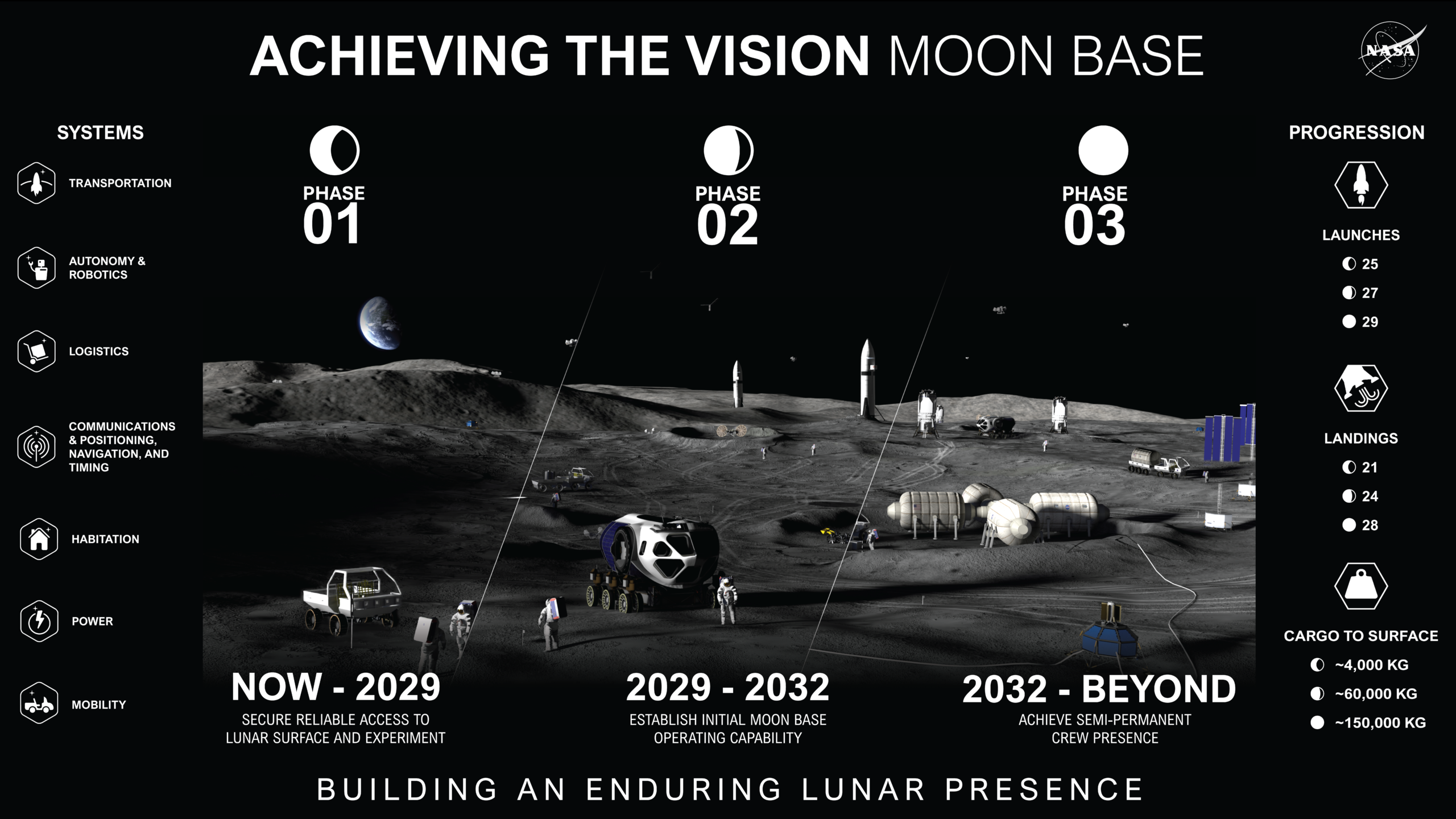
The Moon Base was formally announced during NASA’s Ignition event on 24th March 2026, where the agency unveiled a series of initiatives designed to achieve President Trump’s National Space Policy. The Base will serve as a hub for science, technology demos, and exploration, all designed to unlock new scientific discoveries, advance technologies for future deep space missions, and foster an emerging lunar economy.
Moon Base missions
The plan unfolds in stages with three uncrewed missions set to launch before the end of 2026:
- Moon Base I is targeted for no earlier than autumn 2026, using Blue Origin’s Blue Moon Mark 1 Endurance lander to deliver scientific instruments to the Shackleton Connecting Ridge, demonstrating capabilities to reduce risk for crewed Artemis landings in 2028
- Moon Base II, planned for later this year, will deliver over 1,100 pounds of cargo via Astrobotic’s Griffin lander, including Astrolab’s FLIP rover, to mature lunar mobility systems
- Moon Base III, also targeted for this year, will carry the first payload from NASA’s PRISM initiative – including investigations from ESA and the Korea Astronomy and Space Science Institute – flying on Intuitive Machines’ Nova-C Trinity lander to study lunar swirls at the surface
“The Moon Base will be America’s and humanity’s first outpost on another celestial world,” said NASA Administrator Jared Isaacman. “Every mission, crewed and uncrewed, will be a learning opportunity as we return to the lunar surface, build the infrastructure to stay, and master the skills required to live and operate in one of the most demanding and dangerous environments imaginable. We will go for the science, for all we stand to gain from an economic and technological perspective, for the innovations that will make life better here on Earth, and to prepare for where we will inevitably go next.”
These missions are the first of more than a dozen missions that will be announced this year, each designed to generate operational data and reduce risk ahead of crewed Artemis surface activities.
Lunar robots
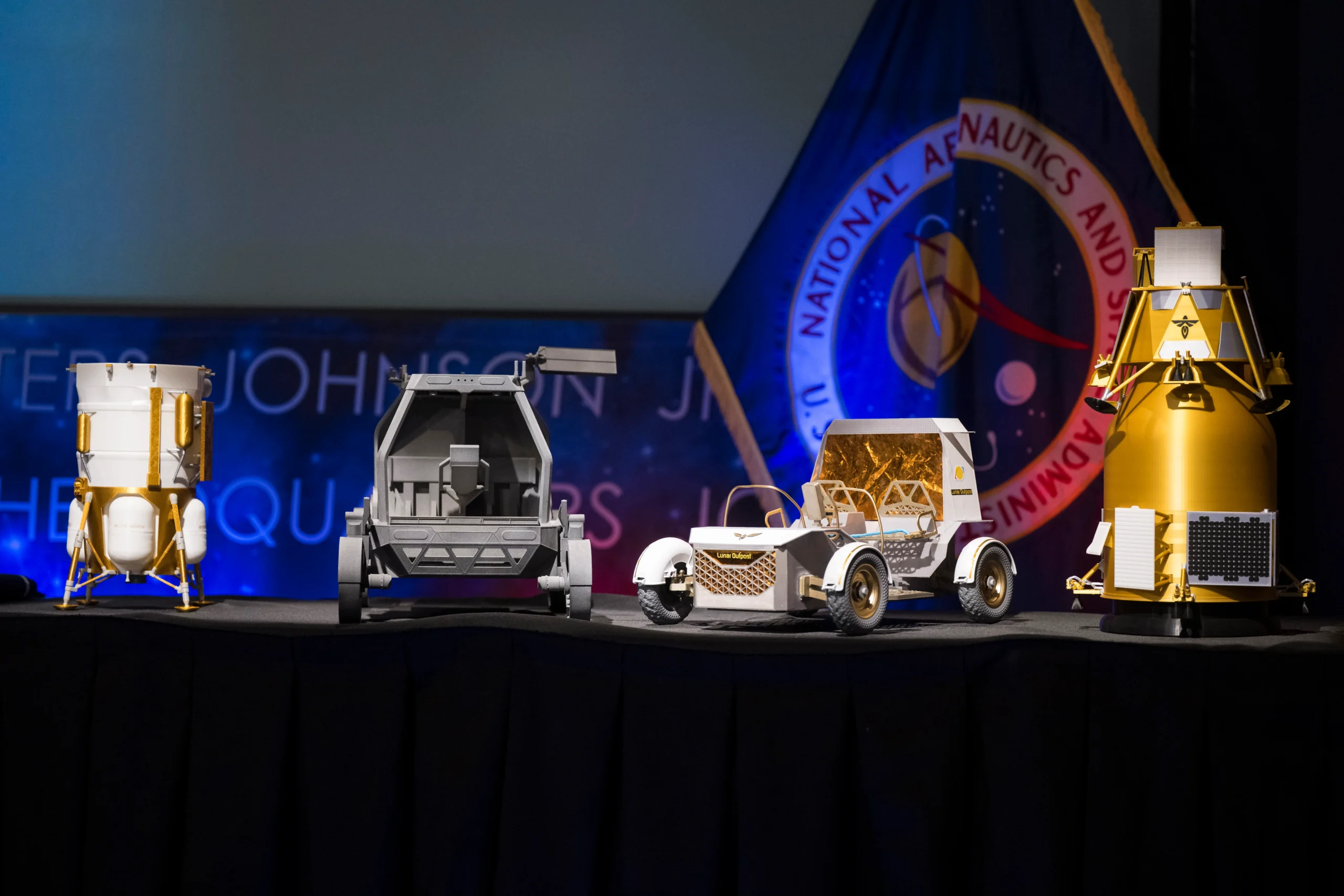
As part of the plan, NASA awarded Astrolab $219 million and Lunar Outpost $220 million to build and deliver the first phase of Lunar Terrain Vehicles (LTVs).
Astrolab’s Crewed Lunar Vehicle, or CLV‑1, adapted from the company’s FLEX architecture, is a crewed rover designed to transport astronauts, carry supplies, and support remote operations, with a compact stowed configuration, a mass of about 2,000 pounds, and the ability to reach more than 6mph on level terrain.
Lunar Outpost’s Pegasus is a lighter, mission‑ready evolution of its Eagle rover designed explicitly to meet NASA’s updated crewed LTV requirements. Operational for up to a year and capable of manual, autonomous, or teleoperated driving at speeds more than 9mph, Pegasus incorporates Apollo‑heritage technologies and builds on prototype and flight experience to deliver human‑centred mobility essential for establishing a sustained Moon Base.
NASA stated that deploying multiple LTVs early in the Moon Base development will accelerate technology demonstrations, inform site planning, and reduce operational risk ahead of crewed Artemis missions, enabling teams to characterise terrain hazards, move materials, pre-stage resources, and mature systems needed for long-duration lunar exploration.
AstroLab and Lunar Outpost will use the next 18 months to finalise rover designs, conduct crewed evaluations, and quality flight units for operational readiness.
NASA has awarded Blue Origin $188 million to deliver these rovers to the Moon’s South Pole region.
MoonFall update
NASA also provided an update on its MoonFall mission – its plan to send four JPL-built propulsive drones to survey the lunar surface for potential Artemis landing sites.
The drones are based on the legacy of NASA’s Ingenuity Mars Helicopter and will be capable of multiple propulsive hops to explore hard-to-reach areas and map safe landing spots and resources such as water ice. Each drone is designed to cover a range of roughly 30 miles (50km) and uses as many as 10 high-definition optical cameras to acquire imagery and video of hard-to-reach terrain.
NASA has selected Firefly Aerospace to build the spacecraft that will transport the drones from Earth orbit to the Moon with launch targeted for 2028.