


In the mid-1930s, tensions were running high. The probability of another world war loomed on the horizon. Aircraft were taking off. The threat of aerial bombing hung over every capital city. The Great Depression was depressing most corners of the world. People needed hope, something to look toward. There had to be a means of defending innocent people from potential enemies.
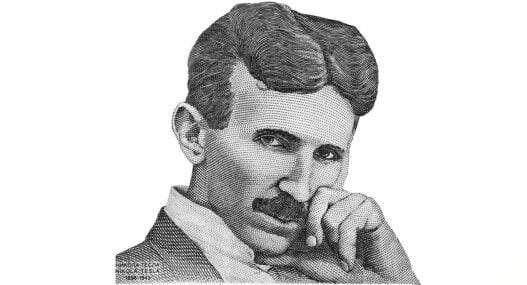
Years earlier, a man named Nikola Tesla hinted that there was a device capable of stopping an enemy in its tracks. Something so fearsome that the threat of it would be enough to deter a would-be enemy. Yet, it wasn’t until 1934, when Tesla was then 78 years old, that the “Death Ray” would get its day.
Media heyday hype
Tesla is famously associated with the sensational, headline-grabbing phrase “death ray”. A death ray, as reported by the press, is a theoretical beam weapon, electromechanical or particle-based, capable of destroying aircraft and killing at a distance.
Around the same era Tesla was associated with it, several other inventors claimed to have built one. Most notable of these inventors are Guglielmo Marconi in Italy and Harry Grindell Matthews in Britain, who in 1923 claimed his device could stop a motorcycle engine and ignite gunpowder from a distance, though he refused to ever properly demonstrate it to the British military. Yet, none of these men – including Tesla – ever produced a working device.
Tesla, however, had another device in mind. Something he called Teleforce. The Teleforce, unlike a death ray, was a particle accelerator, which he hoped would act more as a deterrent than a weapon of mass destruction.
What Teleforce actually was
In 1934, Tesla announced he had designed a weapon capable of destroying aircraft up to 200 miles away. The mechanism, as he described it, worked by firing a concentrated stream of tiny charged particles (like tungsten or mercury), accelerated to extremely high velocity through a specialised vacuum chamber and a Tesla turbine. He claimed that it needed four separate mechanisms working together to be able to generate the particles, charge them, accelerate them, and project them through open, non-vacuum air over vast distances. Something that had never been achieved before.
As for the label of “Death Ray”, this is something Tesla rejected. He argued that rays disperse and weaken as they travel. The farther a beam of light or radiation travels, the more it loses power. Particles, he said, could retain their destructive force over a great distance if properly accelerated. However, he intended this to be a defensive, not an offensive weapon. It was to be a wall of protection so powerful that no nation would dare to cross a border it guarded. He called it a “peace ray”.
A misleading photograph
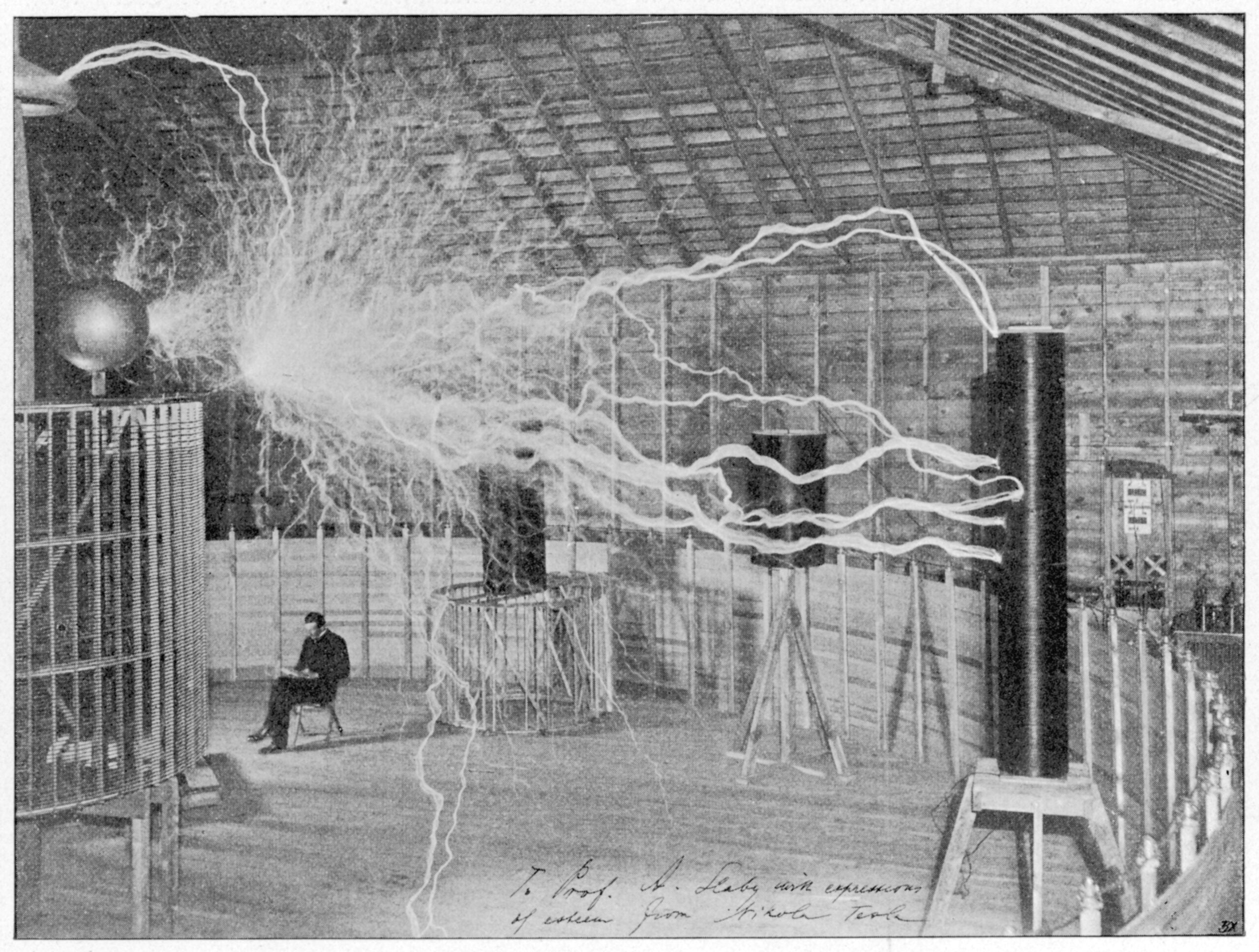
There is an iconic image of Tesla, sitting calmly in a chair while huge bolts of electricity spike and arc around him. It is often used to illustrate stories of the death ray. But it has nothing to do with Teleforce. It was taken in 1899, at Tesla’s laboratory in Colorado Springs, and it depicts his “magnifying transmitter”, which is to say an enormous, super-sized Tesla coil which was part of his early wireless power experiments. The image was created as a deliberate double exposure, where one plate captured the electrical discharge in a darkened room, then the same plate was exposed a second time with the machine switched off and Tesla sitting in a chair. Tesla himself admitted that this was the case in his own notes. It was a publicity image created decades before the Teleforce existed, yet its imagery is strongly associated with the death ray.
Wardenclyffe and why headlines mattered to Tesla
To understand why Tesla was keen to make the headlines by 1934, it perhaps helps to look back to an earlier disaster.
In 1900, financier J.P. Morgan gave Tesla around $150,000 to build a radio transmitter. Tesla spent a portion of the money on building Wardenclyffe Tower on Long Island. It was to be a wireless communications facility where Tesla hoped to expand it into a system for transmitting power, not just messages, across the globe for free. Morgan thought that he was investing in a rival to Marconi’s wireless telegraph business. However, when Marconi successfully transmitted the first transatlantic radio signal in 1901, using equipment far cheaper than Tesla’s tower, investors looked to back Marconi instead. Tesla appealed to Morgan for more funding to keep building; Morgan refused, and no other backers took up the mantle. Construction halted at Wardenclyffe, and in 1917, the tower was demolished and sold for scrap to cover Tesla’s debts.
This cost him his reputation as a serious and commercially viable inventor. It drained his resources. It was a huge blow for Tesla.
Teleforce was never built
Despite its hype, Teleforce was never constructed. Tesla continued to laud it to the press, and in 1935 the Soviet Union paid $25,000 for the plans, but a working device was never realised. At this point, Tesla had been repeatedly sued and was in serious financial difficulty.
Despite Tesla’s claims and the press coverage, the theory was never demonstrated. What survives of Tesla’s actual particle beam papers has since been reviewed by researchers, who generally agree that the plans lack the details needed to build a functioning weapon, and even if they could build a version from them, they would produce very limited power. Tesla’s design accelerated the particles inside a vacuum chamber, but he claimed that the beam could then travel hundreds of miles through open air and still retain its force. Whereas, in reality, once accelerated particles leave a vacuum, they collide with air molecules and quickly lose energy – which is why there has never been a successful particle-beam weapon like the kind suggested by Tesla ever built.
When an idea beecomes a legend
After Tesla’s death, there were several things that played their part in keeping the hope and the myth of Teleforce alive.
There was Tesla’s own financial situation. He was an inventor who had already lost his fortune once and was now watching a second grand vision go unfunded, all while the threat of another war loomed and the world wanted to believe that a miracle weapon might exist.
Tesla himself perpetuated the publicity around his inventions – writing to newspapers, giving birthday press conferences. Like a carrot dangling in front of a donkey, he dangled the promise of details without ever producing them – right up until his death.
There was also an unrelated mystery known as Tunguska that some theorists associate with Tesla. In 1908, a massive explosion flattened around 800 square miles of Siberian forest and reportedly killed herds of reindeer in the blast radius, yet no impact crater was ever found. Decades later, a theory circulated that suggested Tesla had test-fired an early beam weapon toward the North Pole and missed his mark. However, there is no credible evidence for this, and it doesn’t fit the timeline since Teleforce wasn’t publicly described until 1934.
Finally, there’s the paper trail. After Tesla’s death, his papers were seized by the US government’s Office of Alien Property. They were reviewed and found to contain nothing resembling a weapon. They were mostly theoretical notes and old patents.
It’s this space between a device that was talked about constantly, never demonstrated, yet publicly hyped at a time when the world needed a miracle and a man needed a purpose that gives Tesla’s “Death Ray” its hold over the imagination.
Like most decent mysteries, it survives because of the “if only”: if only he’d had the funding after Wardenclyffe, if only the plans had been complete, if only there really was a working prototype hidden away somewhere … if only, if only .. if only. But there were none of these things; there was a clever man in dire straits who told a story over and over. And it is a story that was, and still is, an irresistible mystery – because, if only it did exist …