


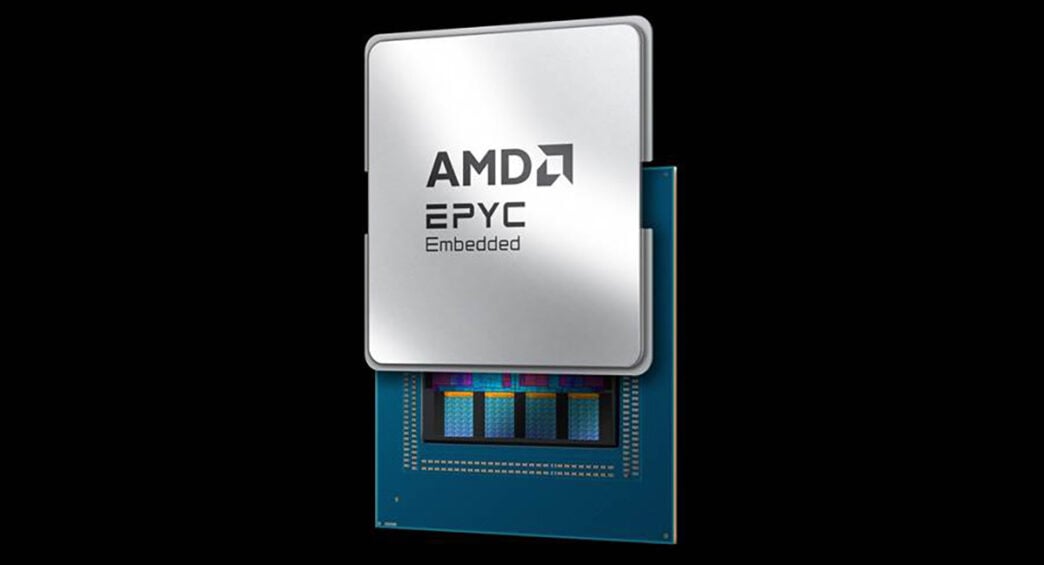
AMD has announced the AMD EPYC Embedded 9006 Series SP7 CPUs, expanding its x86 processor portfolio optimised for embedded customer requirements and deployments. Advanced by the high-performance “Zen 6” core architecture, AMD EPYC Embedded 9006 CPUs combine up to 256 cores, scalable PCIe Gen 6 and CXL 3.1 connectivity, and advanced security from secure boot through runtime. With a throughput increase of up to 1.8x compared with the previous generation 5th Gen AMD EPYC 9005 Series processors, they provide leading compute and high-speed connectivity to scale throughput and handle increasingly demanding workloads in semiconductor automated test equipment (ATE), enterprise storage, and network firewall applications. Seven-year product longevity, support for post-quantum cryptography for firmware signing, and ongoing security updates simplify maintenance and long-term support for mission-critical embedded applications.
As AI infrastructure expands and data volumes grow, semiconductor ATE needs to validate memory and I/O devices faster, firewalls need to process and secure more network traffic, and storage controllers need to move and process more data. AMD EPYC Embedded 9006 processors deliver the high throughput, memory bandwidth, and I/O performance required to meet these growing application demands.
What’s the role of AMD?
“As AI infrastructure grows, the systems that test semiconductors, secure networks and manage enterprise data must keep pace or risk becoming bottlenecks to progress. With AMD EPYC Embedded 9006 SP7 processors, we’re extending AMD CPU leadership by bringing data centre-class compute to embedded systems, and by helping customers increase capacity and do more within their power budgets. Combined with the longevity and support embedded customers depend on, they provide the foundation to build their next generation of products and deploy them with confidence for years to come,” said Salil Raje, Senior Vice President and General Manager, Adaptive and Embedded Computing Group, AMD
What do the New CPUs support?
EPYC Embedded 9006 CPUs help power semiconductor-ATE systems that enable production-scale validation of new memory and I/O devices. The CPUs act as the control and orchestration engine, managing memory and storage test workloads and interfaces for high-speed DDR5 RDIMM and emerging MRDIMM technology, as well as switches and devices supporting PCIe Gen 6 and CXL 3.1. They also provide the compute scalability to run more tests in parallel.
As expanding AI infrastructure increases network traffic, high-end firewalls supporting 400G/800G networks face growing throughput and security-processing requirements. EPYC Embedded 9006 CPUs provide the control-plane engine to manage growing security policies and network sessions, to process new flows and traffic exceptions, and to deliver the throughput for security processing and faster connectivity to data-plane accelerators. They offer customers up to 1.3x higher firewall throughput compared with the previous generation.
AI data growth is transforming enterprise storage requirements. AMD EPYC Embedded 9006 CPUs power non-volatile memory express (NVM Express) connectivity, data movement and storage processing to manage NVMe devices. They accelerate data-intensive storage services such as compression, caching and RAID systems, delivering an increase over the previous generation of up to 1.5x on the intelligent storage acceleration library (ISA-L) benchmark that measures how quickly a processor performs specific functions used in storage services.
What do EPYC Embedded 9006 CPUs deliver?
The processors offer up to 256 cores and 512 threads and up to a 1.8x throughput improvement compared with the previous generation. To help reduce bottlenecks in demanding workloads, they deliver up to 1.5x higher I/O bandwidth and up to 2.7x higher memory bandwidth compared with the prior generation. Sixteen DDR5 memory channels support RDIMM speeds up to 8,000 megatransfers per second (MT/s) and MRDIMM speeds up to 12,800 MT/s. Up to 96 PCIe Gen 6 lanes operate at 64 gigatransfers per second, while flexible PCIe Gen 6 and CXL 3.1 support high-speed connectivity with compatible networking, storage, accelerators, test equipment and memory expansion.
What makes EPYC Embedded 9006 Series unique?
The processors provide seven-year product longevity for long-term embedded deployments. Ongoing embedded-focused firmware updates and software support help simplify maintenance for mission-critical embedded applications and systems. Building on the EPYC 9006 server CPU architecture, they also provide enterprise-class reliability, availability and serviceability features that help teams maintain embedded infrastructure, with telemetry and predictive failure analysis available through supported platform implementations.
Advanced security is delivered with dedicated security engines that provide complementary layers of protection, from establishing trust at boot to securing runtime operation and verifying platform identity and integrity. Each engine uses separate resources to reduce attack exposure and strengthen resilience:
AMD root of trust (ART) establishes the initial immutable silicon root of trust and enables secure boot by creating a chain of trust to authenticate firmware components as the system boots. ART also supports post-cryptography for firmware signing, helping to protect the platform against future quantum threats, along with hardware protections against physical and side-channel attacks.
AMD Security Processor (ASP) acts as the boot orchestrator and provides key security services during operation, including a trusted execution environment. It also provides secure debug capabilities for authorised diagnostics and troubleshooting. For virtualised environments, the ASP also manages the keys used to protect VM memory.
Caliptra, an open-source vendor-agnostic silicon root of trust, is used for device identity and attestation, and allows a remote entity to verify a device is genuine and that the expected BIOS and firmware are running on the platform.