


Reducing the heaviness of electronics is the next lightweighting gamechanger in motorsport. Most racing teams’ talk about lightweighting revolves around carbon fibre, titanium, aerodynamics, and structure – but an overlooked consideration is the weight hidden in the architecture itself, says Emma Armstrong, Group Commercial Director at In2tec.
She said: “Electronics rarely lead the conversation in motorsport, especially F1, but there is increasing evidence of the value of reducing weight in the electronic systems that sit beneath the surface.
“Conventional rigid assemblies are being jettisoned in favour of lighter, more integrated electronic design.
“The next evolution in lightweighting may not lie with the chassis – it may be built into the electronics architecture beneath.”
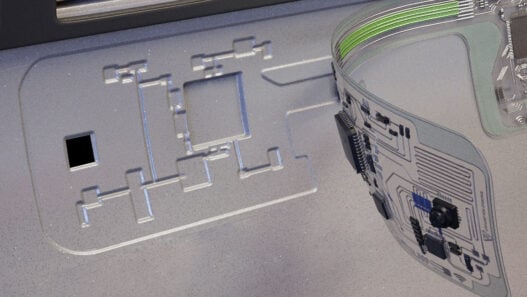
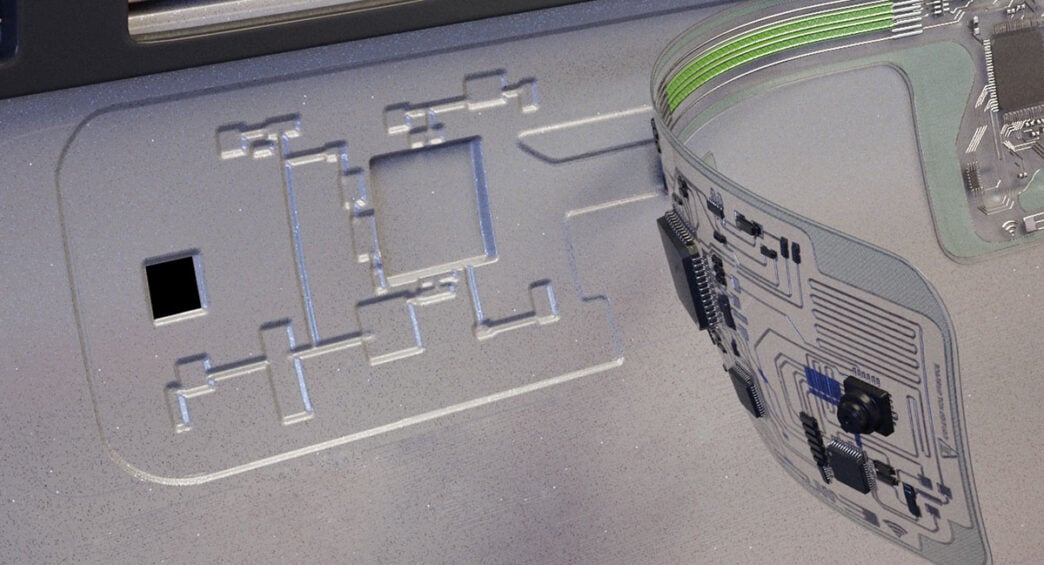
In2tec partners with race teams to develop next-generation systems tailored to fit seamlessly into a vehicle’s contours. In2tec’s Flexi-hibrid technology comprises flexible PCBAs (printed circuit board assemblies), which ‘flow’ in relation to the superstructure, body, and chassis of vehicles, unlike conventional rigid printed circuit board assemblies.
In2tec’s Flexi-hibrid approach combines flexible circuitry and component assembly so that interconnect, local electronics, and interfaces can be considered together within a single defined solution. For motorsport, the strongest case is therefore architectural: use flexible printed circuits (FPCs) where controlled geometry, low profile, reduced secondary hardware, and selective copper sizing create a net benefit, freeing up design constraints.
Flexible finesse
FPCs place copper conductors in a thin, planar dielectric construction. They allow trace widths, spacing, branches, pads, test features, and selected shielding structures to be defined in the bodywork. Unlike a round wire bundle, the conductor position and overall outline are therefore controlled by design. The finished circuit can follow a surface, turn around obstacles, and present connection features where they are required.
The tech enables printed circuitry and wiring harnesses to be combined within a more adaptable structure, reducing dependence on traditional connector-heavy architectures.
A circuit can be shaped to its route, located by its outline, and even supplied with an adhesive backing or integrated fixing features. This in turn reduces the need for separate clips, tie points, and manual wire positioning.
For example, on one project, In2tec assessed a 9-conductor wire harness weighing around 15g. In2tec used an HSM flexible planar solution to reduce this by to 2.95g – 80% lighter – while reducing the wire bundle from 3-4mm thick to just 0.20mm in a single laminated circuit.
“In elite motorsport, that is a huge weight and space saving,” Armstrong adds. “Harness architecture influences weight, packaging, assembly effort, serviceability, and reliability, particularly in environments where development cycles are short, and revisions happen under pressure.”
The aim is not simply to substitute one conductor for another. A conventional harness carries secondary mass in insulation, sleeves, clips, supports, branches, service loops, and connectors. Designing the interconnect as part of the structure also creates the opportunity to reduce some secondary mass.
Additionally, the technology is not limited to simple switch or lighting circuits. In2tec development work has demonstrated how signal and data distribution could increasingly become part of the vehicle structure itself.
Each vehicle is unique, and the optimum architecture may be a tailored hybrid approach where conventional conductors are retained where high current demands them, while moving data, sensing, and low-current functions are handled by significantly lighter planar structures.
Armstrong concludes: “We must ask ourselves if traditional wiring harnesses are one of the biggest hidden constraints in vehicle integration.
“As vehicle electrical architectures continue to grow, will adding more wiring remain the answer – or is it time to rethink the architecture itself?”