


GaN and SiC power semiconductor firm, Navitas has completed its acquisition of power management specialist, Claros to build out its grid-to-xPU power delivery capabilities and enable it to better address AI infrastructure application demands, the company told Electronic Specifier at electronica 2026.
Talking to Electronic Specifier at electronica at Messe München in Munich, Germany in November 2026, Navitas Chief Marketing Officer, Llew Vaughan-Edmunds explained that Claros’ IVR technology enables vertical and embedded power delivery architectures that move power conversion closer to the xPU to deliver higher efficiency, faster transient response, and greater power density to meet the rapidly increasing demands of next-generation processors (xPUs, an umbrella term for GPUs, CPUs, TPUs, NPUs, DPUs, and custom ASIC chips) at the centre of modern AI infrastructure.

Navitas 2.0: ‘Breaking the AI Infrastructure Power Wall’
Talking about the company’s evolution, Vaughan-Edmunds explained that after being one of the early players in GaN power ICs, as the market for consumer applications (such as laptop chargers) became heavily commoditised over the past few years, Navitas has pivoted to high-power applications, initially EVs, then subsequently industrial applications, in particular hyperscale data centres and AI infrastructure.
Combined with Navitas’ GaN and high-voltage and ultra-high-voltage SiC technologies that address the new 800V DC architecture, the company’s acquisition of Claros and its IVR technology for vertical and embedded power delivery architectures enable it to “break the AI infrastructure power wall” Vaughan-Edmunds claimed, addressing the efficiency, power density, and performance bottlenecks emerging as AI data centres and xPUs demand dramatically more power.
AI infrastructure is scaling rapidly, Vaughan-Edmunds explained, driving higher rack power, compute density, and xPU power demands. These trends are exposing the limits of traditional power architectures and creating a new AI infrastructure “power wall.”
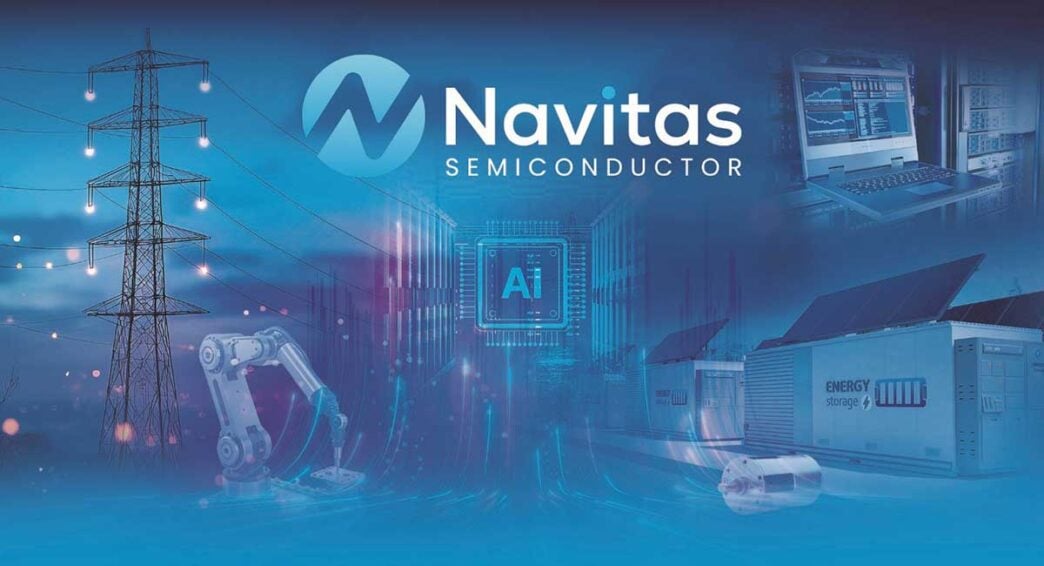
He went on to say that ‘Navitas 2.0’ marks a strategic shift toward high-power, high-growth markets, including hyperscale AI data centres, energy and grid infrastructure, high performance computing, and industrial electrification. The company’s portfolio of GaN, high-voltage and ultra-high-voltage SiC, and now integrated voltage regulator (IVR) technologies addresses critical power conversion and delivery challenges across the AI power chain.
Completing Navitas’ grid-to-xPU power portfolio with Claros acquisition
The completed acquisition extends Navitas’ AI infrastructure portfolio from the grid to the xPU, bringing IVR capabilities. Claros IVR integrates power transistors, digital control, inductors, and capacitors into a single IVR technology stack to enable next-generation vertical power delivery (VPD) and embedded power delivery (EPD) architectures. Its Packaged Integrated Voltage Regulator (pIVR) and Embedded Integrated Voltage Regulator (eIVR) products, based off the same Claros IVR technology stack, move power conversion closer to the xPU to deliver higher efficiency and greater power density, while its modular PowerArray architecture scales power delivery to meet the rapidly increasing demands of next-generation processors at the centre of modern hyperscale AI systems.
“This acquisition is a defining step in the Navitas 2.0 transformation and our strategy to power AI infrastructure from grid-to-xPU,” said Chris Allexandre, President and CEO of Navitas. “With power now the bottleneck for AI, increases in power delivery and efficiency are the key enablers of more compute output. The future of AI depends on delivering thousands of amps to increasingly power-hungry processors with unprecedented speed and precision, in addition to redefining the racks with higher power centralised systems and higher density architectures. This ‘power wall’ has restricted next-generation xPUs in megawatt-scale server racks from achieving the next wave of AI performance. Navitas 2.0 brings together GaN, high-voltage and ultra-high-voltage SiC, and now IVR technologies to break the power wall and address power conversion across the complete grid-to-xPU architecture.
“Additionally, this combination doubles our serviceable addressable market (SAM), deepens our engagement with hyperscalers and AI power platform providers, and strengthens our capabilities and leadership in power delivery for AI infrastructure. As AI power demand accelerates, Navitas is uniquely positioned to deliver greater value for our customers, while driving sustainable long-term growth.”
Navitas expects the acquisition to more than double the company’s identified 2030 SAM to over $8 billion, adding at least $3.5 billion from the rapidly growing VPD and IVR markets. Combined with Navitas’ existing $3.5 billion SAM for GaN and HV/UHV SiC and approximately $1 billion from new JFET technology, the transaction significantly expands Navitas’ opportunity across the complete grid-to-xPU power chain.