







Texas Instruments has launched the industry’s most capable battery monitoring chip for electric vehicles and large-scale energy storage with a built-in diagnostic system designed to detect cell-level problems in real time.
The BQ79826Z-Q1, unveiled at PCIM in Nuremberg last week, uses a technology called electrochemical impedance spectroscopy (EIS) to assess the internal chemical state of individual battery cells. TI compares the approach to an electrocardiogram for batteries: rather than waiting for a fault to manifest, the chip continuously monitors for early warning signs, including conditions that can precede thermal runaway, the dangerous chain reaction responsible for some EV battery fires.
Constant monitoring improves the safety of vehicles. Mark Ng, Director of Automotive Systems at Texas Instruments, explained: “The main advantage is safety, because I’m able to tell when individual cells are starting to run away much faster, and I can take action, so I have much more advanced diagnostics.
“When I have a local temperature sensor, I can only tell when that region is starting to heat up. But when I know individual data from individual cells, I can tell when there’s degradation in the pack or there’s some anomaly, and it can give a more advanced warning to the driver. EIS essentially gives us the ability to create safer vehicles, because you’re able to have a much earlier indication of failure.”
The chip’s headline specification is its cell count. The device supports monitoring up to 26 cells in series, eight more per chip than competing solutions currently on the market. That translates to fewer chips needed per battery pack, which TI says reduces component costs, simplifies wiring architecture, and shrinks the board space required. The company says the increase represents up to 44% more monitoring channels than its previous generation.
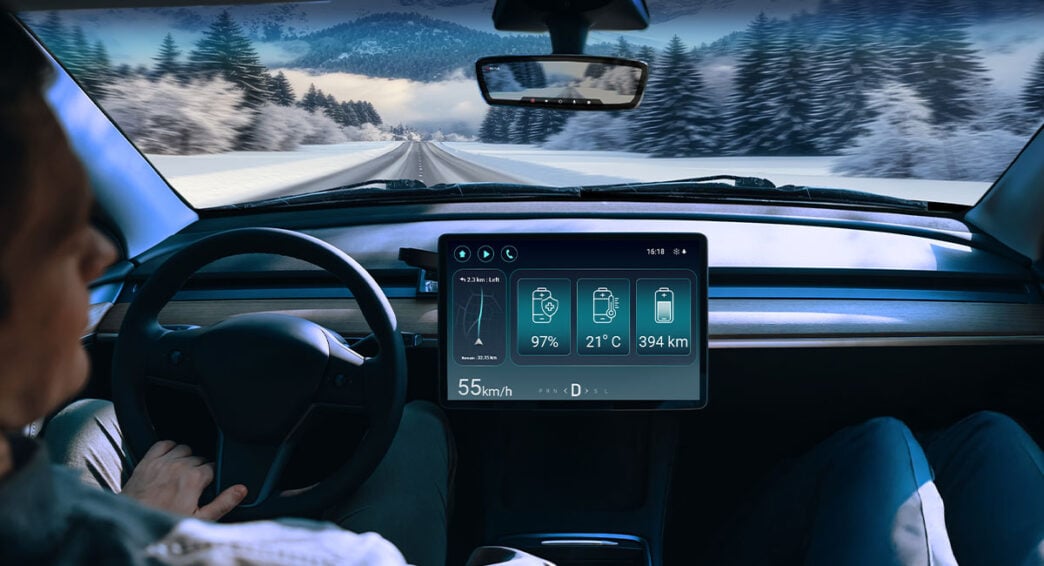
The EIS engine also addresses a persistent frustration for EV drivers. Voltage readings accurate to under 2 millivolts across an operating temperature range of –40°C to +125°C allow for more precise calculations of how much charge remains in the battery – the figure that determines the range estimate shown on the dashboard. Inaccurate state-of-charge readings are a known contributor to range anxiety, the fear of running out of power before reaching a destination or charger. TI says its EIS measurement time is five times faster than previous solutions, and the chip holds Automotive Safety Integrity Level D certification under ISO 26262 – the highest functional safety rating in automotive electronics.
Beyond vehicles, TI is positioning the chip for grid-scale energy storage, a sector under growing pressure to support the power demands of AI data centres. The ability to monitor individual cell health across large storage arrays, regardless of total system size, is increasingly important as battery installations scale up.
Wenjia Liu, TI’s vice president and general manager for battery management systems, said the technology lets engineers “shine a light” inside battery cells – gathering chemical-state data that software can use to make safety and performance decisions in real time.
Preproduction quantities of the BQ79826Z-Q1 are available now, with full production quantities expected by the end of 2026.