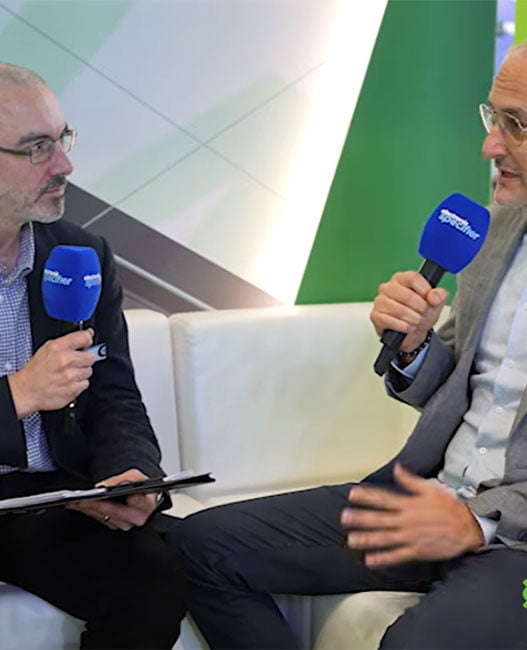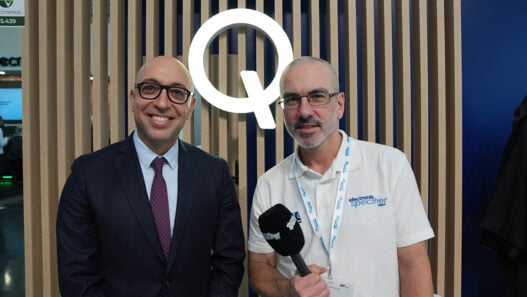


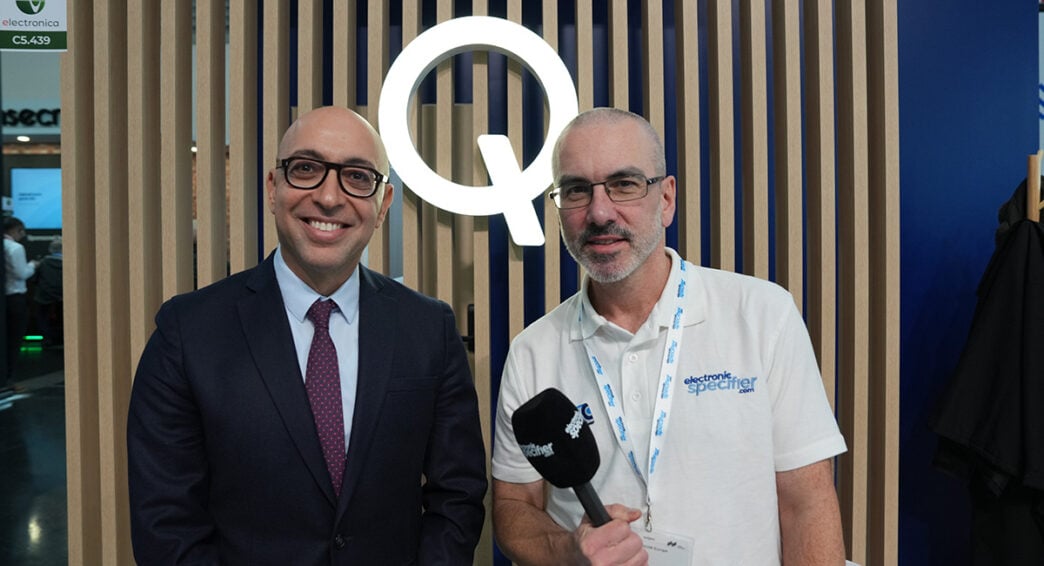
At electronica 2026 in Munich, Electronic Specifier’s Contributing Editor Mark Gradwell sat down with Wassim Chourbaji, SVP & President, Qualcomm EMEA, to discuss the company’s highlights at the show, why AI has become so central to innovation, the role of Physical AI and robotics in transforming industry, and how Arduino is shaping Qualcomm’s developer journey one year on.
Speaking about the show, Chourbaji described it as “a milestone for the industry. We’re bringing AI to the real world, adding value, adding real outcomes,” he said.
From experimentation to business outcomes
The tone of the conversation at this year’s electronica is notably different, said Chourbaji. Rather than talking about what AI might do, customers and partners are now focused on what it can deliver. “The conversation this year is really [about] how AI can really bring business outcomes, change productivity, transform operations,” he explained. “So it’s very exciting to get to that level of discussion, moving away from just experimentation.”
Central to that shift is the Qualcomm Dragonwing portfolio, including the Dragonwing IQ8, IQ9, and IQ10 Series, which Chourbaji said are enabling companies to “truly transform their industries.” The breadth of that ecosystem was on display across the show floor, with more than 28 partners building on Qualcomm technologies across sectors including smart health, retail, and industrial automation.
Chourbaji said that the challenge right now is keeping up with demand, nothing that the industry is currently constrained more by supply than by demand: “We have so much demand, and the use cases are exciting, and we’re building towards those.”
Why AI matters for the future of innovation
Over the last few years, Chourbaji has noticed that most people have experienced AI as a tool for generating content – chatbots, large language models, etc. That is now changing. “We’re entering an era where AI is becoming active in the real world,” he said. “We call it physical AI.”
This move from the digital to the physical world means sensors and machines that perceive, understand, reason, and take action in real time, and that, in turn, means bringing intelligence directly to the machines and sensors themselves. Edge AI enables lower latency, greater security, reliability, and safety, said Chourbaji. “The use cases are really immense. It’s the age of Edge AI.” He also pointed to agentic AI running on these Edge capabilities as the next step.
Physical AI, robotics, and the ecosystem
Chourbaji believes the industry is witnessing a full transformation driven by physical AI, in which “every single machine object will have some kind of intelligence, and that intelligence is driven through AI.”
Crucially, though, he noted that no one company can deliver this alone. “There is no one single company that can do it all,” he said. “So it’s an ecosystem play.” That ecosystem includes partner companies and the developer community building on Qualcomm platforms.
To support them, Qualcomm has focused on creating a simplified journey from ideation to prototyping and on to deployment. Prototyping is where Arduino comes in, with the recently released Arduino UNO Q and Arduino VENTUNO Q bringing Edge AI capabilities to robotics developers, before projects move on to the Dragonwing IQ10 Series for deployment. Chourbaji also highlighted Qualcomm’s agreement to acquire PickNik, the robotics software company behind the open-source MoveIt manipulation framework, to strengthen motion control.
Arduino: one year on
Qualcomm announced its acquisition of Arduino in October 2025, and Chourbaji recently travelled to London to celebrate the one-year milestone with the Arduino community. What he values most, he said, is the symbiotic relationship between the two. “Qualcomm DNA is about partnership. Qualcomm DNA is about openness. And it’s about enablement, and enabling is not like a lock-in.”
The UNO Q serves a range of use cases, while the VENTUNO Q – built on the Qualcomm Dragonwing IQ8 Series with a dedicated STM32H5 microcontroller, and delivering up to 40 dense TOPS – targets Edge AI, robotics, and vision language model (VLM)-oriented applications. At electronica, Qualcomm showcased the VENTUNO Q alongside a performance comparison between the Dragonwing IQ9 and the NVIDIA Jetson, which Chourbaji said demonstrated Qualcomm exceeding Jetson’s performance.
For developers, however, the software experience matters just as much as the hardware. Arduino App Lab provides a common development environment for both the UNO Q and VENTUNO Q, is ROS 2 compatible, and supports MoveIt Pro, enabling developers to move quickly into robotics. “You need a whole journey from, you have an idea, you want a prototype, and go to production,” he said, with Arduino covering prototyping and the Dragonwing IQ Series taking projects into production.
The key takeaway
Asked for the one message he wanted visitors to take away from Qualcomm at electronica, Chourbaji said: “Focus on real-world value, focus on actual use cases, focus on business outcomes. It’s no more the experimentation phase.”
That means looking closely at total cost of ownership (TCO), TCO per watt, and how use cases can move to scalable deployment, an area where Chourbaji believes Qualcomm’s partnership approach really excels.
He also emphasised the importance of EMEA, a region with particular strengths in heavy equipment, industrial automation, precision manufacturing, and energy. “It’s a unique region, and we’re very committed to it,” he said, adding that Qualcomm is equally committed to investing in the region and working with partners to bring these use cases to maturity and to scale.
Watch the full video interview here: