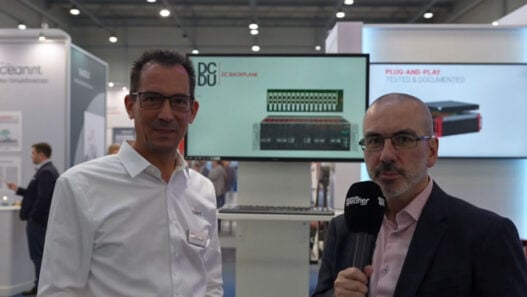





Electronics educator Shawn Hymel had a dream “to be the Bill Nye of embedded.” Speaking to Lucy Barnard at electronica 2026 in Munich, he explained how that mission is evolving as Edge AI, reinforcement learning, and LoRa mesh networking reshape what engineers need to know.
From SparkFun to DigiKey
Hymel began his career as an engineer, designing PCBs, writing embedded code, and creating Arduino libraries for kits sold through SparkFun. He holds a degree in computer engineering and a master’s in electrical engineering, and cites Bill Nye, Alton Brown, Ben Eater, and Chris Gammell as inspirations.
A move into marketing at SparkFun opened the door to developer relations and video, and his career as a content creator took off from there. His focus is the gap between education and industry: helping people go from “Oh, I know how to blink an LED” to “Now, my job is requiring me to use Zephyr.”
That philosophy is behind his real-time operating system (RTOS) series with DigiKey, one of the best-performing series on the distributor’s site. Hymel created it after a university RTOS course that, in his view, spent too long on “weird esoteric scheduling algorithms” and offered little hands-on experience. He has since released a reinforcement learning for robotics series with DigiKey, finished filming a series on sensor fusion, and has another on Meshtastic and MeshCore coming out now.
Engineering skills in the age of AI
Asked what embedded engineers are missing, Hymel looked to AI. “AI is just eating all of the code,” he said. New engineers still need “enough programming to prompt the AI and check its output,” and the people he talks to pair AI-generated code with good software engineering practice: test frameworks and code reviews.
That is changing his own content. Rather than walking through code line by line, his sensor fusion series concentrates on the maths and concepts, “so you can work with the AI to do the programming side.” He also sees value in revisiting first principles, possibly including passive electronics, and notes that AI tools are finally making PCB autorouting worth a second look.
Edge AI: the invisible technology
Edge AI was everywhere at electronica, driven by silicon vendors adding on-chip NPUs and tooling that is only now catching up. Getting a trained model running on a microcontroller can mean learning vendor-specific tools, or turning to Edge Impulse or Zephyr for a more portable framework.
Hymel conceded that it can sometimes feel like “a hammer in search of a nail,” but described it as an invisible technology already all around us. Smartwatches use it to tell whether you are sleeping, jogging, or have had a fall, while drones and smart doorbells process images on the device before anything is sent to the Cloud. The less visible win is in industry, where predictive maintenance listens to motors and machines through sound and vibration data and flags problems before they cause breakdowns, “helping save millions of dollars.”
For engineers new to the field, his advice is to start with a machine learning course on Coursera or Udemy, or a good book. Unlike deterministic approaches such as Kalman filters, machine learning derives the rule set from data, so understanding the statistics matters. Deployment then means pruning and quantising the model to fit the device, and building the system around it: sensor inputs, an RTOS if needed, inference on the NPU, and post-processing. “I think embedded engineers can absolutely still learn this. There’s just a number of steps involved to get there,” he said.
Robots that learn by trial and error
The humanoid robots dancing around the show floor rarely rely on hand-plotted inverse kinematics any more. Instead, Hymel explained, many are trained with reinforcement learning: in simulation, the motors start with random movements and earn rewards for getting closer to the desired behaviour. “Your job as the designer is to come up with this reward function.”
The result is a trained agent (a term that is not the same as agentic AI) which can then be deployed to the real robot. The big research challenge is the sim-to-real gap, where a policy that works well in simulation struggles with real-world noise and imperfect motion.
Meshtastic and MeshCore
Meshtastic and MeshCore are two popular open-source projects that build mesh networks from LoRa radios. Users can mount a repeater on a roof or carry a small device that connects to a phone over BLE, then send messages across the mesh to people on the other side of a city.
The catch is that coverage depends on enough people deploying nodes, and data rates are very low, “probably bytes per second.” That limits it to short text messages, with no pictures or streaming. Even so, it is proving useful for emergency communications as a complement to ham radio, with no licence needed because it runs on ISM bands. It also creates ad hoc networks at conferences or on hikes where mobile coverage is poor.
Some users run IoT telemetry over the mesh, but Hymel cautioned that delivery acknowledgements are not as dependable as MQTT. He advises building and testing your own guaranteed delivery.
What to learn next
For embedded engineers planning the next couple of years, Hymel picked two priorities. “I think Edge AI is here to stay,” as more inference moves onto individual devices. Microcontroller Edge AI still tackles narrow problems, but it increasingly complements traditional algorithms, for example by adding vision trained to detect a single thing.
His second pick is Zephyr. As applications move onto larger frameworks, Zephyr makes code more modular across systems and lets vendors supply networking and HMI support, such as the LVGL graphics library, so developers can focus on the application. “Zephyr’s been around for a while, but that’s a really good one to learn.”
Watch the full interview here: