



Connectors rarely get the spotlight, but as machines across almost every industry become more connected and more autonomous, the interconnect is being asked to do more than ever.
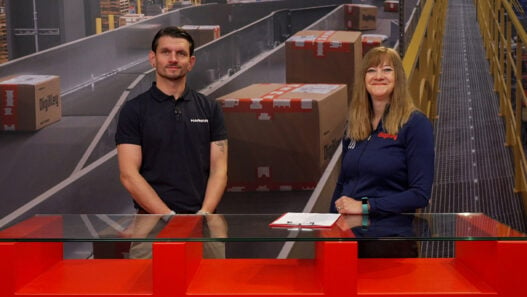
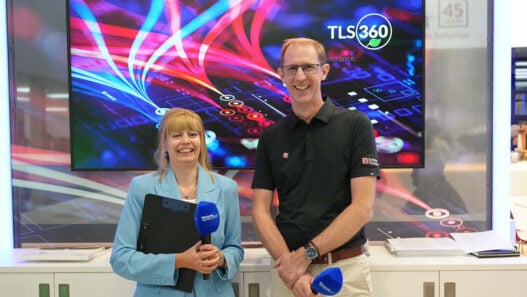
At electronica 2026, Editor Lucy Barnard caught up with Ian Vanner, Business Development Manager for Distribution at Molex, to talk about how connectors originally designed for the harsh conditions of the automotive world are crossing over into new markets, and how connectivity requirements themselves are changing.
Built for the toughest environments
Vanner has been with Molex for 14 years. Based in the UK, he supports customers across the distribution network who are looking to use connectors developed predominantly for automotive applications, whatever the end application may be.
Molex itself is one of the global leaders in interconnect and electronic solutions, with products spanning cable harnesses, wearables, automotive, medical, military, and aerospace. The automotive-derived portfolio Vanner looks after is designed to survive in demanding conditions such as high levels of vibration, temperature extremes and, for parts mounted under the hood or on the outside of a vehicle, ingress from salt spray, water, and dust.
Beyond the garage
So why are engineers in other industries turning to automotive connectors? Proven reliability is part of the answer, but Vanner pointed to some very practical advantages too. The product is available off the shelf and is “[…] produced in high volumes with high quality assurance,” which often makes the price point attractive to customers in other sectors.
The most natural crossover is into markets adjacent to automotive, like trucks, buses, agriculture, and construction, where control units and telematics perform very similar functions. But Vanner was clear that the opportunity doesn’t stop there. “It could go well beyond the garage,” he said, citing industrial applications, military, and aerospace where commercial off-the-shelf (COTS) parts are used, and even home appliances.
The key is specifying the right connector for the job by considering the physical, electrical, and environmental demands of the application, from the number of circuits to current-carrying capability and voltage.
Sealed or unsealed? It depends on the application
That principle applies whether the end product is an excavator, an autonomous vehicle, or a drone. Molex offers both very small unsealed connectors and small sealed connectors. On a drone, for example, the choice between the two for the link between controller and motor depends on where that connection sits. For other equipment, the decision is more clear-cut: “[…] an application like an agricultural vehicle, you’re probably going to want it to be a sealed connector.”
Meanwhile, an unsealed product such as DuraClik might connect to a PCB inside a drone, or be found in a headlight or head-up display within a vehicle.
Drone size also matters. Larger drones, such as those used in agriculture, have bigger motors drawing more current and therefore need larger terminal contacts. At the other end of the scale, designers of very small drones will look for the smallest possible connector to save weight and cost, particularly where drones aren’t built for longevity.
The data challenge of autonomy
One of the fastest-growing areas is high-speed data, driven by cameras and other sensors. While automotive data rates aren’t yet at the level of data centres, Ian noted that every autonomous system, from a last-mile delivery robot to an excavator in a mine, works on the same principle. Inputs from radar, LiDAR, cameras, or even sonar feed into a controller, which perceives the environment, communicates with the outside world, and decides on an output, such as changing direction or speed.
All of that data must be handled reliably and in real time. Otherwise, “…the vehicle misses something, or it comes to a point where the vehicle stops because it knows that there’s a lag.”
Power adds another layer of complexity, as sensors are power-hungry; “we’re having to deliver more power as well as deal with the high speed and the signal integrity.”
Molex addresses these needs with high-speed solutions such as the HSAutoLink interconnect system and High-Speed FAKRA-Mini (HFM) connectors, with the focus on maintaining signal integrity end to end, whether over coax or twisted pair. Vanner added that customer integration is backed up with evidence and expertise: “[W]e’ve got test data to support the performance,” along with knowledgeable people who can advise on implementation.
Looking ahead
Over the next two to three years, Vanner sees the same trends emerging across almost every sector: people want more power and “[T]hey’re wanting higher speed, they’re wanting the connectors to take up less space as well.”
That is driving a shift towards smaller contact systems, alongside the integration of terminals into hybrid connectivity solutions, some of which will be modular. For customers, this offers design flexibility at a lower cost because “[T]hey’re not having to tool up a custom-specific connector” for their application.
From tractors to drones and autonomous delivery robots, it’s clear that connectors proven in the car are ready to go wherever reliability matters.
Watch the full interview with Ian Vanner here: