
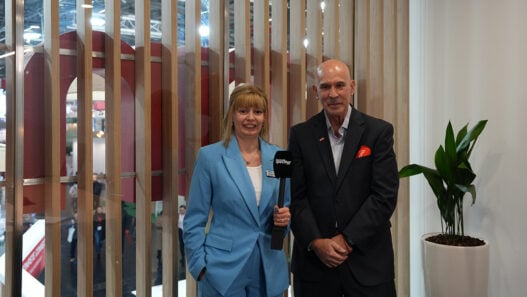


At electronica 2026 in Munich, Electronic Specifier Editor Lucy Barnard sat down with Andreas Kürzdörfer, Senior Sales Manager at Murata, to talk about two demonstrations on the Murata stand that are helping to change the way people interact with machines: a hand-tracking system that works without cameras, and a tiny sensor that picks up your voice through a surgical mask.
Two decades at Murata
Kürzdörfer knows the company well. “I’ve been working at Murata since 2006,” he said. “I have over 20 years experience in the field of electronics, and I have gone through several stages in my career from engineering to sales, marketing. Now I am running [Murata’s] marketing for robotics and other new emerging technology markets.”
For those less familiar with the company, Kürzdörfer described Murata as “a global leader for electronics”, best known for advanced passive components such as capacitors and inductors. These components are used in everything from smartphones and cars to industrial and medical equipment – and the products listed on Murata’s website are only a fraction of what it makes. “Everything what you see on the webpage on Murata is just the tip of the iceberg,” he said.
Hand tracking without a camera
The first demonstration tracks the movement of a person’s hand and fingers using antennas instead of cameras. Small three-dimensional antennas work with a low-frequency magnetic field, and by measuring that field the system can tell exactly where each finger is and how it is moving.
So why not simply use a camera? The problem, Kürzdörfer explained, is that fingers get in each other’s way. “A camera has always one limitation, sometimes the one finger is in front of the other finger, and then the camera … has not a clear line of sight,” he said. “And that clear line of sight is very important to actually see all the different movements, and that is something we can overcome with our [magnetic] field detection.”
The technology has been developed with Murata’s partner, startup Melt Interface Technologies, and is used in Melt’s ContactGlove3 Pro hand-tracking glove. According to Murata, its antennas make the glove around three times more power efficient than similar existing gloves running on the same size battery.
Why capturing human movement matters
Humanoid robots are designed to work in a world built for people, so they need to move in a human way – and recording how real people move is the best way to teach them.
“So the movement of the robots have to be as human-like as possible. And therefore, it is very important that the human movements are kind of mimicked by the robot,” said Kürzdörfer. “It’s about training, [and] teaching the robot to act like a human hand when it comes to the fingers.”
A voice sensor that isn’t a microphone
The second demonstration looks like a tiny microphone fitted inside a surgical mask, but Kürzdörfer was quick to point out that it works quite differently. Rather than picking up sound from the air, it uses a sensor that detects tiny vibrations in the mask itself. “When you speak, the surgical mask is moving, and our sensor can detect the movement and translate it into sound,” he explained.
This approach has a clear advantage in noisy places. A conventional microphone picks up every sound around it, so it needs noise cancellation – the same technique smartphones use – to separate your voice from the background. That takes a lot of processing power and energy. Because Murata’s sensor responds only to the movement of the mask, it captures your voice and leaves the background noise behind. “With our technology, you can really isolate the sound which you want to capture from the sound which is in the environment,” said Kürzdörfer.
Small, light and low-power
Both demonstrations are wearable devices, and building electronics into something people wear comes with its own engineering challenges. Above all, the components need to be small and light enough that the wearer barely notices them. As Kürzdörfer put it, “No one wants to carry a huge brick around because it’s just too heavy.”
This is where Murata’s expertise in miniaturisation comes in: by packing advanced technology into very small components. “Wearables have to be small. They have to be reliable. They [need to provide] low energy consumption, and that is where Murata is very strong,” he added.
Bridging the gap with Melt
Murata develops these technologies with its partner Melt Interface Technologies, and the two companies formalised their relationship with a business alliance in September 2026. Kürzdörfer explained that each side plays to its strengths: Murata makes the sensors, while Melt builds them into wearable devices that show what they can do.
Murata was founded in 1944 and has spent more than 80 years building up its expertise in technology and materials. It doesn’t make finished products itself, though, so it relies on partners like Melt to turn its components into real-world applications. “[A company] like Melt is actually helping us in giving us this … advanced insight of what can be done with our products,” said Kürzdörfer.
Looking ahead: robots that learn by watching
So how could this change the way we interact with robots and AI-powered systems? Kürzdörfer compared today’s robots to early computers, which had to be programmed line by line before more intuitive interfaces came along. “Right now, robots can’t do anything on their own. They have to be taught to do something,” he said.
Today, that usually means writing scripts and algorithms. The next step is for robots to learn simply by copying what a person shows them – and he offered a friendly comparison: “Think of a kid learning to walk. He looks at what the parents are doing, and then he tries to do it on his own. Of course, he will fall very often, but that is part of the learning process.”
In this analogy, Murata’s sensors take the place of the child watching its parents. They capture exactly how a person moves, giving the robot what it needs to understand that movement and copy it.
Also on the stand
Murata is also using electronica to launch its new MGJ2T2 series of isolated gate-drive DC-DC converters for high-voltage silicon carbide (SiC) power applications, alongside a Smart Ring demonstration of 3D tracking developed with Sensoryx.
Watch the full interview
To hear more from Andreas Kürzdörfer, watch the full video interview: DigiKey at electronica 2026 with MuRata