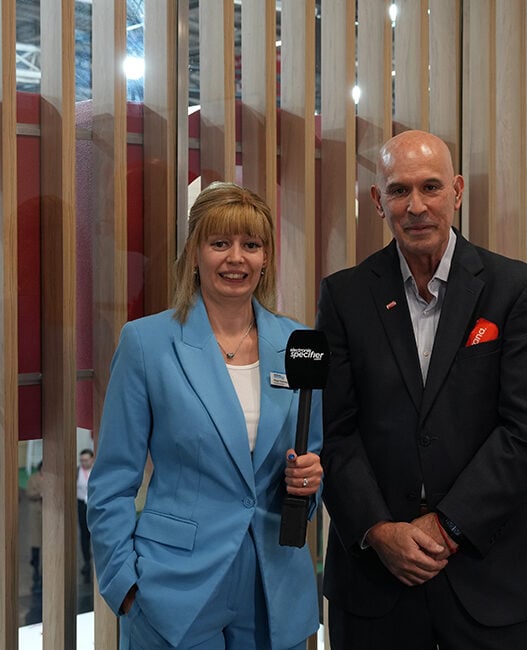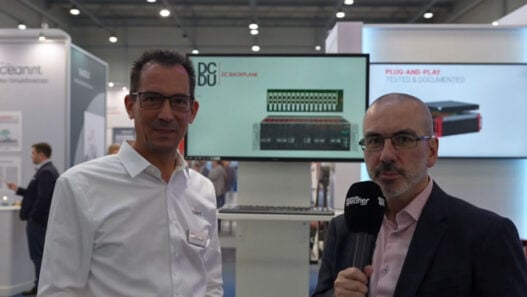



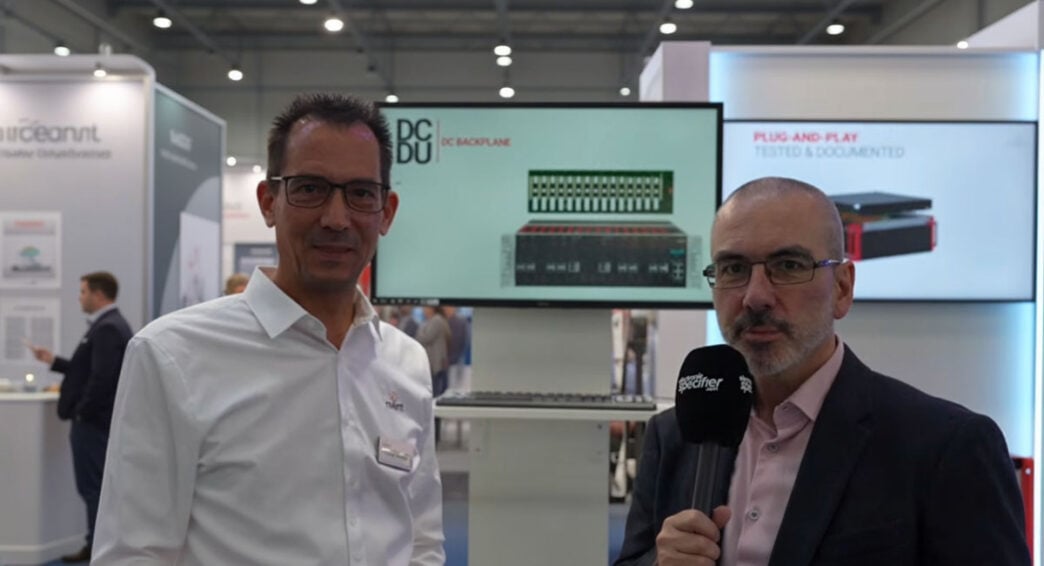
At electronica 2026 in Munich, Electronic Specifier’s Mark Gradwell joined nVent SCHROFF’s Global Project Managers, Christian Ganninger and Waldemar Schulz on their booth to look at three linked challenges: distributing power, managing heat, and protecting electronics in harsh environments.
Asked to sum up the nVent SCHROFF booth in one headline, Christian Ganninger didn’t need long to answer: “I think it’s all about higher power density.”
AI is pushing high-performance computing out of the data centre and into telecoms, railway, industrial, and even defence applications. TThat creates three challenges: distributing the power, keeping it cool, and protecting the electronics in environments far harsher than a data centre.
Power: the Smart DCDU
The first stop was the nVent SCHROFF Smart DCDU, a smart DC power distribution unit for telecom networks. It’s built on a modular approach: up to 15 outlets can be fitted with 10 A, 35 A or 60 A outlets, all fed from a 250 A input. The outlet modules can be hot-swapped during operation, and every outlet is protected by a circuit breaker.
The “smart” part comes from a management controller. It lets operators monitor current and power and switch outlets on and off, including remotely. A dual redundant Ethernet interface supports standard protocols such as HTTPS, SNMP and Redfish for connecting to higher-level management software. As Ganninger explains, “you can even daisy chain up to 64 of these units in a row and connect it with one IP address to your network.”
Cooling: from cabinet to chassis
More power means more heat, and that’s where Waldemar Schulz comes in. nVent SCHROFF’s strength, he says, is that “we are really thinking through the whole heat dissipation path from the hotspot to the cabinet level.”
He introduces the company’s Smart Fan tray, that is remotely controlled and monitored that adds around 200 to 300 W of cooling into a cabinet, and users can adjust both the cooling level and the noise level. When moving air is no longer enough, the LHX air-to-liquid heat exchanger takes over. It supplies cold air to the front of the cabinet, draws hot air in at the back and passes the heat to facility water through a radiator.
Inside the chassis, there’s a lot that can be done before going liquid. The Air Inlet Card slots into unused slots in a subrack to bring in more intake air, with an integrated filter, and can easily be retrofitted. “If you position it right you can have up to 200% more air in the neighboring slots here,” Schulz says, citing nVent’s internal tests.
Alongside it, the AirBender evens out airflow within the chassis. It blocks air to slim PCBs that need little cooling and sends it to larger boards that need more. Internal tests show up to 85% more airflow in the slots where it’s needed.
When air reaches its limit
At that point, Ganninger says, you have to move to water cooling. Bringing liquid right to the board in modular electronics is usually tricky, because water connections have to go through the front or the backplane with blind-mate quick connects.
nVent SCHROFF’s EasySwap LFT avoids this. A spring-loaded liquid cold blade is fixed in the card cage, and customers only need to redesign their heat sink with an angled surface that matches it. When the board is inserted, it makes full thermal contact with the blade. “So typically you have like 80 watt of cooling in such a chassis with air cooling. With that you’re getting above 200 watt of cooling capacity.”
The heat can go to facility water or a chiller. The demo system uses a closed loop with an air-to-water heat exchanger at the back, which gives 600 W of cooling capacity at ambient temperatures up to 50°C without connecting the chassis to facility water.
PXI Express Gen 5
In applications such as radar and semiconductor test, Ganninger says, today’s chassis are often the bottleneck. Most PXI chassis on the market support PCIe Gen 3 and up to 80 W of cooling per slot. nVent SCHROFF’s new chassis supports PCIe Gen 5, which is four times faster, with a two-link system slot, x8 connections to each peripheral slot and 96 GB/s of total bandwidth within the chassis. Optimised airflow gives a 25% improvement in cooling over previous versions. To deal with EMC at higher frequencies, a second level of shielding above and below the card cage protects the chassis up to 40 GHz.
Built for harsh environments
Many of these applications don’t run in a clean lab. The modular EuropacPRO platform covers several ruggedisation levels. There’s a light setup for labs, a heavy setup for applications such as railway with higher static and dynamic loads, and a rugged subrack for military and defence that handles shocks up to 25 g, is tested to MIL 901, and works from -40°C to 85°C.
One customer project on the booth put an IP67 outer housing with a cleverly designed heat sink around a subrack suspended on wire rope isolators. The modules, or the whole subrack, can be swapped quickly when the technology changes.
For even more demanding environments, nVent SCHROFF is launching a new rugged VPX embedded system. It’s a sealed chassis that will be tested up to 40 g, with a high-speed PCIe Gen 4 VPX backplane and an I/O board that filters all incoming signals. The company also plans versions for CompactPCI Serial and proprietary architectures. It’s due to launch in the first half of next year.
The takeaway
Ganninger’s closing message brought it all together: “high power density needs a systematic approach.” First you distribute the power, then you tackle the heat at board, chassis, and cabinet level. “And last but not least, we are not talking about data center white space. So we have to protect also the electronics in harsh environment.”
Watch the full interview
To hear more from Christian Ganninger & Waldemar Schulz, watch the full video interview: Electronic Specifier and nVent SCHROFF at electronica 2026