

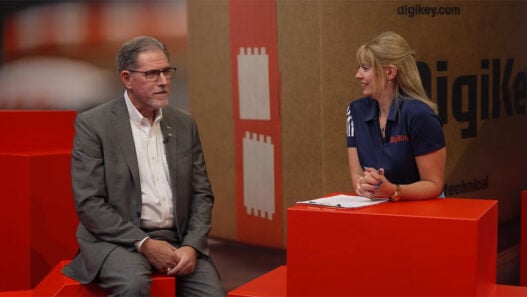


Drones are flying further, carrying more data and working more autonomously than ever. All of that depends on one thing, as Debbie Gibson, General Manager of Infrastructure at Qorvo, puts it: “The communications link is the drone’s lifeline.”
Qorvo is also now a part of Skyworks, a global developer in high-performance RF, precision timing, power management, and mixed-signal solutions.
A broad engineering background
Gibson leads the Infrastructure Business Unit within the High Performance Analogue division at Skyworks. The unit works on high-performance wired and wireless communication equipment for cellular base stations, cable TV, and outside plant equipment. It also covers more demanding applications such as drones, satellite direct-to-device, and tactical comms.
“Our core mission is to assure connectivity with high performance, high efficiency, and ensure reliable connectivity for devices that are in that sub 8 gigahertz frequency range,” she explains.
She has been with Qorvo for almost four years and clearly enjoys it. “We’ve got a lot of creative, innovative products, so it’s a really fun atmosphere to be at.” Her career has covered design engineering, applications engineering, strategic marketing, business development, and programme management. Technically, she has worked on DC-DC power supply design, analogue and mixed-signal design, inertial products and system solutions, and RF components.
Qorvo and Skyworks together
Skyworks recently acquired Qorvo on October 5, 2026. “We’re happy to be together,” Gibson says. The combined company serves a wide range of markets, including defence and aerospace, AI data centres, infrastructure, connectivity, and mobility. Its portfolio spans connectivity, power management and conditioning, and timing products, “and of course, RF is our bread and butter.”
Why the link matters
Without a reliable link, a drone can’t receive its command and control signals or send back video, telemetry, sensor data and, increasingly, AI-enabled mission data from the field. As Gibson puts it, the link “allows them to complete their mission safely. And as drones fly further away and [become] more autonomous, that connectivity becomes something that’s more mission critical.”
The challenges
Keeping that link going is no small task. The further a drone travels, the more its data link is restricted, which raises the risk of lost or dropped data. Movement makes things harder, and so do crowded RF environments. Limited battery life cuts range, and drones are too small for large antennas.
All of this leaves engineers juggling what the industry calls SWaP-C: size, weight, power and cost. It’s a trade space, Gibson says, “that the systems engineer really has to balance, and that becomes their challenge.”
How the RF front end helps
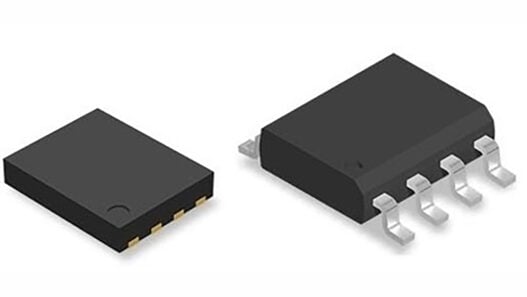
This is where advanced RF front ends make a difference. “More efficient and linear PAs allow the drones to communicate further, and it also can conserve energy and power as efficiency improves. Improved noise figure in the LNAs can help the receiver sensitivity and assure less dropped bits.” Filtering is also critical for rejecting interference in congested environments.
Manufacturers are also using multiple channels for comms links, wider-band PAs that allow frequency hopping, and techniques such as MIMO antennas, and beamforming to improve signal reception.
So how do engineers get the best drone possible without sacrificing power, size or thermal performance? “It becomes a very complex trade space,” Gibson admits. “It really does.”
One approach is to optimise each uplink and downlink channel individually, which improves power efficiency across the whole system. Antenna design is critical, and thermal design is just as demanding: “having good… innovative packaging solutions is a must.”
At the device level, Qorvo’s job is to push for higher efficiency and wider bandwidths, to “really give that systems engineer the flexibility to find the most optimal solution to help them make that trade.”
Beyond drones
Gibson sees three key growth areas for high-performance RF. The first is AI-enabled infrastructure, where distributed edge compute needs high-speed connectivity. The second is satcom, with launch economics “really causing that whole industry to just skyrocket.” The third is defence and tactical comms, “where performance always is king.”
Looking further ahead, she says 6G is shaping the roadmap, with edge compute, ubiquitous connectivity, and integrated sensing and communications all part of it. “Ultimately, what everybody wants is more for less, more performance at less power.”
Future drones will communicate over many more links: terrestrial, satcom, other drones, operators, and ground stations. Because of that complexity, Gibson believes “flexible, configurable, software-defined radios will become an interesting thing to watch for as the industry evolves.”
What’s next
Over the next three to five years, wider-bandwidth PAs are a major focus, and Qorvo has “some great products that’ll be coming out soon in that area.” Gibson also expects better filtering, timing solutions for synchronisation and further gains in LNA noise figure to matter.
Her verdict is simple: “Ultimately, the winning solution will be those that can deliver the best high performance at the lowest power levels.”
Watch the full interview
To hear more from Debbie Gibson, watch the full video interview: DigiKey at electronica 2026 with Qorvo