







Payam Pajoohi, Engineer at PHYTEC, examines how US manufacturers can distribute Physical AI workloads between Edge devices and Cloud infrastructure, and what this means for performance, energy efficiency, and embedded hardware selection.
The computing demands of Physical AI
Physical AI is transforming the way industrial robots and autonomous machinery operate by combining artificial intelligence with sensors and control technologies. Instead of following only predefined instructions, these systems can interpret their environments and adjust their behaviour in response to changing conditions.
As manufacturers introduce more advanced AI capabilities into industrial equipment, the need for Edge computing is also increasing. Deloitte reports that 36% of surveyed organisations had scaled AI at the Edge in 2026, with that figure expected to reach 72% by 2028. For US manufacturers, an important consideration is determining which computing tasks need to happen directly on equipment.
Cloud processing can introduce delays when machines depend on immediate responses, however, moving every workload onto a device is not always practical, given the additional demands on hardware, energy consumption, and thermal management. Manufacturers therefore need to identify where local processing offers a genuine operational advantage.
Identifying which AI workloads should run locally
Physical AI systems perform several interconnected functions, from interpreting sensor data and making decisions to planning movements and controlling machinery. While these processes must work together, they can have different computing requirements and do not always need to run on the same hardware or infrastructure.
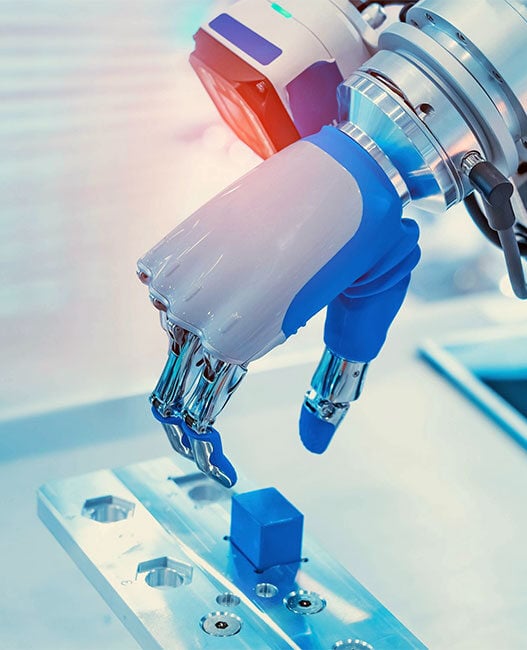
An industrial robot handling components on a production line, for example, may use cameras and AI models to recognise objects and determine their positions. If an object moves unexpectedly, the robot needs to adjust its actions accordingly. Running this processing on the machine itself avoids the delays associated with communicating with a remote server.
The same principle applies to autonomous mobile robots (AMRs), which need to recognise obstacles and navigate environments that may change throughout the day. Local computing is particularly valuable when reliable network access cannot be guaranteed.
Not every function demands this level of responsiveness. Training AI models, examining historical production data, and monitoring equipment across multiple sites can often be managed through centralised systems.
Using a hybrid computing architecture allows manufacturers to retain critical, time-sensitive processing at the Edge while relying on Cloud infrastructure for resource-intensive analysis, model development, and software distribution.
Key considerations for performance and reliability
Latency and predictable response times
For industrial robots, the delay between detecting an event and responding to it can influence both precision and operational reliability. Manufacturers must therefore understand the latency requirements of individual workloads before deciding where their processing should take place.
Moving AI inference onto local hardware can eliminate communication delays associated with remote processing, but this alone does not guarantee faster performance. Overall response time also depends on sensor acquisition, the time required to execute an AI model, and how quickly the system can translate its output into an action.
Predictable timing is equally important for certain industrial functions. Motor control, for instance, may require dedicated real-time processing cores, allowing control operations to run consistently while separate AI processors handle perception and decision-making.
Managing power consumption and thermal demands
Computing performance must also be balanced against the physical limitations of industrial equipment. Mobile robots and compact machines may have limited room for processors, cooling components, and power supplies.
Higher-performance processors can support more complex AI applications, but they may also increase power requirements, heat generation, and hardware expenditure. This makes selecting the appropriate level of computing capacity an important part of system design.
For instance, a straightforward visual inspection application may operate effectively using a low-power AI accelerator. A more advanced robotic system interpreting several camera streams simultaneously could require substantially greater processing resources.
Connectivity and maintaining reliable operations
Network availability is another factor manufacturers need to address when designing Physical AI systems. Industrial equipment cannot always depend on an uninterrupted connection, especially when operating in dynamic environments where decisions must be made immediately.
An autonomous robot that sends obstacle detection data to the Cloud could experience difficulties responding if connectivity is lost. Performing these functions locally removes the dependency on a continuous network connection for that processing, helping the robot maintain operation within its intended safety and performance limits.
Keeping more processing at the Edge can also reduce the volume of data transmitted across networks. Rather than continuously sending raw sensor information to centralised infrastructure, machines can analyse it locally and communicate relevant findings, alerts, or selected data.
Matching processing tasks to embedded hardware
Physical AI applications frequently need to perform several computing functions simultaneously. A robotic system might interpret camera images, exchange information with other equipment, and manage motion control, all while running AI inference.
Instead of assigning every operation to a single processor, manufacturers can distribute workloads across different processing technologies according to their individual strengths.
- Central Processing Units (CPUs): manage general computing tasks, application software, communications, and system coordination. They can also support AI operations where specialised acceleration is unnecessary
- Neural Processing Units (NPUs): provide energy-efficient acceleration for supported AI inference workloads, including object detection and image classification, making them useful in power-constrained applications
- Graphics Processing Units (GPUs): offer parallel processing capabilities for computationally demanding AI models and advanced computer vision, although their memory, cooling, and power requirements may be higher
- Real-time processing cores: handle operations where consistent, predictable execution is essential, such as motor control and sensor coordination
For example, a manufacturing robot could use an NPU to interpret visual data, a CPU to coordinate its overall operation, and a real-time processor to manage movement.
Embedded computing solutions such as System on Modules can integrate these capabilities within a single platform, enabling manufacturers to match processing resources to their equipment’s operational requirements.
Evaluating hardware costs and long-term requirements
The financial implications of embedded computing go beyond the purchase price of processors and associated components. Software development, system integration, electricity consumption, and ongoing support can all contribute to the total cost of deploying Physical AI.
Specifying more powerful hardware than an application requires may increase expenditure without delivering meaningful improvements in performance. At the same time, selecting a processor based solely on its advertised computing capability can overlook other important factors.
Memory capacity, software compatibility, and resource allocation also affect system performance. When AI inference shares hardware resources with other applications, competition for memory or processing capacity can affect responsiveness and reliability.
Manufacturers should also assess the financial trade-offs between local and centralised infrastructure. Applications that operate continuously and require immediate responses may benefit from dedicated Edge hardware, whereas occasional or computationally intensive tasks may be better suited to Cloud resources.
This approach can help businesses avoid installing unnecessarily powerful processors across every device while retaining access to additional computing capacity when required.
Planning for Physical AI implementation
Successful Physical AI deployment depends on understanding computing requirements before committing to a hardware architecture. Decisions made early in development can influence how effectively a system performs, how much energy it consumes, and whether it can accommodate future changes.
Manufacturers should begin by separating workloads that require local execution from those suitable for centralised processing. This provides a foundation for evaluating the processing capacity, latency, memory, power, and cooling requirements of each application.
Hardware should then be tested under realistic operating conditions, rather than assessed solely through individual performance benchmarks. Testing multiple applications simultaneously can reveal resource limitations that may not be apparent when workloads run independently. It’s also important to evaluate how systems behave during network interruptions, particularly where reliable operation depends on local decision-making.
Long-term requirements deserve equal consideration as software updates and changes to AI models may place different demands on processing resources over the equipment’s operational life. Allowing for these developments during hardware selection can help manufacturers avoid unnecessary redesigns.
Building a balanced computing architecture
As Physical AI becomes increasingly important to US manufacturing, choosing where computing takes place will remain a critical design decision. Edge hardware offers the responsiveness and independence required for immediate machine-level operations, while cloud infrastructure continues to provide valuable resources for training, large-scale analysis, and demanding workloads.
Rather than attempting to process everything locally, manufacturers can achieve a more effective balance by matching each workload to the infrastructure and hardware best suited to its requirements.
Understanding those needs from the outset can help businesses develop Physical AI systems that deliver reliable performance without unnecessary expense or technical complexity. As these technologies advance, the efficient allocation of computing resources will be just as important as the processing capabilities themselves.