







Selecting an Edge AI platform now involves more than comparing processor specifications. As AI applications move from Cloud-based development into embedded products, the engineering questions change. Processor performance still matters, but latency, power, and cost depend on the complete system in which inference executes.
Training frameworks, model architectures, and deployment tools have become increasingly accessible, allowing many engineering teams to achieve the required inference accuracy in the Cloud. Yet greater uncertainty begins when the model leaves the development environment. It must then be prepared for the target hardware, integrated with conventional embedded software, and made to execute predictably within fixed memory, power, and thermal constraints.
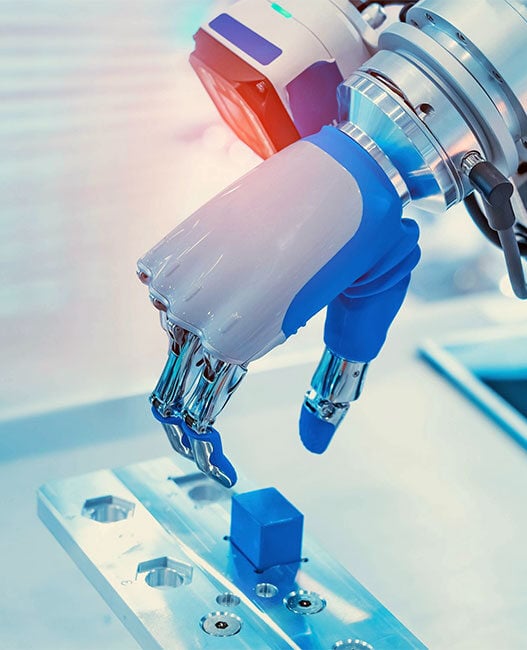
This is particularly important with Physical AI, where systems such as robots, smart cameras, industrial inspection equipment, and autonomous machinery must sense, reason, and act in the real world. Here, inference must work alongside complex sensing, communications, and control, often with its output directly affecting a physical process.
The engineering question is no longer whether the model achieves the required inference accuracy. It is whether the deployed system behaves as expected inside the intended product and operating environment.
Why Physical AI changes the Edge AI problem
Many assumptions made during Cloud-based AI development no longer hold at the Edge. Compute and memory cannot simply be scaled when more performance is needed. The system has to fit within fixed physical and commercial limits, which may include a power envelope below 10W for example, bounded latency, multiple sensor interfaces, and a bill of materials (BoM) cost that remains viable at volume.
The decision between Cloud and local inference becomes part of that system design. Sending data to the Cloud provides access to greater processing resources, but also introduces network dependency and less predictable latency. Local inference supports offline operation, tighter control over data movement, and the rapid response needed for closed-loop control, but places far greater demands on the embedded platform.
Those demands change with the application. A smart camera analysing occupancy has very different timing and safety requirements from a robot adjusting its movement around a person. The processor, sensors, memory, software, and data paths all have to work within the conditions the finished product will encounter. Physical AI therefore cannot be reduced to selecting the accelerator with the highest headline performance.
The deployment wall between models and products
A model that achieves the required inference accuracy is not automatically ready to execute on its target hardware. Before it becomes part of an embedded application, it must be adapted to the capabilities and constraints of the target system.
This forms a second engineering workflow. Unlike model development, deployment adapts the model to a specific hardware platform while preserving its accuracy results. It may involve quantising numerical precision, replacing unsupported operations, compiling for a particular accelerator, and checking that inference remains consistent.
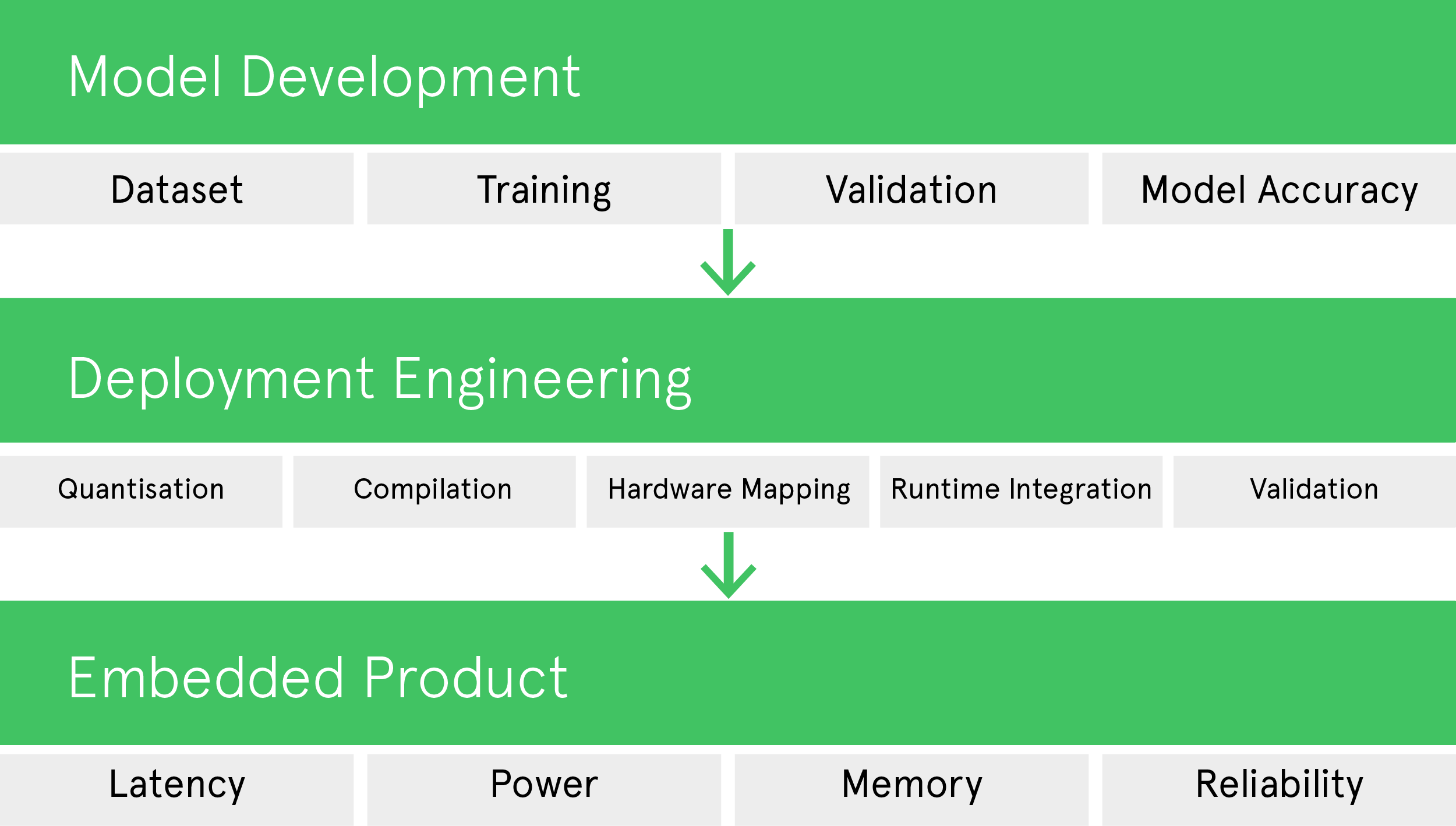
This is the Physical AI deployment wall. Many production problems emerge not from the model, but when the hardware cannot sustain the workload, data does not move efficiently, or integration introduces unexpected latency. The platform must also remain supportable throughout the product lifecycle, particularly in industrial systems expected to operate for many years.
Engineers will usually encounter a power-performance-cost triangle. All three cannot be maximised at once, so the correct balance depends on the application. A battery-powered robot may prioritise frames per second per watt, while a high-volume smart camera may be governed more strongly by unit cost. The right platform is the one that meets those practical priorities, not the one that wins an isolated processor comparison.
Trusted tools and visible deployment decisions
Finding the right balance between power, performance, and cost is only useful if the model can be moved onto the chosen platform without losing the accuracy or predictability achieved during development. This is where the deployment toolchain becomes critical.
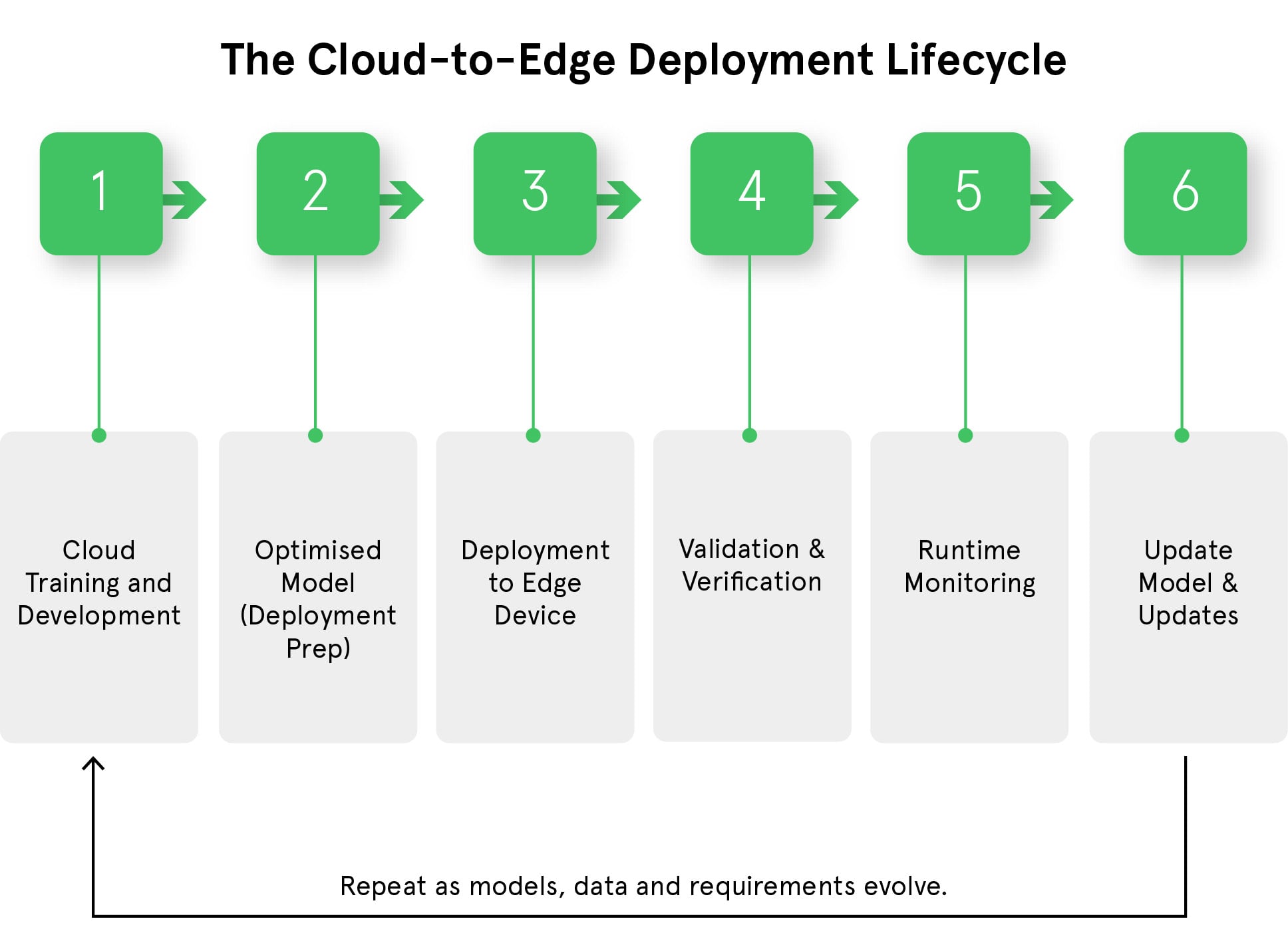
A model developed using 32-bit floating point may need to be quantised to 8-bit integer, adapted to replace operations the accelerator does not support, and then compiled for the target hardware. Critically, these steps can have a significant impact, especially with Physical AI. Quantisation may alter accuracy, while an unsupported layer that falls back to the host CPU can change data movement, increase power consumption, and turn a model that appears to run successfully into one that misses its latency target.
The value of a trusted toolchain is not that it hides this complexity. It allows the engineering team to see what has happened to the model. Accuracy can be compared before and after quantisation, unsupported operations identified, and execution profiled across the CPU and accelerator. If performance changes unexpectedly, the cause can then be traced to a particular conversion, layer, or runtime decision rather than discovered only during final system testing.
That traceability also matters after launch. Models and software will continue to change, and each update may affect performance or resource use. A visible and repeatable deployment process makes it much easier to establish what has changed and what needs to be validated again.
Measure the system the application will use
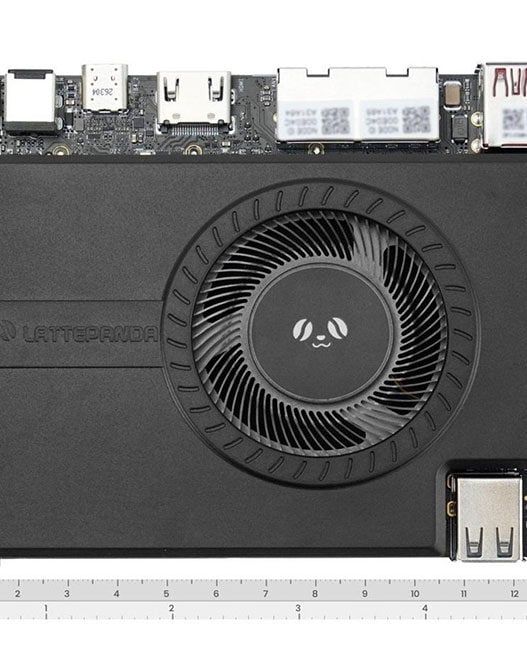
Once the model runs, the next question is whether it runs well enough inside the finished system. Tera operations per second (TOPS) says how much theoretical AI compute is available, but not how quickly sensor data reaches it, how much energy the complete platform consumes, or whether performance holds up across the end-to-end pipeline; data ingestion, pre-processing, inference, and post-processing rather than AI inference in isolation. Avnet Silica’s own testing illustrates the difference. Although the DEEPX DX-M1 and Orin Nano are rated at 25 TOPS and 67 TOPS respectively, across the mix of image-classification and object-detection models used in the comparison, a Raspberry Pi 5 with the DX-M1 averaged approximately 946 frames per second (FPS) at 10.9 W for the complete platform. The Orin Nano in INT8 mode averaged approximately 661 FPS at 19.0 W. That equated to 87.5 FPS/W for the DX-M1 platform and 35.0 FPS/W for the Orin Nano configuration tested.
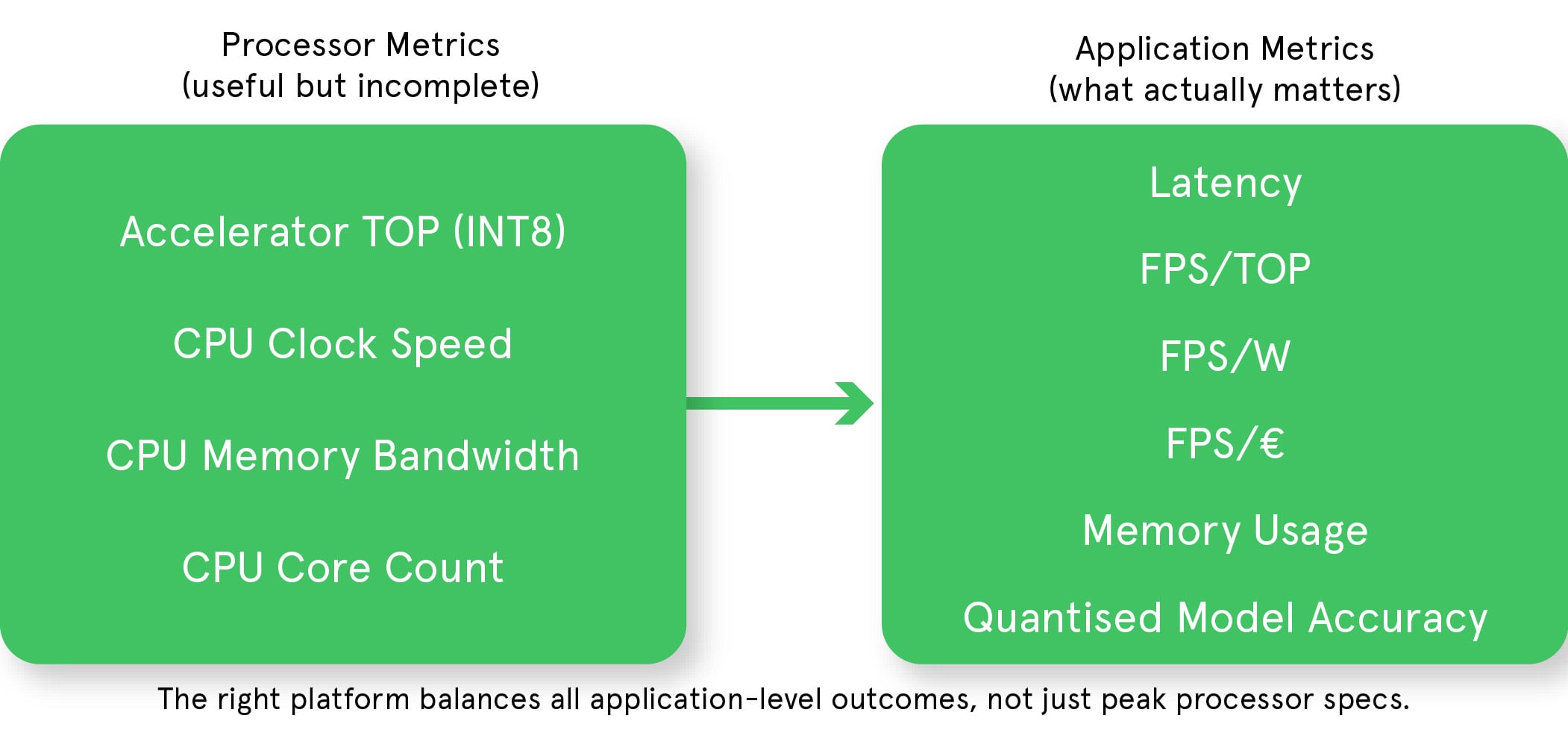
The point is not that one result settles every platform decision. It is that the relationship between throughput and whole-platform power reveals something TOPS cannot. The same applies to cost, memory use, thermal behaviour, and the accuracy retained after quantisation. Each needs to be measured using the models and operating conditions that matter to the application.
Object detection also shows why the workload cannot be reduced to inference alone. The model output still has to be filtered and interpreted before the application can use it. In DEEPX testing with YOLOv5s, post-processing unit (PPU) optimisation reduced the output returned to the host from 8MB to 128KB, cutting the data that must travel across the PCIe interface.
This is where architecture becomes more important than the headline number. The DX-M1 combines three neural processing unit (NPU) cores and 6.75MB of on-chip static RAM memory, LPDDR4X/LPPDR5 support and post-processing unit acceleration. Keeping data and more of the workload close to the accelerator reduces host CPU demand and helps the platform sustain useful performance within its power envelope.
Enablement closes the gap between benchmark and product
In Physical AI, integration problems ultimately show up in how the system behaves. Even a strong benchmark result does not make a platform deployment ready. It may show that the accelerator can run the chosen model at the required throughput and power, but not whether the finished machine can turn sensor input into reliable action within its latency target. That depends on the complete path through sensing, processing, communications, and control, as well as whether the hardware can sustain the workload within the product’s power, thermal, and lifecycle limits. The benchmark is therefore where the wider integration work begins.
This is where Avnet Silica’s role goes beyond supplying the accelerator. Its engineers can help customers evaluate enabled platforms, benchmark candidate hardware, and understand how power, performance, and BoM trade-offs affect the choice. With technologies from suppliers including AMD, DEEPX, NXP, Renesas, and STMicroelectronics, Avnet Silica can compare different routes to deployment rather than steering every workload towards the same architecture. Its wider portfolio across memory, sensing, connectivity, and power also allows those choices to be considered as part of the complete Physical AI system.
That breadth matters most before the architecture is fixed. A memory-bandwidth or thermal limit discovered during platform evaluation can still be addressed by changing the processor, memory arrangement, or wider system design. Once the PCB, enclosure, software, and certification work have been built around those choices, the same discovery may force substantial redesign.
Conclusion: deployment is where Physical AI becomes useful
For Physical AI, a correct inference that arrives too late to influence motion or control has little practical value. Neither does a model that meets its target only on the bench, then throttles, exceeds the product’s power budget, or depends on a connection that cannot be guaranteed in the field.
Deployment is where model capability becomes system capability. By helping engineers understand the trade-offs, test realistic workloads, and resolve the gap between software and hardware, Avnet Silica can help turn Physical AI from a promising model into a product that works reliably in the real world.