





With Meta, Google, and other major players accelerating their AI wearable strategies, one big question remains: at what point will people actually want to buy and wear these devices all day? From smart glasses to AI pendants, the next generation of wearables must overcome fundamental hardware challenges – weight, heat, comfort, battery life, and audio quality – before they can achieve mainstream adoption. Even the most capable AI experience won’t succeed if the device it runs on is bulky, awkward, or runs hot.
I spoke with Mike Housholder, Vice President and General Manager of the Thermal Management Business Unit at xMEMS, about why hardware – not just AI – is becoming the biggest bottleneck for wearable adoption, what needs to happen before AI glasses and other always-on devices go mainstream, and the engineering trade-offs manufacturers are making to fit more processing into increasingly compact devices.

Industry constraints
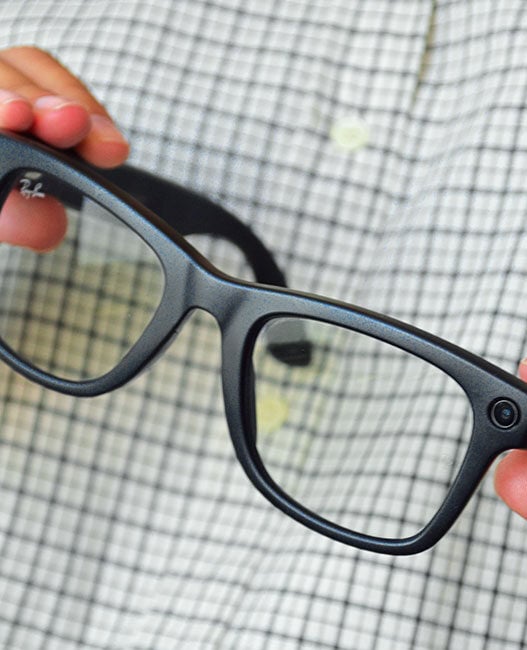
Housholder was clear about where the industry’s real constraint lies: “From a hardware perspective, there are two fundamentals that are really sticking out. One is weight. Basically, the everyday eyeglasses magic number is 30g. You need to weigh under 30g to be comfortable to sit on the bridge of your nose and your ears all day. Most smart glasses are 50g and up.”
Cutting weight starts with the speaker. Replacing a traditional coil-and-magnet driver with a thin MEMS device removes roughly 70-90% of the speaker’s weight while also reducing its thickness, giving designers room to work toward a more fashionable, glasses-like form factor rather than a bulky headset.
The second fundamental is thermal management, and Housholder believes it is the constraint most companies are underestimating. As AI processing shifts from the Cloud to the Edge, glasses are being asked to sense and process continuously rather than run a task and go back to sleep.
“You now have complex chips generating heat, and the glasses sit on your skin all day,” he explained. “So heat mitigation, heat dissipation becomes a big issue, because you don’t want to have a heat generator touching your skin all day. You can’t just spread heat; you have to get it out before it sinks into the plastics and then sinks into your skin.”
Conventional heat-spreading techniques, such as graphite sheets, struggle in this application simply because glasses don’t offer the surface area needed to dissipate heat passively, and conventional fans are too large to fit the mechanical envelope. xMEMS positions its microcooling chips as the smallest active convection solution available for the category, small enough to be designed into a glasses’ temple today.
Housholder expects thermal issues to become far more visible as capability increases. “Glasses kind of start off as audio glasses, and you can do audio effectively without a fan,” he said. “I think it’s really where AI kicks in – where in video recording, going from standard-def to 2K, 4K video, that’s going to be a heat generator. Bringing in displays compounds the problem, but again, AI agents always running in the background – they’ll get to a point where they just can’t spread the heat effectively, and they’re going to need active cooling.”
Audio, power, and thermal are all fighting for the same millimetres
Beyond weight and heat individually, engineers are having to resolve all three constraints – audio, cooling, and power – within the same tightly constrained mechanical envelope. “All of this takes space,” Housholder said. “It’s always going to be the electronics fighting with the mechanical to get to a good form factor.”
That squeeze is intensifying rather than easing. Some glasses manufacturers are now asking for two speakers per side rather than one, doubling a constraint that was already difficult to satisfy with legacy coil-and-magnet components. According to Housholder, this is precisely where MEMS earns its place in the design: smaller footprint, thinner profile, and far greater flexibility in placement.
A roadmap built around the display, not just the processor
xMEMS’ first-generation cooling product is already designed into glasses due to reach the market in 2027. Feedback from early customers on its existing XMC-2400 device prompted the company to develop a smaller variant, the XMC-1200, at around 40% smaller than its predecessor.
The demand didn’t come from the processor side of the glasses, but from the display. “As these augmented reality glasses come out, the display sits in the front of the glasses, and they needed something smaller to basically fit into the mechanical form factor where the display driver and the light engine sits,” Housholder said. Manufacturers can now choose the XMC-1200 to address heat from the display and light engine, or continue using the XMC-2400 for the processor and temple electronics.
What a ‘solved’ pair of AI glasses looks like
Asked what the industry looks like once these constraints are resolved, Housholder starts with comfort rather than capability. “You have glasses that are light enough to wear on your head all day, just like conventional glasses. They have to be comfortable to wear, meaning they can’t heat up the temples of your head. So they’ve got to stay cool, they’ve got to mitigate heat.”
Only once weight and heat are under control does application flexibility follow – glasses capable of persistent, always-on processing that can deliver real-time information about the wearer’s surroundings without becoming uncomfortable to wear.
“I don’t think anyone has really nailed all of the use cases yet. It’s a developing category, so I think everyone’s putting out a product, learning from that product, and putting those learnings into Gen 2, Gen 3,” Housholder notes.
He draws a direct comparison to the smartwatch, a category that took several generations to move from early adopters to broad, mainstream acceptance. In his view, AI glasses are following the same trajectory and are “another generation or two away” from becoming genuinely desirable for the mass market, with AI integration itself acting as the eventual trigger.
However, for AI agents on glasses to be genuinely useful, Housholder argues they need a camera to understand their surroundings – but that raises a challenge that sits outside pure engineering. “How to manage the privacy of that camera, I think is a big challenge that hopefully the best in the industry find a good way to solve,” he said, adding that regulation is likely to play a role alongside technical safeguards.
For now, though, Housholder’s message to the industry is consistent: before AI wearables can win over the mass market, the physical problems have to be solved first. Weight, heat, and audio may not be as visible in a product launch as a new AI feature, but they will ultimately decide whether people are willing to wear these devices all day, every day.