



Agricultural producers often make decisions based on small crop samples, leaving them more exposed to losses and reduced productivity. An autonomous robot equipped with cameras and trained with data collected over four years can move through fields without compacting the soil, providing continuous, close-range information that manual scouting simply can’t match.
An electric, modular robot equipped with sensors, capable of moving non-invasively through orchards and vineyards and detecting crop diseases, is now available to farmers and agricultural producers. The solution, called Orioos, aims to address an issue felt across Europe: an agricultural labour force that is both scarce and ageing.
The technology was developed over four years and can analyse permanent crops and estimate the productivity of a farm by ‘reading’ the flower at an early stage of the harvest cycle. Currently, producers managing large-scale crops can only monitor a small portion of what is planted – and it is from that limited picture that they estimate productivity and allocate resources.
The robotic solution interprets crop conditions through artificial intelligence algorithms trained at one of Portugal’s leading agricultural robotics laboratories, INESC TEC (the Institute for Systems and Computer Engineering, Technology and Science).
Orioos was designed to operate in permanent crops such as orchards, pear trees, and vineyards, providing producers with greater certainty in a context where reliable forecasts are rare.
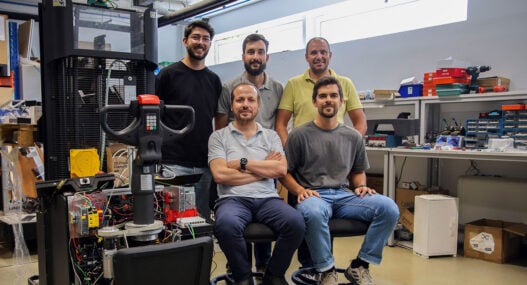
“Instead of having only 10% of the crop manually monitored, we can now monitor vineyards and orchards across their entire area 24/7, through an autonomous process,” explained André Aguiar, researcher at INESC TEC.
This continuous monitoring solution accurately identifies areas showing symptoms of disease, water leaks, or the need for additional nutrients. Although drones also allow agricultural monitoring, Orioos stands out because of the proximity of its analysis and the quality of the information collected. Equipped with several cameras, the robot processes data on board and stores memory and historical records of crop readings.
“We currently have a very extensive database covering different types of crops. We trained AI models capable of identifying crop conditions and detecting disease symptoms. This is possible thanks to the close-range analysis carried out by Orioos. The information we provide to decision-support systems – or directly to producers – has much greater added value,” Aguiar said.
Inside the training pipeline
Speaking exclusively to Electronic Specifier, Aguiar was keen to stress that Orioos isn’t a data-collection unit reliant on the Cloud for its intelligence. Each robot carries two embedded, lightweight compute modules, paired with a rugged smartphone that handles manual and joystick control, the dashboard, and connectivity. Detection and classification – disease symptoms, fruit counting, anomalies – all happen in real time on that on-board hardware, using computer-vision architectures adapted specifically for Edge operation.
“We’re not shipping raw video to the Cloud for inference,” Aguiar told us.
Alongside disease and productivity data, the team has built up an equally significant volume of data around canopy characterisation and vegetation indices – NDVI, LAI, and similar indicators – since canopy vigour monitoring matters just as much to growers as disease detection.
The R&D focus now, Aguiar explained, is on making training more data efficient. Active sample selection is already cutting the volume of data that needs processing by 60-70%, while retaining over 90% of the agronomically relevant signal. A continual learning layer, meanwhile, allows models to update incrementally in the field rather than requiring full retraining cycles.
“The model isn’t trained once centrally and frozen – it keeps adapting from selected on-device observations across different crop conditions,” he said.
Beyond the field: industrial perimeter inspection
Since the technology’s original debut, ViField has evolved it further, and interest has emerged from an unexpected direction. “We have already received requests to test the robot in industrial environments, where monitoring would focus on perimeter inspection,” Aguiar added.
Those enquiries, he clarified, are coming from companies that commercialise perimeter security and surveillance solutions, looking to add Orioos to their portfolio as a mobile complement to fixed CCTV. The pitch is a more sophisticated, moving alternative to static cameras: 360° vision, artificial lighting for day-and-night operation, and instant alerts pushed to a security control centre – positioned as a way to make human operators’ jobs safer and more effective, rather than replace them.
Crucially, adapting the platform for this use case is largely a mission-profile change rather than a hardware redesign. The same sensor stack – 360° vision, low-cost 3D LiDAR, and RTK GNSS for precise patrol routing – simply runs a different perception model and patrol logic tuned for intrusion detection instead of crop scouting.
The economics: coverage, cost, and ROI
For context on the problem Orioos is solving, Aguiar pointed to the economics of manual scouting: fully covering a 10-hectare orchard by hand costs around €3,200 – roughly a week of skilled labour per hectare – which is precisely why most producers only sample under 10% of their land in practice, at a cost of around €320 for that partial, error-prone coverage.
Against drones and satellites, Aguiar was clear that the case for Orioos isn’t about being cheaper per flight. It’s that ground-level, continuous monitoring delivers direct, plant- and fruit-level data at close range, with no recurring per-hectare flight cost. Drones and satellites, by contrast, offer indirect, plant-level-at-best readings, and are constrained by weather, regulation, and revisit frequency.
The pitch to a mid-size operator, he said, comes down to two numbers: 20x faster coverage than manual inspection, and a reduction in monitoring costs of more than 50%, alongside a reported 40-45% productivity uplift from working with full-plot, tree-by-tree data instead of a 10% sample.
What’s next
The team is now focused on adding new features to the solution, which also stands out for being extremely lightweight, reducing agricultural soil compaction. Researchers are currently calibrating the system to estimate fruit weight and quality even before harvest. The goal is for Orioos’ repeated journeys through crop rows to allow more accurate forecasting of expected harvest conditions.
The first prototype emerged in 2022, when INESC TEC researchers dedicated to advanced robotics, automation, and IoT solutions won the EUSPA award in the ‘Best Idea’ category with this permanent crop monitoring and phenotyping solution.
ViField is one of INESC TEC’s six active spin-offs, part of the Portuguese research and technology organisation from which dozens of companies have already emerged. Orioos has already travelled hundreds of kilometres across Portuguese farms, and ViField’s goal is now to expand the technology into the European market.