








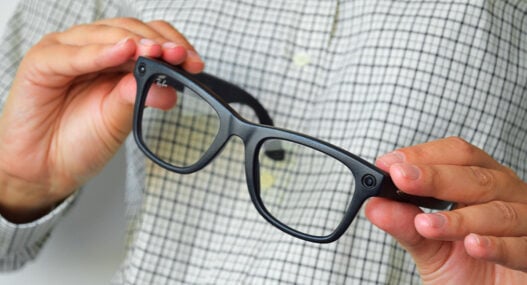
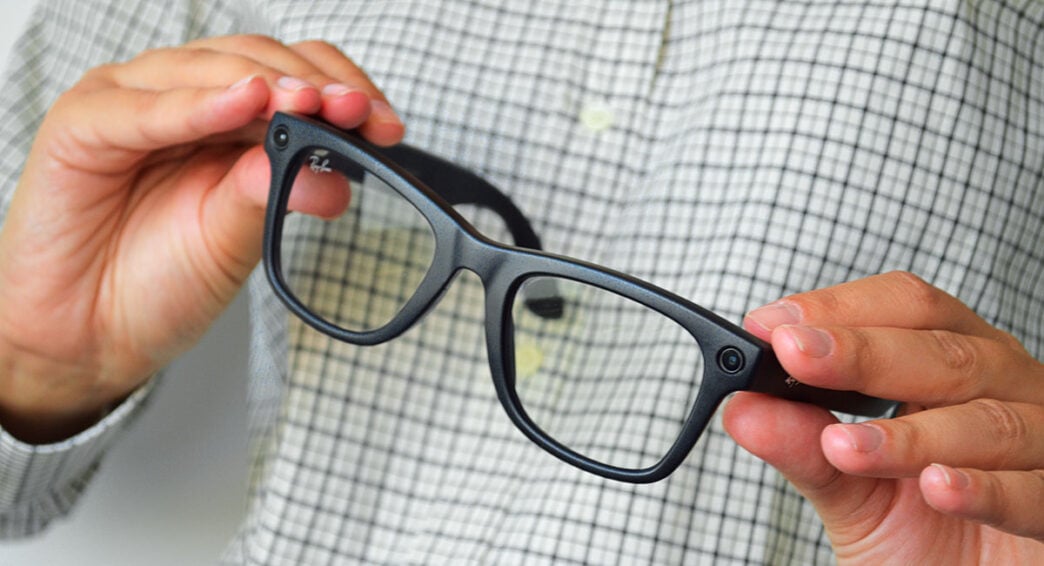
AI glasses have graduated from research curiosity to retail product faster than most wearable categories before them. The engineering that made this transition possible is more complex than the finished form factor suggests. Packing a Bluetooth radio, microphone array, near-ear speaker drivers, a camera module, and an inference accelerator into a frame that weighs less than 50 grams, sits on a human face for hours at a time, and must survive sweat and outdoor conditions is a constraint problem that touches every layer of the signal chain.
This piece looks at the design trade-offs involved in the three subsystems that define the user experience: wireless connectivity, the audio path, and camera integration.
Wireless connectivity: antenna placement near the head
The most immediate difficult aspect of wireless design in eyewear is the antenna environment. A frame worn on the head places the antenna in close proximity to biological tissue with high water content, which attenuates RF signals and shifts antenna resonant frequency in ways that cannot be fully characterised in free-space testing. This is a well-understood problem in hearing aid design, but consumer AI glasses face it with the additional constraint of a Bluetooth audio stack that has significantly higher throughput requirements than the protocols used in medical devices.
Bluetooth Classic and Bluetooth LE Audio handle the link differently. Classic profiles such as A2DP offer higher sustained throughput at the cost of power draw. LE Audio, introduced in the Bluetooth 5.2 specification and detailed in the Bluetooth Core Specification, uses the LC3 codec to achieve comparable audio quality at substantially lower bit rates, reducing both power consumption and the duty cycle demands on the RF front end. For a device where every milliwatt-hour matters, this difference is not marginal.
Antenna placement in a glasses frame is constrained to the temples, where the cross-section available for a radiating element is narrow and the proximity to the skull is closest. Simulated head models, derived from standardised SAM phantom specifications, are essential during antenna development to characterise gain patterns and SAR behaviour, but final tuning typically requires measurement in a cabled or reverberation chamber with a physical phantom.
Engineers working in this space often accept a gain penalty of several dB relative to a free-space reference antenna as a fixed cost of the form factor and design the link budget accordingly.
Co-existence with other radios operating in the 2.4GHz band, including Wi-Fi from nearby devices and the user’s phone, adds another constraint. Some current designs use adaptive frequency hopping more aggressively than a standard implementation would suggest, and a few have moved toward 5GHz Bluetooth operation where permitted, though that introduces its own propagation trade-offs near biological tissue.
The audio subsystem: open-ear acoustics and microphone arrays
The audio path in AI glasses is fundamentally different from in-ear headphones or bone conduction devices, and it rewards a different design approach. Near-ear open-air speakers must couple sound toward the ear canal without a physical seal, which means the acoustic coupling efficiency drops sharply relative to sealed designs. Low-frequency response is the first casualty: without a sealed volume, the bass rolloff is pronounced, and compensating with EQ burns power without recovering real acoustic output.
The practical implication for speaker driver selection is that sensitivity and efficiency matter more than they do in sealed headphone designs. A driver that performs adequately in a conventional headphone may be acoustically insufficient when the geometry between the driver and the ear varies by several millimetres based on how the user wears the frame.
Some designs address this by moving to a wave-guide geometry that channels sound more directionally toward the ear, reducing the sensitivity to positional variation while also reducing the acoustic footprint for nearby listeners.
Microphone placement is the other half of the audio challenge. AI glasses need to capture voice clearly for both call audio and wake-word detection while rejecting wind noise, environmental noise, and any acoustic coupling from the speaker drivers. The standard approach uses a beamforming array of two or more MEMS microphones positioned along the frame, with digital signal processing handling noise suppression and directional filtering in real time.
The DSP load for this is modest by modern SoC standards, but it represents a continuous power draw that must be accounted for in the power budget alongside the Bluetooth radio and, in models with active AI inference, the neural accelerator.
Wind noise in particular is a meaningful problem for glasses worn outdoors, as the frame geometry creates localised turbulence patterns that vary with head angle and movement. Physical wind baffles over the microphone ports help, but the geometry constraints of a glasses frame limit their size and effectiveness.
Algorithmic wind rejection has improved considerably as inference hardware has moved on-chip, and several current platforms use a dedicated lightweight model for wind detection that gates the main noise suppression pipeline selectively.
Camera integration: optics, thermal management, and synchronisation
Adding a camera to a glasses frame introduces a set of challenges that are distinct from those faced by smartphone camera modules despite superficial similarity. The module must fit within the frame cross-section, usually at the bridge or corner, where the available volume is small and the mechanical mounting points are limited.
Image stabilisation, which smartphone cameras address with optical or sensor-shift mechanisms, is generally unavailable in glasses form factors, leaving electronic stabilisation as the primary option. The results are adequate for casual video but impose a processing cost and introduce the latency and artefacts familiar from CDIS implementations on constrained hardware.
Thermal management around the camera and its ISP is closely coupled to the overall frame thermal design. A glasses frame with no active cooling and limited thermal mass relies on conductive spreading through the frame material and convective coupling to ambient air. ISP activity during video capture generates localised heat that, in a poorly designed thermal path, concentrates near the nose bridge or temple contact points. This is uncomfortable for the wearer and can, in sustained recording sessions, trigger thermal throttling of the ISP before the battery is depleted.
Synchronisation between the camera, the AI inference pipeline, and the audio system is a system-level concern that affects the quality of contextual AI features. A glasses assistant that responds to what the camera currently sees needs the inference result to be available within a latency window that feels responsive to the user, typically under 500 milliseconds from trigger to spoken response. This latency budget is divided between image capture, ISP processing, frame transfer, inference, and text-to-speech synthesis.
On-device inference keeps the transfer step local but demands more from the SoC; Cloud offload reduces on-chip compute requirements but introduces network round-trip latency and requires a reliable connection. Most current products handle this with a hybrid approach, running lightweight models on-device for low-latency responses and offloading more computationally intensive tasks to the Cloud when connectivity permits.
Research into efficient on-device visual inference for wearables is covered regularly in IEEE Spectrum‘s engineering coverage, reflecting how active this area of applied AI hardware development has become.
From engineering constraints to consumer product
The finished products that emerge from these design trade-offs now span a range of capability levels, from audio-only frames at the simpler end to fully integrated sunglasses with camera, on-device AI, and multi-microphone arrays at the more capable end. Electronic Specifier‘s wearables coverage tracks the component and platform developments that underpin this category, and the AI analysis section covers the inference hardware and software stack developments that are directly relevant to what ships inside current AI glasses.
The engineering maturity of the category is reflected in how quickly the design constraints that limited earlier generations have been resolved. Battery life that once limited useful operation to two or three hours now extends through a working day.
Antenna performance that required careful de-tuning compensation is now handled more reliably through better phantom-based simulation at the design stage. Audio quality that was clearly inferior to earbuds in early products now meets a bar that most users accept for everyday use.
What remains genuinely difficult is the integration work: making these subsystems co-exist within a frame that must also be comfortable, stylish, and manufacturable at consumer price points. Each constraint on one subsystem ripples through the others, and the system-level design of AI glasses remains a problem where good component selection is necessary but not sufficient.
The products reaching consumers now represent a credible first-generation solution to that problem. The engineering headroom that remains suggests the second and third generations will be considerably more capable.