





Once a specialised tool for data scientists, AI is now thoroughly mainstream, powering everything from search and recommendation engines to autonomous vehicles.
Its evolution has been rapid. And as AI models have grown in size and complexity, so has their need for fast access to data. And that’s where Dynamic Random Access Memory, or DRAM, comes in.
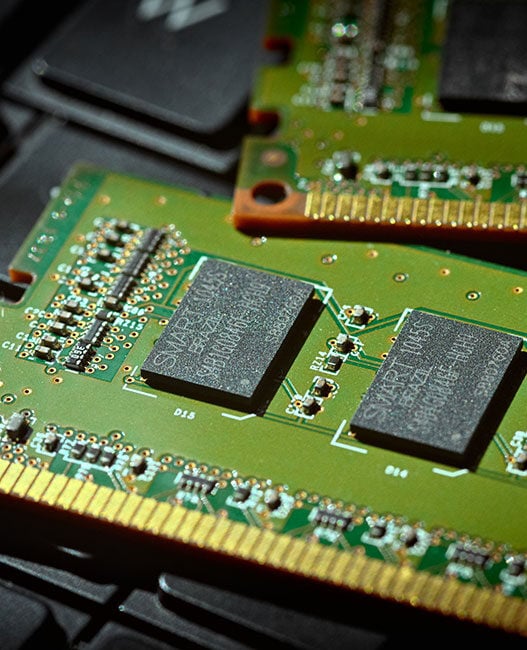
DRAM is essential for moving data quickly between processors and storage – and vital for the high performance required of today’s AI models. Little wonder it’s fast become one of the most sought-after resources of the AI era.
What is DRAM and why does it matter?
Whenever an AI system generates text, analyses information, or makes a prediction, its processor needs to retrieve and manipulate large volumes of data. DRAM provides the working memory necessary to access data at high speed. If that data can’t be supplied quickly enough, AI accelerators end up waiting for memory instead of carrying out computations, reducing overall system performance.
Since high-capacity, high-bandwidth DRAM is essential for keeping AI workloads running efficiently, demand from tech companies and expanding datacentre infrastructure is putting unprecedented pressure on the DRAM market. And that contributes to higher prices and reduced availability for other applications.
Conventional silicon DRAM also brings an energy challenge: to refresh and retain data, it requires constant power, adding significantly to the energy consumption of memory-intensive AI systems.
A new approach: IGZO eDRAM on flexible polyimide
We recently published a paper demonstrating Indium Gallium Zinc Oxide embedded DRAM (IGZO eDRAM) on a flexible polyimide substrate. While it’s not currently a drop-in for silicon DRAM, it provides a compelling approach for a future, more heterogeneous approach to the AI memory problem.
IGZO eDRAM itself is not a new idea. Previous research has shown that IGZO transistors can achieve exceptionally low leakage currents and extended memory retention on conventional rigid substrates.
But our work takes this a step further by demonstrating, for the first time, long-retention IGZO eDRAM on a flexible substrate. This may sound like a small difference, but moving from a rigid foundation to ultra-thin, flexible polyimide unlocks an entirely new value proposition.
• Extended retention periods
Silicon DRAM needs to be refreshed thousands of times per second to maintain stored data. By contrast, the low leakage of IGZO means data can be held for more than 100 seconds without requiring a refresh cycle. And that brings a number of benefits that tackle the main challenges of AI’s memory requirements
• Lower energy consumption
For many Edge applications, including some using machine learning techniques, a retention period of more than 100 seconds is sufficient for a task to be completed without requiring a refresh. But even for applications with a longer execution time, IGZO DRAM refreshes will be less frequent, reducing consumption of energy
• Simpler memory control
When the retention period exceeds the time needed for an application to complete its operation, IGZO eDRAM can effectively function as quasi-static memory. This means dedicated circuitry for managing regular refresh cycles may no longer be necessary, potentially simplifying the system and reducing its overall footprint
• New possibilities for memory manufacturing
By taking high-retention memory beyond conventional rigid silicon, IGZO eDRAM on polyimide expands how and where memory can be fabricated
What’s more, IGZO DRAM cells can be deposited onto silicon wafers as part of back-end-of-line processing – stacking directly on top of an AI chip, to create a substantial last-level cache. This gives the processors fast access to long-retention memory, breaking, helping to address the memory bottleneck that can constrain AI workloads.
Flexible IGZO eDRAM offers a denser, lower-power alternative to SRAM for flexible chips operating under tight energy constraints. Retention times of up to 925 seconds have been demonstrated – orders of magnitude beyond traditional embedded DRAM.
That makes the technology a promising candidate for a range of future applications, including flexible microcontrollers, BLE beacons, tiny Edge ML accelerators, computational RFID, and other energy-harvesting devices.
What does this mean for AI?
AI’s memory demands are unlikely to slow down. Addressing those demands will require innovative approaches to materials, architectures, and manufacturing. Our work demonstrates one potential direction.
We have shown that advanced memory can be made efficiently, with alternative form factors and manufacturing routes. IGZO eDRAM, or IGZO DRAM deposition during BEOL processing, is not yet a direct replacement for conventional silicon DRAM, but it presages a wider and more diverse memory ecosystem.
Our innovation demonstrates that the future of memory may lie not in making more of the same, but in finding new ways to make it.