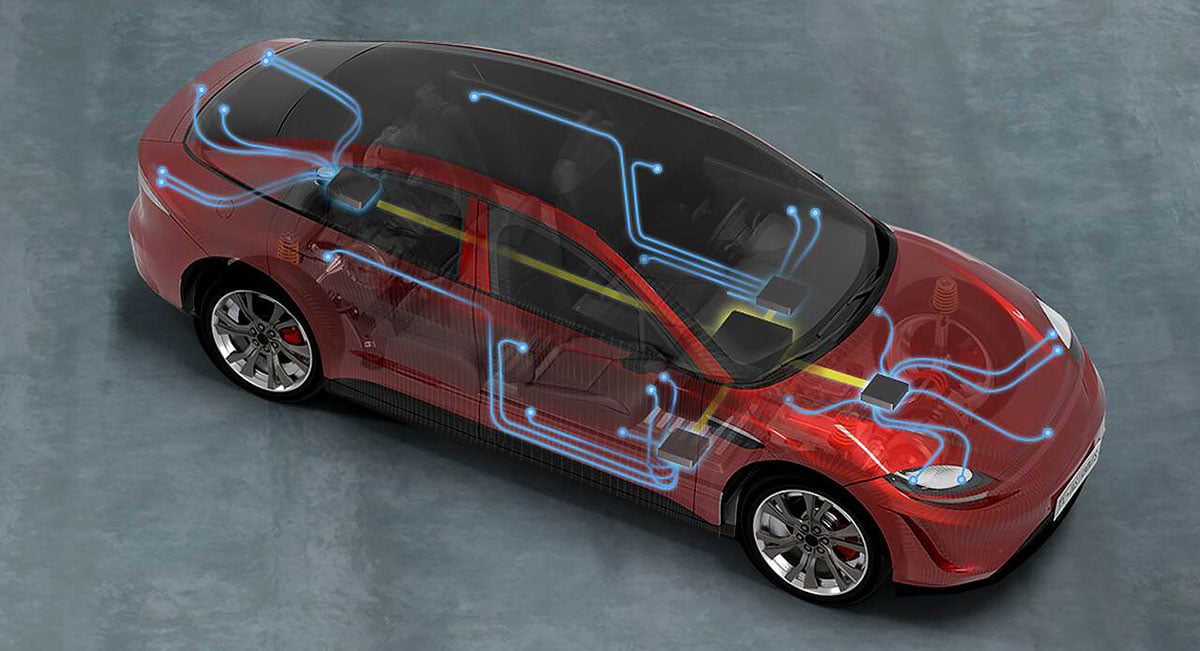



In Part two of this series, we turn to a different but equally critical layer of automotive design: how cars sense, time, and interpret the world around them.
From BAW clocks synchronising ADAS and infotainment systems to ambient light sensors, lidar, and laser-driver technology extending a vehicle’s perception beyond the driver’s own senses, this instalment looks at the semiconductor building blocks enabling safer, more autonomous, and more responsive vehicles – plus a look at how audio innovation is adding another dimension to the in-cabin experience.
Beyond quartz: How BAW clocks are redefining ADAS and IVI
In the journey toward more autonomous zone architectures, software-driven decision-making requires precise timing and reliable clocking circuits. From advanced driver assistance systems (ADAS) to in-vehicle infotainment (IVI) and high-speed data networks, automakers are implementing the Peripheral Component Interconnect Express (PCIe) 6.0 specification, Gigabit Ethernet, and serializers and deserializers (SerDes) to improve safety and enhance the driving experience. At the heart of these connected systems is the bulk acoustic wave (BAW) clock, beating with precise timing like a heartbeat, synchronising vehicle subsystems.
Read more in this technical article.
How intelligent sensors expand our detection of light
Our eyes constantly interpret the world around us, perceiving a spectrum of colours and adapting to various situations. In the same way that our eyes provide signals to our brain, ambient light sensors precisely measure lighting conditions in an environment and provides lux reading to a system. Light sensing technology continues to improve the way we see things – as well as what we can’t see.
Discover more in this technical article.
Light sensors
Our optical light sensors with integrated photo sensor and passive filters offer excellent spectral matching, low power and configurable conversion times. These products support a wide dynamic range with semi-logarithmic output and an auto-ranging feature to ensure exceptional performance in all lighting conditions. Applications of these products range across industrial, automotive and personal electronic markets.
Lidar leaps forward: Enabling safer vehicles with precise, long-range detection
Humans have been driving vehicles for over a hundred years, with a less than stellar safety record. While vehicles are safer now than they have ever been, automotive accidents and fatalities have been increasing in many regions of the world. This trend can be attributed, in part, to the increasing number of distractions confronting drivers.
Read more in this technical article.
An Introduction to Automotive Lidar
Lidar, which means light detection and ranging but is sometimes called time of flight (ToF), laser scanning or laser radar – is a sensing method that detects objects and maps their distances. The technology works by illuminating a target with an optical pulse and measuring the characteristics of the reflected return signal. The width of the optical pulse can range from a few nanoseconds to several microseconds.
Find out more in this dedicated whitepaper.
Transconductance amplifiers & laser drivers
Our portfolio of transconductance amplifiers and laser drivers comprises products with wide bandwidths and high slew rates, perfect for optical modules, laser drivers, active filters, sample-and-hold circuits and more. With options for pulsed and continuous operation, our high-output-current devices can drive a wide range of output loads.
Looking for the future of autonomous driving? It’s in your car today
Discover how today’s semiconductors are powering the current and future landscape of autonomous driving.
Beyond sound: How semiconductor innovation is transforming audio experiences
Audio makes our lives richer, more personal, and even safer. When you add semiconductors, what’s possible?
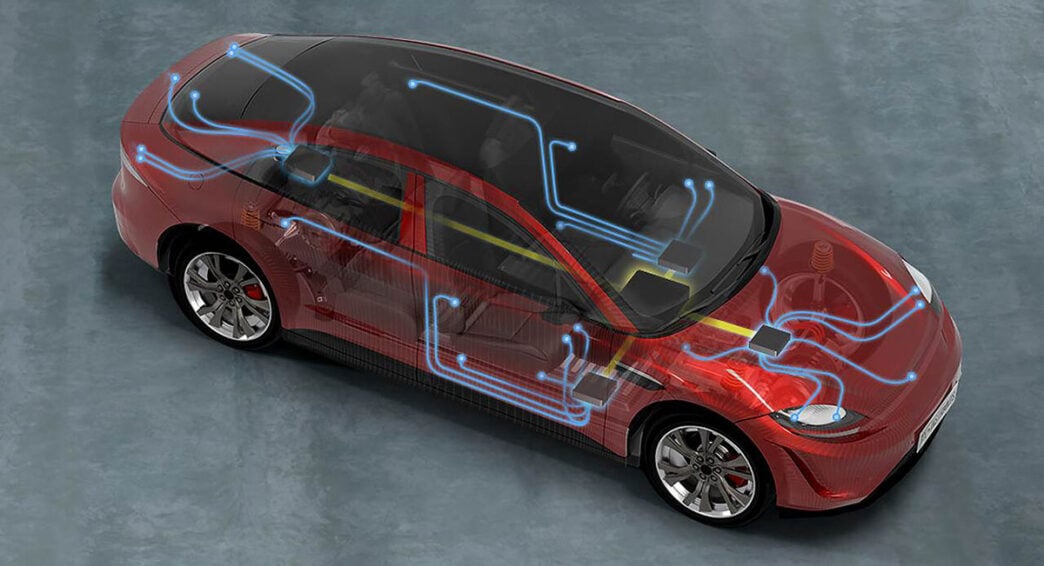
Together, these technologies point to a vehicle that senses more, reacts faster, and communicates more precisely than ever before – whether that’s through a clock keeping subsystems in perfect sync, a sensor reading the light around it, or a lidar system mapping the road ahead. As automotive architectures continue to evolve toward greater autonomy, the semiconductors underpinning timing, sensing, and audio will only become more central to how vehicles perceive and respond to their environment.