

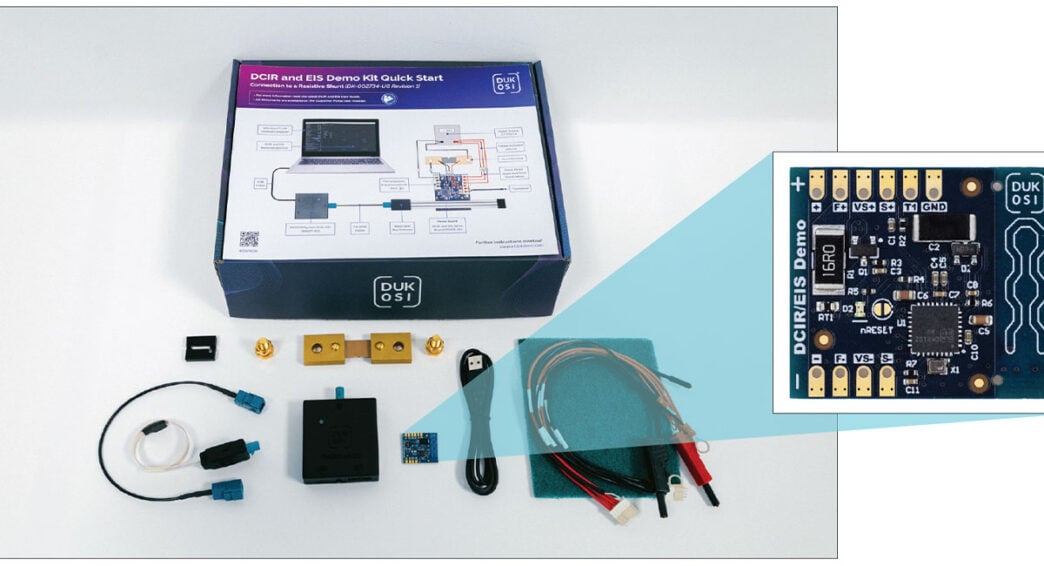
Edinburgh-based battery monitoring company Dukosi has released an evaluation kit that lets developers take two kinds of diagnostic measurement directly on individual lithium-ion cells: DC internal resistance (DCIR) and electrochemical impedance spectroscopy (EIS). Until now, both have mostly needed dedicated laboratory equipment.
The kit is aimed at companies across the battery supply chain. Dukosi said it lets them test its “Smart Cell” chip-on-cell technology and start designing it into production packs. The company said the measurements need no extra software or calibration.
DCIR measures how much a cell resists the flow of current. It is a key input when a battery management system (BMS) works out how much power a pack can safely deliver. EIS sends signals across a range of frequencies to build a more detailed picture of the electrochemical changes inside a cell as it ages.
Dukosi said its DCIR tests run considerably faster than rival systems, giving the BMS a near-real-time view of conditions inside each cell, though it did not give comparative figures. The company’s cell monitors already report per-cell voltage and surface temperature from an on-die sensor. Dukosi said combining these readings allows more accurate estimates of available power and more detailed thermal modelling.
For EIS, developers can run a full frequency sweep from 0.1 Hz to 3.5 kHz, or pick specific frequencies to shorten test times. Dukosi said customers who benchmarked the system against several competing products found it was the most accurate and ran 15 to 20 times faster. These results have not been independently verified.
The company argues that tracking the State of Health (SoH) of each cell, rather than of the battery as a whole, could support predictive maintenance and help catch faulty cells early. It could also add value to cells headed for second-life use.
“We’re building on that foundation with industry-leading, cell-level DCIR and EIS measurements that bring insights previously available only from high-end lab equipment directly into production-spec batteries,” said Joseph Notaro, Dukosi’s President. He was referring to the company’s existing cell monitoring products and its proprietary C-SynQ communication protocol.
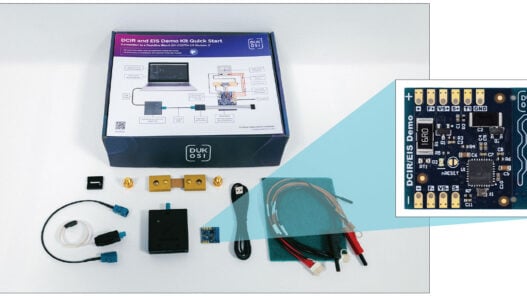
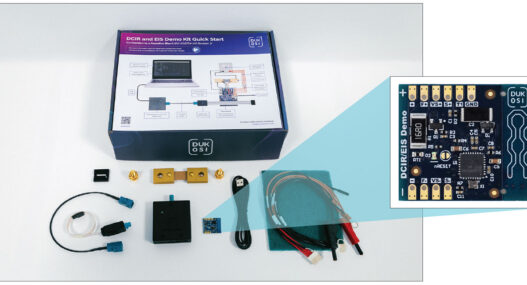
The kit includes a Cell Monitor board, which is needed for each cell under test, and a System Hub that can connect up to 216 boards. Developers can link several boards together to simulate a full pack. It also comes with the cables needed to test with either a power supply or live cells, and graphical software that shows a “digital twin” of the setup and switches between DCIR and EIS tests without rewiring.
Dukosi is targeting electric vehicles, industrial and marine systems, robotics, and grid-scale energy storage, including storage for AI data centres.
The company showed the kit at the electronica trade fair in Munich on 10–13 November, along with a battery passport demonstrator it built with STMicroelectronics.