


For much of the digital era, we have measured innovation in familiar terms: faster processing, greater automation, more data, and greater scale. Those things matter. But as technology becomes increasingly woven into how we think, work, care for ourselves, move around cities, and tackle environmental challenges, another question is becoming harder to ignore: what does technology enable people and communities to do?
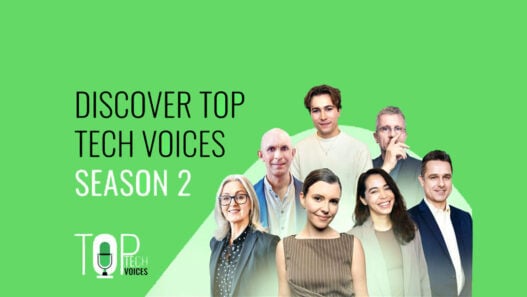
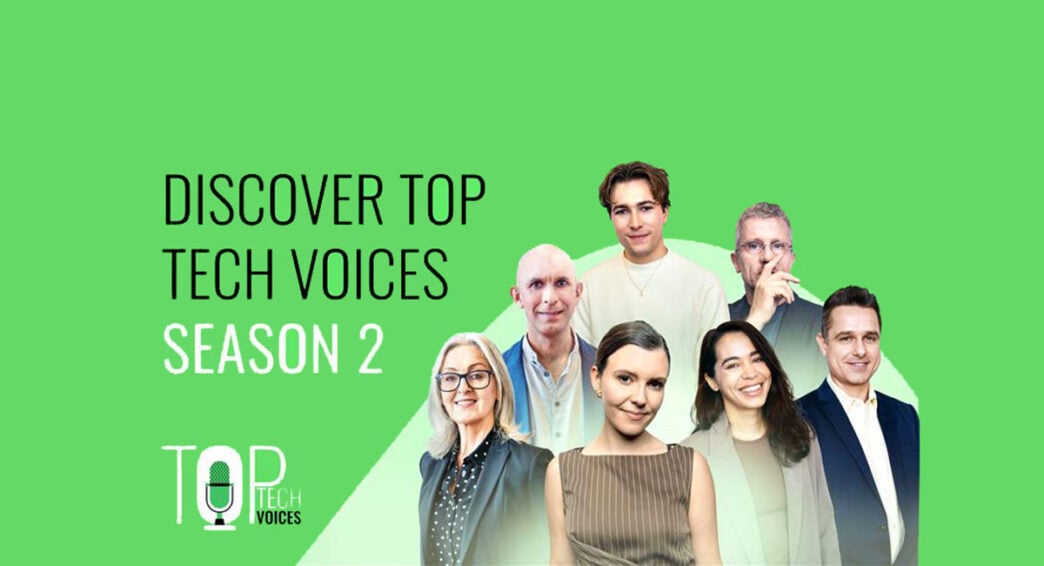
That question ran through the second season of Top Tech Voices, Farnell’s expert-led podcast series. Hosted by Georgia Lewis-Anderson, the six-episode season brought together experts from neuroscience, health technology, sustainable innovation, and urban design.
The subjects ranged from digital wellbeing and neurotechnology to microplastic removal, AI-assisted thinking, healthspan, and responsive cities. Yet a clear theme emerged: technology is at its best when it does more than make a process quicker or cheaper. It should give people more agency, support healthier choices, build trust, and help address the problems that genuinely matter.
The strong global response to the series suggests that this is not an abstract debate. People increasingly want to know not only what technology can do, but how it should be used.
Start with real people
Human-centred technology starts with a simple observation: people are not machines.
Digital tools can make information easier to access, reduce routine work, and help people stay connected. They can also take something away. In his Top Tech Voices discussion on mental health and technology, neuroscientist, author, and broadcaster Dr Jack Lewis explored how excessive screen time can crowd out movement, uninterrupted thought, and face-to-face contact – activities that support cognitive health and resilience.
That is not an argument for switching off technology or wishing for a pre-digital world. It is an argument for using it with more care.
A system can be technically seamless while still leaving people distracted, overloaded, or oddly disconnected. Equally, the right tool can remove unnecessary admin, make it easier to focus and free up time for better conversations and decisions.
The difference often comes down to the assumptions made at the design stage. Too many services are built for an imaginary user who is always available, always motivated, and happy to manage an endless stream of alerts. Real life is less tidy. People have competing priorities, fluctuating energy, limited attention, and very different circumstances.
Technology that overlooks this may scale rapidly. That does not necessarily mean it improves anyone’s day.
Keep people in the loop
The same is true, perhaps even more so, with AI and neurotechnology.
Professor Anil Seth, a cognitive and computational neuroscientist, challenges simplistic ideas about how the brain processes reality. Human perception is not a passive recording of the world. The brain combines sensory signals with prediction and experience to interpret what is happening.
That helps explain why two people can see the same situation differently. It is also a useful reminder for anyone designing systems that influence decisions.
If human judgement is contextual, shaped by experience, and inherently varied, replacing it wholesale with AI raises important questions about what could be lost. We could end up with what Seth describes as a kind of “mental monoculture”: systems that reward standard answers, flatten difference, and leave less room for challenge, imagination, and productive disagreement.
The more promising role for AI is as a partner in thinking. It can help identify patterns, structure information, and offer starting points. But it should not make human judgement redundant, nor should it obscure who remains responsible for a decision.
Dr Anne-Laure Le Cunff, a neuroscientist and founder, offers a helpful way of thinking about this. Her approach centres on “tiny experiments”: small, repeatable actions that allow people to test an idea, learn from the outcome, and adapt. It is a useful antidote to the pressure to make every decision a grand, irreversible commitment.
Used well, AI can support that process. It can prompt curiosity and make it easier to explore possibilities. The final judgement, though, should still belong to people.
For technology leaders, the question is not just, ‘Can this system make the decision?’ It is also, ‘What might it miss?’ ‘Whose perspective could be lost?’ and ‘Who is accountable when it gets things wrong?’
Design for lasting change
There is another lesson here: information alone does not change behaviour.
Health technology has made it easier than ever to track sleep, exercise, nutrition, and countless other measures. But more data does not automatically mean better health. A stream of notifications and scores can be motivating for one person and exhausting for another.
Dr Julia Jones, a neuroscientist, former Olympic psychologist, and healthtech founder, argues for a more grounded view of health technology. Rather than treating wellbeing as a relentless exercise in self-optimisation, the focus can shift towards healthspan: helping people spend more of their lives in good health.
That means recognising how change really happens. Sustainable habits are built through repetition, time, and environments that make better choices easier. They are rarely created by guilt, willpower, or a dashboard full of red flags.
This matters far beyond health apps. Whether an organisation is designing workplace software, a consumer service or a connected product, it should consider the behaviours it reinforces. Does the technology make people feel capable, or constantly monitored? Does it create space for focus and recovery? Does it help people take practical action, or simply give them more information to process?
The aim should not be to use technology to perfect people. It should be to make progress more achievable in the messy, complicated reality of everyday life.
Make scale meaningful
The impact of technology is not limited to individual users. It can reshape the environmental and civic systems around us.
Environmental innovator and inventor Fionn Ferreira’s work on microplastic removal is a good example of innovation beginning with a real-world problem. After seeing pollution along the West Cork coast, he started experimenting with ways to analyse and remove microplastics from water. With limited access to laboratory equipment, he built his own setup, including a spectrometer made from a Raspberry Pi, webcam, and LEGO.
The detail is memorable because it illustrates how innovation can begin: with close observation, practical experimentation, and a willingness to keep refining an idea before the solution is complete.
Ferreira’s work also highlights the challenge that follows a breakthrough: scaling it. A promising prototype alone will not solve an environmental problem. Turning it into a usable, widely deployed solution requires collaboration, clear communication, and the ability to earn the trust of partners, funders, and communities.
Architect and MIT Professor Carlo Ratti’s work on smart cities raises a similar point at a much larger scale. Sensors, data, and responsive systems could help cities deal more effectively with floods, mobility, green space, and public services. Yet gathering data is not the same as creating a better place to live.
Cities need good information, but they also need public trust in how that information is collected and used. People should be able to understand what data is collected, why it is collected, and how it is protected. Technology should help make urban life more responsive without making it feel more intrusive.
It is equally important not to lose sight of the role of public space. The best cities are not simply efficient systems. They are places where people meet, spend time, and feel part of something shared. Technology should support that civic life, not quietly erode it.
A better measure of progress
Taken together, these conversations suggest a broader way of thinking about technological progress. The measure should not simply be what a technology can achieve, but what it enables people and communities to do. That means considering whether technology:
- Strengthens agency – helping people make better-informed choices rather than quietly removing their ability to choose
- Respects human limits – recognising our attention, health, motivation, and need for connection
- Earns trust – through transparency, meaningful privacy protections, and clear accountability
- Creates lasting value – looking beyond the pilot, launch, or short-term efficiency gain to ask whether a technology improves outcomes over time
This is a tougher test than efficiency alone. It is also a more durable one.
Technology will continue to become more capable. The opportunity now is to be equally thoughtful about how that capability is applied – ensuring it broadens opportunity, supports curiosity, and helps people, communities, and the planet thrive.
The next measure of technological progress may be simple: not just what technology can do, but what it enables people to do better.
Explore the conversations behind these ideas in Farnell’s Top Tech Voices Season Two. Watch the full series on Farnell’s YouTube channel.