


At Pretzl Connect 2026 in Budapest, one question was put to five industry voices: how far can the Edge go? Their answer was “very far” – but how far depends on power, cost, and who gets to make the decision.
Edge computing has spent years being described as the next big shift. Now, with AI workloads multiplying and Cloud bills climbing, the question is no longer whether intelligence moves closer to the data source, but how much of it can realistically live there.
I sat down with representatives from across the value chain – from component and power semiconductor makers to battery monitoring specialists, test and measurement, and wireless SoCs – to find out where they see the limits.
First, what is the Edge?
Ask five people to define the Edge and you will get five different answers.
For Fabrizio Petris, Senior Strategic Marketing Manager, Aratas, it is “the boundary between the digital processing and the action.” A smart sensor reacts to what it senses: “there is a process and a decision made on what the sensor is detecting.”
Tamas Daranyi, Product Marketing Manager, AI & ML, Silicon Labs, who spent several years in the Cloud industry, offered a more pragmatic view. “For those guys, everything is Edge that is outside of the Cloud, even if it’s a super powerful multi-core server in a huge rack.” His own distinction is about abstraction. “In the Cloud, depending on how much money you want to spend, you have an infinite amount of compute on virtual machines. At the Edge, you need to deal with real physical hardware.” That spans everything from local data centres down to “the tiny MCU devices that we are actually manufacturing.”
Rudy Sengupta, Senior Vice President, Chief Technology and AI Officer, Emerson Test & Measurement described “a really broad dynamic range”. In Emerson’s oil and gas applications, he talks about the field as “the Edge of the Edge – where the analogue and digital world really meets”, and where resources are tightly constrained.
Joseph Notaro, President, Dukosi agreed it is a continuum, but suggested starting from the function rather than the location. “What functions need to be performed near the end use, or near the load? Something mission-critical, time-critical – you want that close. Something where you want more data analysis, maybe maintenance, you could do that in the Cloud.”
Compute is coming closer to the data
For Daranyi, the direction of travel is clear. “We see a global trend in the industry: there is more and more compute coming down to the Edge – and the Edge means the closest to the data source.”
The reasons, he explained, are both technical and commercial. “The system must be real-time, the system must answer immediately – it’s a mission-critical thing. There could be constraints in the bandwidth, or the device must operate offline.”
Privacy is another driver, and not only for consumers. “In a consumer good, you do not want to have your data being uploaded anywhere. But also the IP – intellectual property security. You do not want to have your industrial data being uploaded anywhere, so you must process the data on the Edge.”
Sometimes there is simply no choice. In agriculture and smart city deployments built on long-range, low-power radio links, Daranyi noted, “you’re just not able to upload that much data with that simple radio protocol.” In some industrial environments, the data is so dense and so high-frequency that no protocol could carry it all. “So you must process it on the Edge.”
Sengupta sees the same pull from customers. “They’re needing us to provide more compute capability, more sensing, higher bandwidth communications.”
Power is the hidden cost of data
Every bit processed has to be powered, and that is where Filippo Scrimizzi, Regional System Application Director at Nexperia, focused. His team works on system applications and reference designs built around wide bandgap technologies – silicon carbide and gallium nitride – as well as silicon itself.
“The huge amount of data that has to be managed is an indirect cost – an indirect cost that the analysts agree can affect the trend of the market in this area in the near future,” he said.
The semiconductor maker’s contribution, in his view, runs the length of the power chain: “From the medium voltage transformer up to the final main board for the CPU, DDR, and graphics processors.” As processors switch dynamically between workloads, the demand is for higher power delivery with a faster response. “This will be translated into a huge amount of current that has to be managed.”
Today, those multiphase buck converter architectures are handled by smart power stages. Scrimizzi believes the next step is GaN. “Because of the fast switching frequency, the capability to go faster will imply high power density per area – making the solution smaller, lighter, and consuming less energy, and once again affecting the final cost of the solution.”
Storage is becoming part of that chain too. Scrimizzi described battery and UPS units increasingly integrated into data centre power architectures, requiring fast, bidirectional energy transfer while holding the input voltage within a tight range for the resonant topologies that follow. “At the end of the day, everything is cost,” he said. “If you are efficient and very well controlled in the constrained space that you have, that will be cost saving, and efficient end to end.”
Aratas is tackling the same problem from the component side. Alongside its work on sensing, Petris said the company is focused on “dependable power products that can provide the power the system needs,” and on thermal management, “to reduce the heat inside UPS and data centres as much as possible.”
As power density rises, so does the heat. Petris said Aratas is working on components with very low contact resistance, as well as cold plates and microchannel cooling, where the material can change from copper to steel depending on the coolant used.
Intelligence at the sensor and the cell
For some, the Edge is already the sensor itself. Petris explained that Aratas is working to “expand embedded intelligence in sensors” – putting more intelligence into sensing “to elaborate the data as much as possible and send to the Cloud only what is necessary. So with our action, we can be very close to the Edge.”
He gave the example of face recognition software embedded in a camera module. Sending every image to the Cloud means “a lot of data, a lot of addressing, so a lot of cost as well.” Process the image inside the sensor, and only the result leaves the device – a count of people in a shop, say, or an estimate of their age and gender. “It’s GDPR friendly,” he said. “You work on the Cloud only on the value of the data, not on the process.” Aratas is applying the same idea to other sensors, such as detecting whether a person in care has fallen and raising an alarm.
Dukosi works even further down the stack, monitoring individual battery cells. “Definitely the Edge could go very far,” said Notaro. “We have the technology; we have the semiconductor technology knowledge to bring it to the extreme. There’s a lot of processing at the Edge, like we do on cell monitoring for battery cells.”
Cell-level monitoring is a clear local use case – measure voltage and temperature, and trigger an action if a threshold is crossed. But Notaro sees the Cloud closing the loop. Analytics on impedance and internal resistance can be shared upwards. “Now you have big data. You have 100 cells in one pack, you have one million vehicles on the road. I start looking at trends in the data, and that data helps me improve my estimation models.” Those models can then be updated in the field, and the insights fed back into manufacturing.
Daranyi added that energy budgets make local processing a necessity in wireless designs. “Especially in the radio space, if you transmit, that’s a lot of battery consumption each and every time. While you can process the data right there on the Edge device, you can save a lot of battery life, just sending only the really necessary data – or the result of the inference.”
Regulation and security
For Sengupta, regulation is another constraint that drives innovation. Emerson deploys equipment into hazardous locations with strict certification requirements. “You’re putting very sensitive, very high-end measurement capability inside a high-vibration, explosion-proof scenario,” he said. “We had to innovate to be able to survive in that environment.”
He expects new challenges as more wireless technology enters spaces that have not had it before. “If you’ve got a whole bunch of radios at the bottom of a launch pad that didn’t used to have a bunch of EMF and RF before, that starts interfering with other communications.” Cybersecurity and EMF certifications will become a bigger consideration, and regulators will need to catch up with what vendors are putting into these environments.
On security, the EU’s Cyber Resilience Act (CRA) was front of mind. Silicon Labs is taking it “very seriously,” said Daranyi, with a dedicated action group. “I think it’s inevitable to have some regulation in this space.”
Sengupta called the CRA “a really important regulation” that he expects to spread beyond Europe. “We’ve never really put CE marks on software before, but we will going forward because of the CRA.” More importantly, it pushes a secure-by-design approach, “thinking about security and data privacy right at the conception of the product itself,” followed by penetration testing – including using large language models to attack your own systems. Emerson’s own AI agent, Nigel, was designed so that it “never transmits customer data out to the Cloud,” and large language models are never trained on it.
Notaro was less convinced that consumers are paying attention. “There’s a lot of awareness in B2B because of the business environment. I think it’s lacking today with the consumer.”
So, how far can it go?
The consensus: very far, and further still. “There are more and more applications,” said Daranyi. “We see more and more companies, also in our competition, releasing way more powerful devices.”
Sengupta said Emerson is “excited to continue to deal with those constraints and innovate and meet [customers’] more complex needs.”
He expects AI to fade into the background, much as the Internet has. “Today nobody’s asking how you are using the Internet,” he said. “It’s like walking into a room and assuming that there’s a light switch. You just assume that there’s electricity in the room. It’ll be like that.”
Notaro cautioned that there will be no single answer. “There’s a good space between full Edge and full Cloud. It’s going to be determined by the functions, what you want to achieve, and the impact of that decision. Efficiency is important, but so is data bandwidth and the cost of sending data. It’s definitely not one size fits all.”
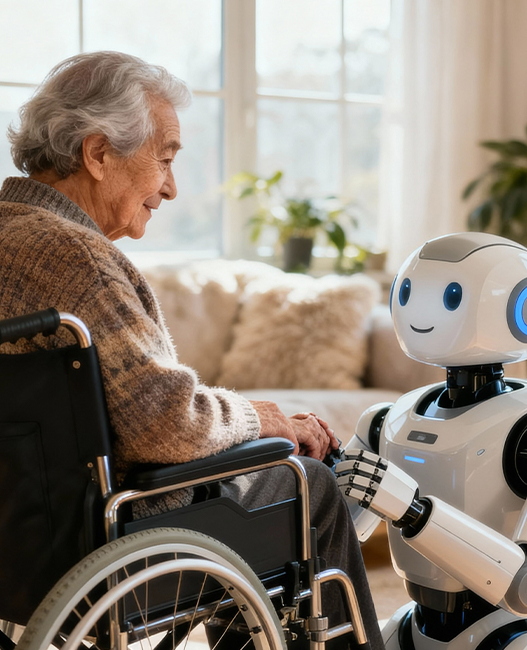
Petris’s advice was to “try to be close to the Edge and close to the action as much as possible.” And for anyone imagining science-fiction robots that learn continuously and work among us, Daranyi offered a reality check: that is still “pretty far” off.
Perhaps the simplest summary came from Daranyi. “Holistically, how far can tech go is really about two simple things: how much compute we can squeeze into a given tiny form factor at a reasonable price – and how we can power that. Those are the two key principles.”