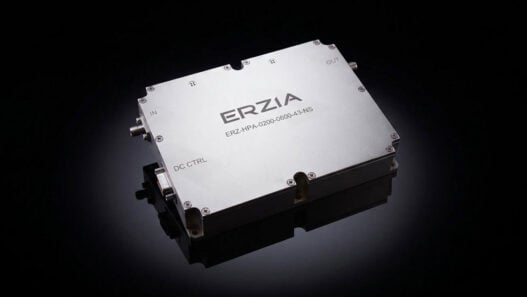


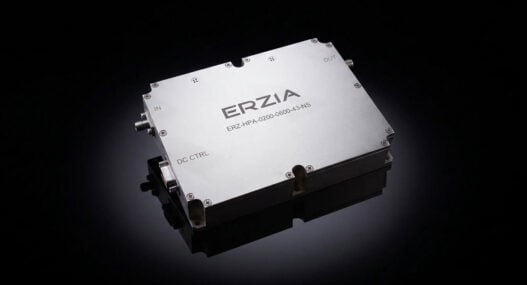
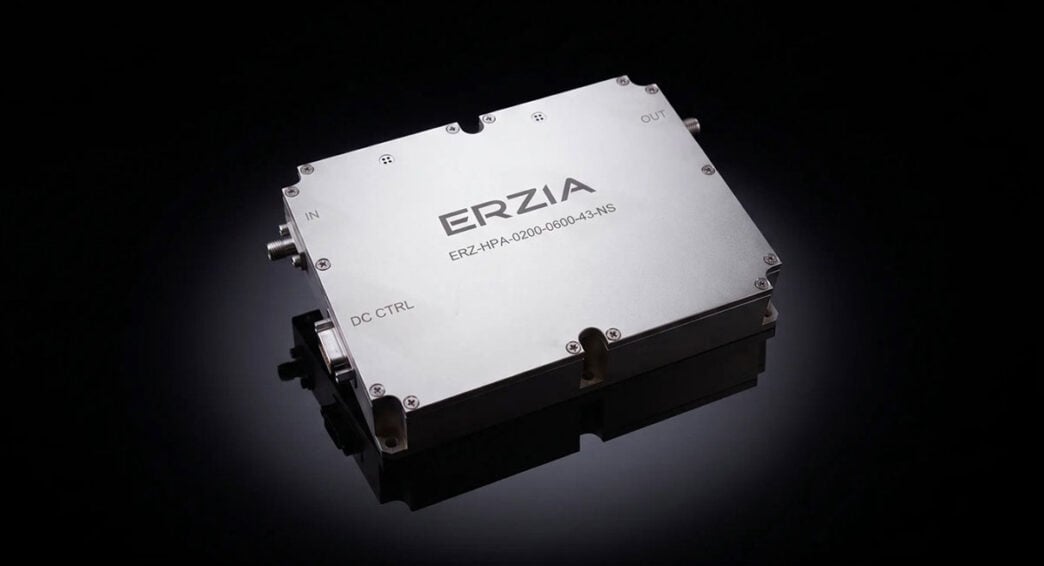
ERZIA has announced an upgrade of the environmental ratings across its entire New Space (-NS) amplifier line. The -NS line was introduced with the same MIL-STD-810 environmental specifications as ERZIA’s commercial off-the-shelf (COTS) amplifiers, already a robust baseline proven in hi-rel applications. Launched in September 2025 with 13 amplifiers, the line has since grown to 20 and will continue to expand. Qualification test data now show that -NS amplifiers withstand significantly more severe levels, and the datasheets of all 20 -NS amplifiers, 10 high-power amplifiers (HPAs) and 10 low-noise amplifiers (LNAs), have been raised accordingly.
The increase is substantial. Random vibration rises from 8g RMS to 23.5g RMS for three minutes per axis, almost three times the original rating; quasi-static acceleration rises from 15 to 25g; and shock, previously specified as a 20g, 11ms sawtooth pulse, is now qualified to 1,414g (SRS, Q = 10). The upgraded ratings also add sine vibration up to 25g and 10 thermal-vacuum cycles from -40 to +85°C below 1×10⁻⁵ mbar with the unit operating and functionally tested at each plateau. The new levels follow ECSS-E-ST-10-03C and GSFC-STD-7000B (GEVS), the standards satellite manufacturers work with every day and are listed in a new ‘Environmental Specifications (-NS)’ section of every datasheet.
Radiation tolerance, part of the -NS specification from day one, is now stated to ECSS-Q-ST-60-15C: 30 krad(Si) total ionizing dose for the DC section behind the housing, more than 300 krad(Si) for the RF section, and single-event latch-up immunity or protection, with key components rated to an LET of at least 43 MeV·cm²/mg. These figures are supported by ERZIA’s 2026 heavy-ion test campaign, carried out at NASA and Michigan State University laboratories, on the -NS power-conditioning components, which recorded no destructive single-event effects.
Qualification is only half of the commitment. Every -NS unit that leaves ERZIA’s facility in Santander is thermally cycled four times from -40 to +85°C and ships with an Acceptance Test Report measured at three temperatures: -40, +25, and up to +85°C for low-noise amplifiers (+70°C for high-power amplifiers). Additional acceptance tests, such as vibration or thermal vacuum, are available on request, and no non-recurring engineering (NRE) is required for catalogue -NS products.
For mission engineers, the upgrade means more margin and fewer unknowns. ERZIA’s New Space products are supplied as COTS hardware that customers integrate into their own systems, and a datasheet that states demonstrated qualification levels lets them check margins against their launch and mission environments before ordering, instead of after. The line is also already proving itself in flight: -NS amplifiers are operating in Ka-band, X-band and low Earth orbit (LEO) missions, and customers have reported successful performance. It is the same philosophy behind the whole -NS line: space-ready hardware, available on short notice, with performance that customers can verify.
“Our -NS amplifiers were robust from the start: they were launched with the same MIL-STD-810 ratings as our COTS line,” said David Diez, Managing Director of ERZIA. “Our qualification data now tell us they are even more robust than that, so we have raised the specifications to match. Publishing the levels we have demonstrated by test, and testing every unit before it ships, is how we turn reliability from a promise into a specification customers can check, across the whole -NS line.”
The updated datasheets are available now on each product page of the New Space line at www.erzia.com/newspace. Visitors to European Microwave Week can also see the -NS COTS amplifiers in person this week, 6-8th October, at ExCeL London. ERZIA will be at stand D45, where its engineers are ready to discuss your next mission requirements.