



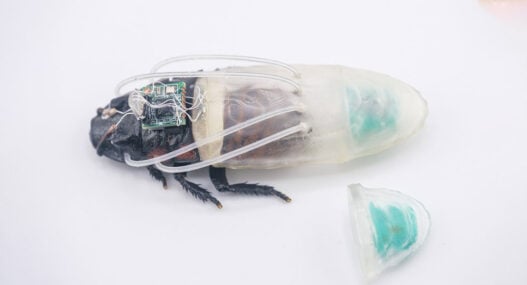
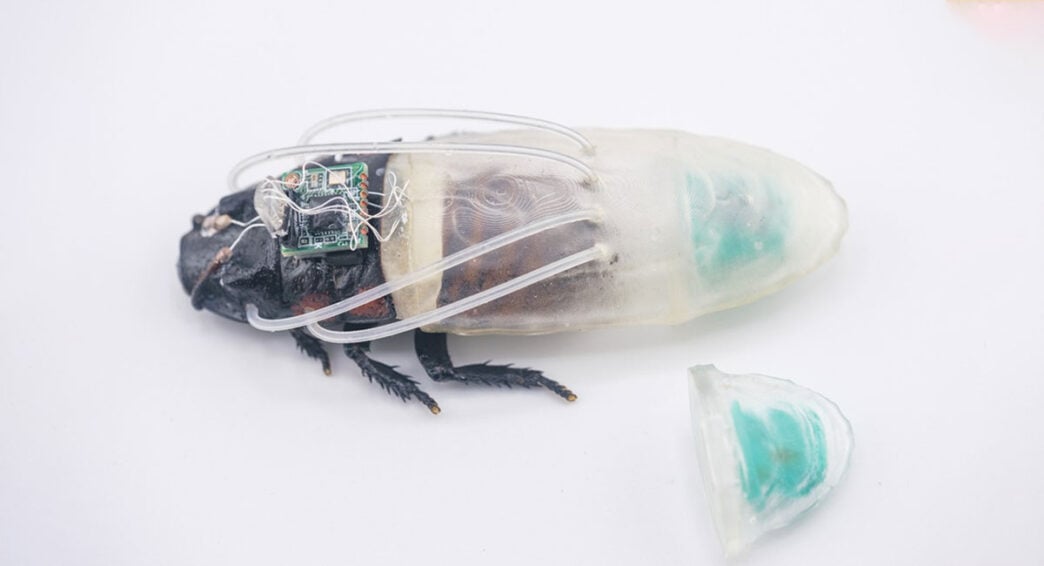
Scientists from NTU Singapore and Waseda University have created a flexible, 3D-printed diving suit for cyborg cockroaches to add to their wardrobes.
The aim is to use these low-powered insects to traverse disaster areas that may otherwise be difficult or dangerous to reach. The diving suit allows them to travel through flooded rubble, submerged spaces, and puddles, as well as walk across dry land – turning a land-based cyborg insect into an amphibious one.
Ever the species of choice when it comes to cyborg experiments, the team selected the Madagascar hissing cockroach for its tests. This is because the insects are large, robust, and have no wings.
The suit
Whether an insect is a cyborg or not, it still depends on its own respiratory system to breathe. Cockroaches take in air through small openings called spiracles, which feed a network of internal tubes for gas exchange – it’s a system that doesn’t work underwater. Professor Hirotaka Sato, who led the study at NTU Singapore’s School of Mechanical and Aerospace Engineering, explained that the new suit solves this by working “like the oxygen tank used by human divers,” generating oxygen and delivering it straight to the insect’s breathing holes.
The suit needed to meet three requirements. It had to be soft and flexible enough to allow the cockroach to move naturally in unfamiliar terrain. It needed a reliable oxygen generator. And it required a set of supply tubes fine enough to attach directly to the insect’s spiracles without causing it harm.
To create a reliable oxygen generator, the team 3D-printed a small tank from PMMA-type resin, which gives it a transparent, plastic-like appearance. Inside sat a sponge coated in manganese dioxide, acting as a catalyst. A small amount of diluted hydrogen peroxide was then injected into the tank, and the opening was sealed with UV-cured adhesive to stop any leaks. Once activated, the manganese dioxide slowly breaks down the hydrogen peroxide, releasing a steady supply of oxygen.
That oxygen is carried from the tank through the soft outer shell and along four silicone tubes, which connect to the cockroach’s thoracic spiracles. In testing, the setup kept the insects active and mobile underwater for up to three hours, at speeds only slightly slower than they manage on dry land. The tubes can also be removed afterwards without causing the insect pain or injury.
The reason
The point of these experiments is search and rescue. Life and death. Disaster zones hit by heavy rain or flooding often become impassable for both people and traditional robots, if rubble, drains and narrow gaps fill with water. Cyborg insects, however, are small enough to slip through these spaces, and because they move using their own muscles rather than motors, they need far less power than a robot of equal size.
The team believes that giving these insects the ability to operate underwater as well as on land will make them useful in an even wider range of disaster scenarios – and, further down the line, for jobs like inspecting flooded pipes, drains, and tunnels in ordinary infrastructure.
How cyborgs operate
A cyborg cockroach is a living insect fitted with a small electronic backpack that steers it. This controller sends signals to the cockroach’s nervous system, which means that its direction can be adjusted at the touch of a button, while the insect still relies entirely on its own legs and muscles to move. That’s the main advantage over artificial robots of a similar size, which need bulky, high-power batteries to run their motors.
However, it’s not only navigation. The backpacks can also carry sensors capable of detecting signs of life in rubble or debris, including movement, heat signatures, and carbon dioxide emissions. It’s this kind of data that’s critical in the first hours after a disaster when locating survivors quickly matters most.
The NTU has been researching cyborg insects for more than a decade, and Sato’s team has built versions of the technology for use on land, in the air, and now underwater. The researchers say the diving suit concept could eventually be adapted for other terrestrial cyborg insects too, including other cockroach species, locusts, and beetles, since they share similar spiracle-based respiratory systems. Next steps for the team include testing the suit in simulated disaster environments, improving its durability, and integrating navigation systems for real-world field use.
There’s no arguing with the logic behind this research. The hours after a disaster, such as an earthquake or flood, are chaotic and disorienting, so anything that can gain access to a collapsed building or a submerged drain and report back matters. Not only this, but cyborg insects are cheap, small, and need barely any power to move. It’s this that makes it useful, but it is also for this reason that technological advances are needed more than ever.
The cyborg works because the insect’s own muscles are borrowed. Its instincts are overruled. Which is the point. But it’s also what makes it feel less like a tool and more like servitude.
However, when we look forward, there is a future where every generation of battery and micro-motor technology closes the power gap a little further, and it’s not unreasonable to hope that in a decade or two from now, robotics will be efficient enough to do this job without needing a living insect to carry the load. Until then, if a Madagascar hissing cockroach in a 3D-printed diving suit is what helps to find someone trapped under flood debris who might otherwise not be found in time, it’s difficult to argue with the outcome – even while hoping it’s a stepping stone rather than the destination.