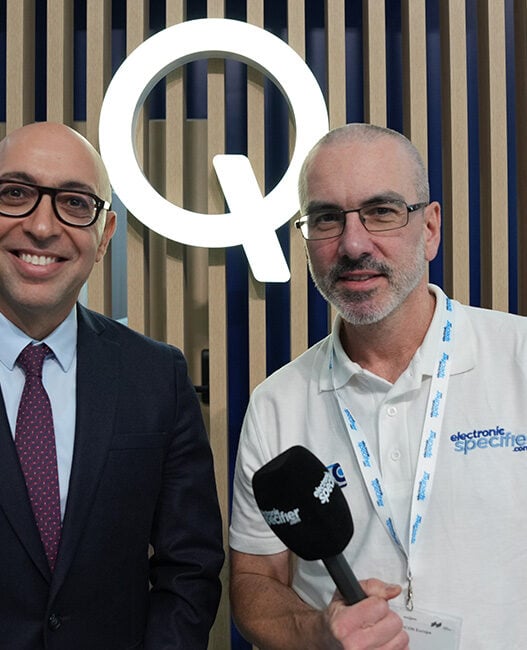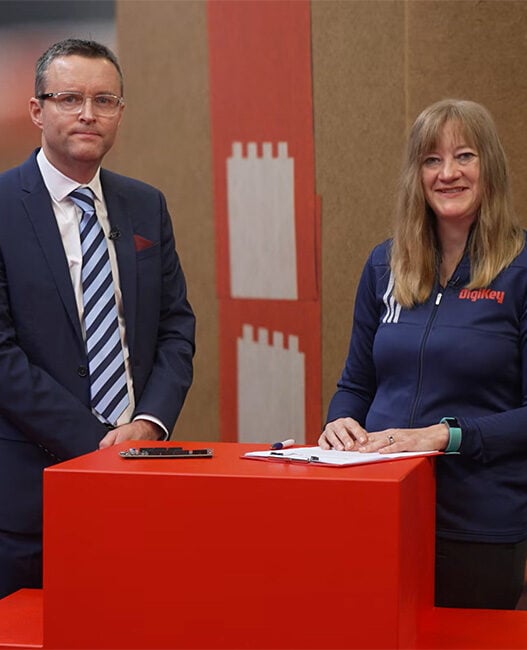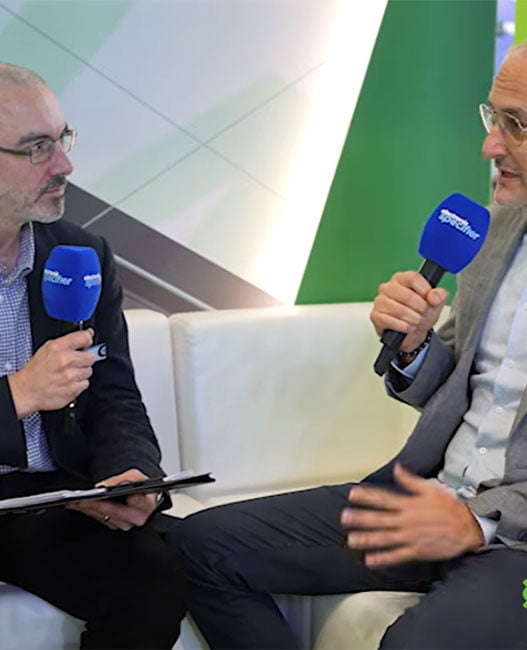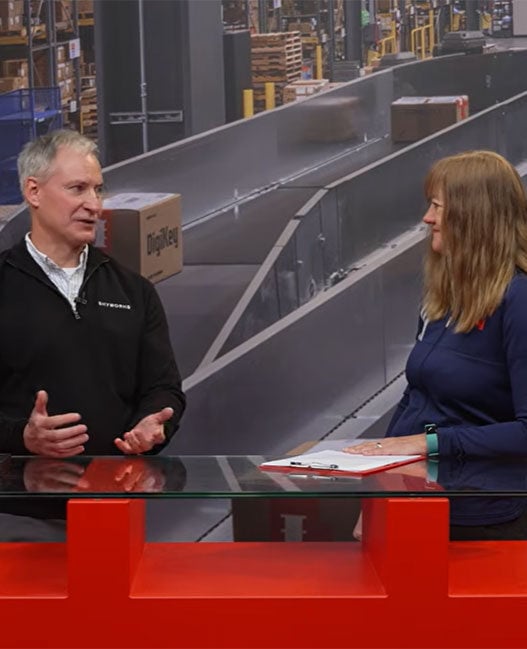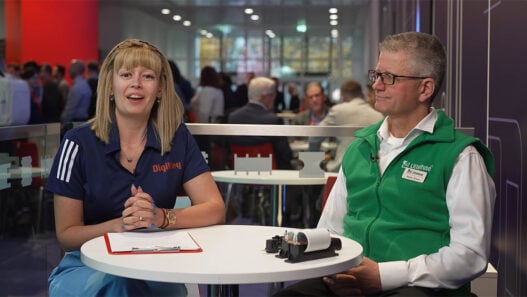





On the DigiKey booth at electronica 2026, Managing Editor Paige Hookway spoke with Petr Kadlecek, Application Engineering Specialist for Electronic Materials Solutions in 3M’s EMEA region, about managing EMI and RFI in ever-denser designs.
Megatrends such as miniaturisation and lightweighting are making designs more dense and complex, Kadlecek said, raising thermal and EMC challenges at both board and device level. Underestimating that complexity early is costly: “It’s really a painful moment for the future steps,” with any rework or redesign carrying a big economic impact.
3M’s focus is largely on near-field applications, where a high density of components per square centimetre creates many interactions that need mitigating, and which in turn affect far-field performance.
Wireless adds another layer. Wearables and phones pack GSM, GPS, and NFC antennas side by side, and as frequencies rise through 5G towards 6G, everything must work “in perfect harmony”, neither being disturbed nor disturbing others.
Shielding versus absorbing
Shielding reflects RF energy, while an absorber converts it into heat – though at microwatt levels, Kadlecek stressed, the surface won’t get hot. Shielding, typically metallic tapes or sheets, works best at lower frequencies and must be grounded to be effective, as in a Faraday cage. Absorbers suit higher frequencies, need no grounding, and can tackle both conducted and radiated noise more easily, which makes them popular.
Reflection has a catch. “Thanks to that reflection, you are just moving the problem a couple of millimetres or centimetres away from the original position,” he said.
Poor grounding can make things worse still. If engineers connect a shielding can or tape to signal ground instead of earth ground, “instead of blocking that radio and mirroring back, you will create the antenna”. In that case, “maybe it’s better not to use anything”.
Better together
The best results come from combining materials. With an absorbing layer on top and a shielding layer beneath, incoming signals are attenuated as they pass through the absorber, reflected by the metal film, then attenuated again on the way back out.
That principle underpins 3M’s EM25TP, a hybrid absorber and shield in one product, which performed best in 3M’s trace noise tests. Kadlecek described it as a go-to recommendation, “especially if they don’t really know the frequency of the parasitic noise”.
New materials
3M’s 9793KT and 9793KW double-sided conductive tapes are the latest generation, with much stronger adhesion in response to customer demand – around 2,500g per inch, or almost 10N/cm.
The 9793KT is designed for low contact resistance with the substrate, “super important especially for high frequencies” to minimise passive intermodulation and harmonic distortion. The 9793KW is more compressible, filling gaps and uneven edges. Thicknesses in Europe range from 150 to 400 microns, with 650 microns the physical maximum.
The new MSG7000SDX gasket tape is a soft, compressible metal mesh with an adhesive backing. It helps ground metal cans and sheets, covering gaps from 0.2mm to around 3mm with a single product. “It’s making engineers’ life much easier,” he said.
Most of 3M’s absorbers target 1GHz and above, but a new generation is aimed at lower frequencies, using thin, lightweight materials with permeability of up to 160,000.
Standards and sustainability
Customers often want thermal conductivity, electrical insulation, and EMI suppression in one product, but “it’s physically impossible”, so combinations of materials are often needed.
Standards bring their own challenges. Flammability standards such as UL, ASTM, and EN were largely written for hard plastics and insulating polymers, not for metal tapes or absorbers, where only the adhesive layer can burn. Kadlecek also pointed to Europe’s Packaging and Packaging Waste Regulation (PPWR), with its emphasis on recyclability and recycled content, as “a big challenge for the future”.
Avoiding common mistakes
The biggest mistake Kadlecek encounters is still confusion between signal ground and earth ground. Another is not tracking down parasitic noise early. In the near field, no anechoic chamber is needed: a spectrum analyser, signal generator and near-field probe can scan a PCB quickly, even with pocket-sized tools.
That preparation pays off before formal certification testing, which “costs huge money”. Without it, engineers risk failing and having to rebuild – “a stressful moment for them”.
Finally, Kadlecek described DigiKey as a key channel partner for 3M, valued for its willingness to add new products “as quickly as we launch them to the market” and for an approach to service and quality that “also mirrors our key values”.