

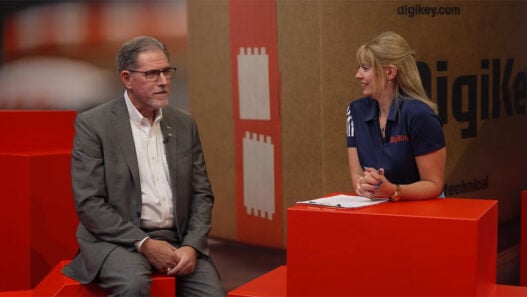
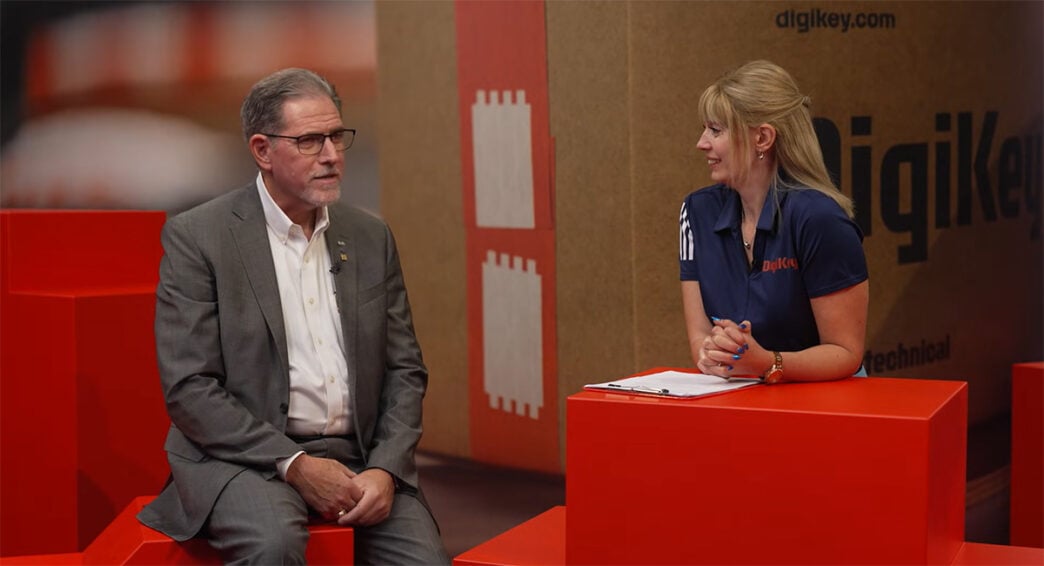
On the DigiKey booth at electronica 2026 in Munich, Paige Hookway caught up with David Luna, VP of Global Sales and Distribution at Orion Fans, to talk about a record year, the cooling demands of data centres and AI, explosion-proof fans, and what’s coming next from the thermal management specialist.
Distribution and stock marks a strong year
Alongside his role at Orion Fans, Luna leads international sales for Knight Electronics, the Dallas-based parent company of Orion Fans and its largest division. The company manufactures and sells thermal management products including cooling fans, blowers, accessories, and cords.
At the close of its fiscal year, Orion Fans was up 30%. Luna credits this to strong demand and a significant push through distribution, with partners building stock and placing scheduled orders, including OEM-focused distributors: “Over 85% of our business goes to distribution,” he explained. Much of his time is spent nurturing those relationships, supported by a sales team that works closely with distributors, their branches and product managers to get product to them in a timely fashion.
Inventory is the other half of the story. With one of the broadest inventories in the industry, Luna said: “People are coming to us because we can ship.”
Lead times as a differentiator
Asked how the acquisition of a major German competitor by a large US industrial group has affected the market, Luna said he doesn’t expect it to change things dramatically, though he believes it may steer that business towards larger industrial air-moving applications. What he has noticed across the market, whether connected to the acquisition or not, is that “lead times have gone out dramatically … up well over 50 weeks in some instances.”
By contrast, Orion Fans quotes lead times of 12 to 14 weeks when building from scratch, which Luna describes as the lowest in the industry. And because the company’s owner is a transportation specialist, Orion can ship to almost anywhere in the world fairly quickly.
Data centres need bigger, stronger fans
Data centres are a fast-growing opportunity, particularly among companies supplying cooling equipment such as chillers and heat exchangers. Customers are now looking beyond standard fans. This has prompted Orion to expand into larger-frame fans and blowers. “We recently have quoted some fans that are well over 1,000mm. So that’s pretty large for us,” Luna said.
Rising rack densities and AI workloads are a big driver for the move towards larger, higher-performance fans. Densely packed cabinets produce a lot of heat, and getting that air out requires high static pressure. A fan that can’t deliver it will effectively stop doing its job, Luna explained, so strong motors are essential. Orion offers a full high-performance line, and its larger-frame fans now take that into much higher airflows and static pressures.
Beyond the data centre
Networking and datacom remain strong markets, and the medical sector continues to grow, increasingly with AI-related products. Luna says, any product drawing power generates heat, and “If there’s heat, there’s going to be cooling.”
Taking the example of a wall-mounted EV charger, he noted that lower-power electronics may manage without a fan. But where there is a power supply or another significant heat source, a heat sink can only bleed off so much temperature, so forced-air cooling is needed, with a fan either drawing air off or pushing it through. Liquid cooling is an alternative, but it comes with trade-offs: “[The] problem with fluid is it can leak. There could be contaminants. It’s a great way to do it, but it’s very expensive, too.”
ATEX and UL 60079: explosion-proof demand grows
Demand for explosion-proof products is expanding dramatically, and Orion is introducing a whole new series of DC ATEX-rated products. One driver is in the data centre itself. Some cooling units use refrigerants such as R290 internally, and “That kind of gas can potentially spark or blow.” ATEX-rated fans and components are designed to eliminate that sparking risk.
Orion is also working with UL on UL 60079, the US standard for electrical equipment used in explosive gas atmospheres, which Luna said is somewhat stricter than the European ATEX and IECEx requirements. The aim is to meet requirements not only in Europe, but in the United States and globally. Orion’s existing OD254AP series, a 254mm DC fan rated to UL 60079 for Class I, Zone 2, and delivering up to 1,000CFM, is already available through DigiKey.
What’s next for Orion Fans
Over the next 12 to 18 months, Orion is exploring counter-rotating fans, which deliver very high static pressure in a more compact package and are used in servers and data centre equipment. The company is also expanding its EC (electronically commutated) range across both axial fans and centrifugal blowers, giving customers lower-power options. Distributors are already on board: “They’re actually begging us for more product,” Luna said.
After a 30% rise this year, Orion Fans is forecasting at least 20% growth next year, and Luna is optimistic: “I’m hoping we can go higher, but we’ll see what happens.”
Watch the full video interview here: