


Opportunities for Edge AI continue to grow across many industries, with Allied Market Research projecting the global AI Edge computing market to grow from around $9 billion in 2020 to more than $59 billion by 2030. Nevertheless, one of the key challenges facing Edge AI integrators is how rapidly technologies are evolving, whether in terms of capability or to meet specific requirements such as energy efficiency or size.
In some sectors, the regular influx of new processing platforms is welcome. For industrial companies, however, replacing machinery designed for long-term use can undermine capital investment and interrupt established processes. Where application circuitry remains largely unchanged over time, modular separation of computing resources can therefore ease processor upgrades that help modernise systems and extend their lifetime. Still, it is important to first understand why industrial Edge AI workloads might benefit from being conducted at the Edge.
The industrial advantages of AI processing at the Edge
There are many use cases for Edge AI processing in industrial applications. AI machine vision, for example, helps support quality inspection, autonomous mobile robot (AMR) navigation, and personal protective equipment (PPE) compliance. Alternatively, AI audio analysis or vibration monitoring can enhance workplace safety and predictive maintenance efforts.
The main reason for conducting these workloads at the Edge is timing. Edge processing helps reduce latency and jitter associated with moving data to and from the Cloud while supporting operational continuity in the event of network interruptions. On a manufacturing conveyor line assisted by AI vision, for example, more predictable processing windows enable downstream equipment to respond within strict timelines that determine the maximum line speed, which directly affects manufacturing throughput.
Another advantage of Edge AI is that it can help with data privacy and governance requirements. Cloud-based processing may require sensitive data to be transmitted beyond the device or local networks, but this increases exposure risks and adds costs for the data transmission. Furthermore, large image files may delay processes if network bandwidth becomes constrained. As such, AI processing resources usually associated with the Cloud are now moving into Edge devices themselves.
Addressing the Edge processing requirements for local AI
AI processing often requires sequential, parallel, and specialised neural-network processing resources to execute workloads efficiently. Modern processing platforms increasingly offer multicore CPU resources, integrated GPU cores, and neural processing units (NPUs) within a single package. These heterogeneous processors can hold several advantages beyond reducing component footprint and bill of materials for industrial Edge systems, including reduced overhead for data movement between processing resources and higher performance per watt.
Industrial Edge devices often demand reliable operation in harsh thermal and mechanical environments. Still, where long-term system evolution is a requirement, heterogeneous processing may also need to be upgradable or replaceable. This is where computer-on-modules (COMs) based on open standards offer a perfect solution.
How open COMs ease processor upgrades for long-term industrial systems
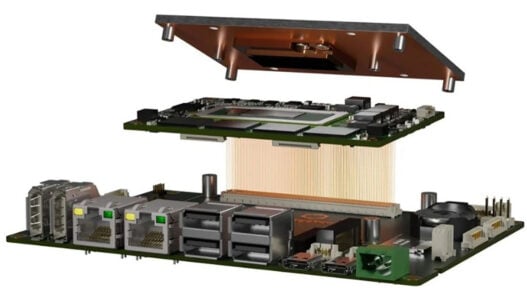
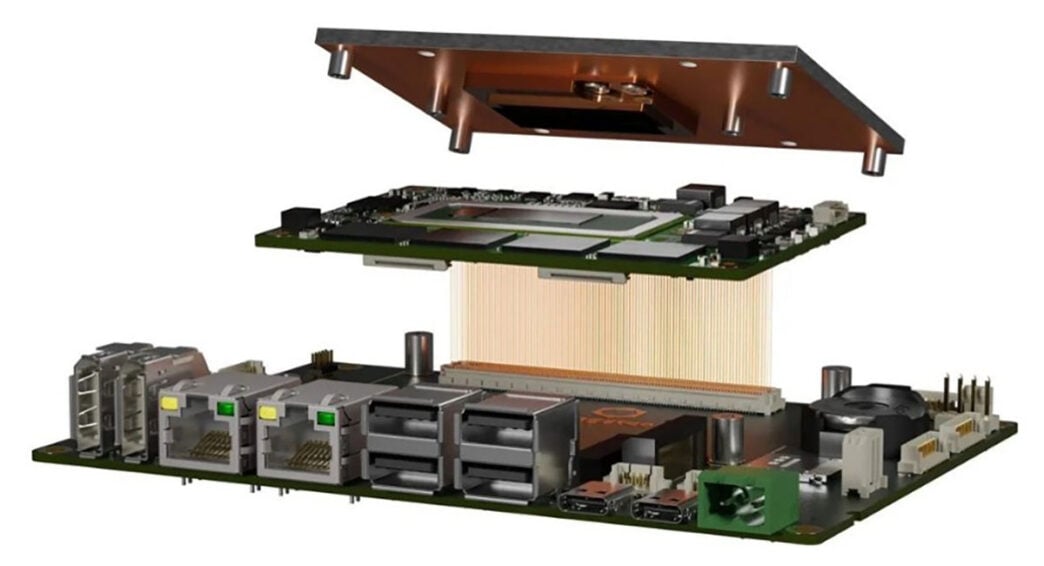
COM-based design takes computing resources and places them on a separate board that is interfaced with an application-specific carrier system, typically using a high-density mezzanine or Edge connector. This allows engineers to upgrade Edge devices easily as technologies evolve while preserving the core functionality of an industrial system.
Open COM standards help support compatibility between standards-compliant COMs from different vendors, which is extremely useful for supply chain management. Deployment scalability is another advantage, since engineers can more easily find platforms that meet specific requirements rather than overspecifying.
Open COM standards and commercial ecosystem considerations
Each open COM standard uses its own form factors, pin assignments, interface configurations, and power envelopes that can have specific advantages depending on the application.
SMARC Module, for example, is a compact open COM standard managed by SGET. Its form factor offers a footprint of just 82 × 50mm while still accommodating leading Arm-based or x86 heterogeneous processors and a wide range of interfaces. A narrow power envelope makes SMARC Modules particularly useful for battery-operated devices such as handhelds or AMRs. Memory is soldered down, eliminating mechanical connections associated with socketed memory, which can be advantageous in shock- and vibration-prone settings.
Alternatively, PICMG’s COM-HPC open COM standard accommodates more powerful processors, with some module classes supporting socketed memory. This flexibility can be useful for high-resolution AI image analysis, for example. However, some COM-HPC modules may be less well suited for space-constrained systems due to larger module sizes and additional thermal management requirements to support higher-power processors. COM-HPC footprints range from 95 × 70mm for ‘Mini’ modules to larger sizes such as ‘Server Size D’, which measures 160 × 160mm.
When considering commercial-off-the-shelf (COTS) COMs, it is also worth investigating vendor-specific ecosystem opportunities while being careful to avoid lock-in. Evaluation carrier systems can help accelerate development and deployment, and ready-to-use software options can help ease Edge-to-Cloud integration, while virtualisation can support workload consolidation, isolation, and mixed-criticality applications.
A practical example of heterogeneous processing and open COM scalability
Imagine a pick-and-place machine that must identify, sort, and reorient objects on a production line. Within a heterogeneous Edge processor, CPU resources may handle task scheduling, image preprocessing, and basic machine coordination workloads across multiple cores and threads. GPU resources can then support machine display graphics as an NPU accelerates supported neural-network inference operations for machine vision, potentially providing higher performance per watt than general-purpose processing resources.
Now consider how one pick-and-place system might only handle uniform, cuboid boxes, while another may need to classify, identify, and handle a wide range of dissimilar objects. Despite the underlying robotics remaining identical for both installations, the latter machine will likely require more sophisticated Edge computing resources to perform its AI workloads efficiently.
By using open COMs, system architects can build a pick-and-place system where compute can be closely aligned to the application requirements of individual installations. When these requirements change, the COM can also be replaced to improve performance, depending on the power, thermal, and I/O constraints set by the carrier infrastructure.
Conclusion
As AI increasingly benefits from deployment at the Edge, modern heterogeneous computing architectures can reduce processing latency while improving energy efficiency and compact integration opportunities across many applications, including long-term industrial equipment. COM-based design helps facilitate core computing resource upgrades and replacement while preserving underlying application hardware over the lifetime of an industrial deployment. In turn, this approach can enable systems to embrace future advances in AI technology without undermining existing equipment investment.