




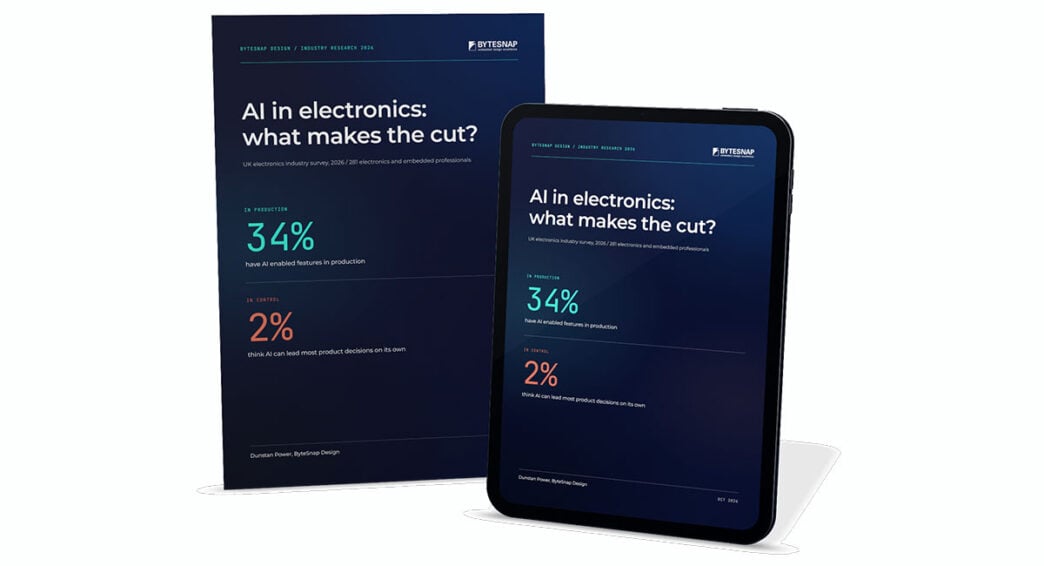
One in three (33%) UK electronics professionals report increased verification, assurance and governance workloads as artificial intelligence becomes more embedded in product development, according to new research from embedded electronics and software consultancy ByteSnap Design.
The findings show that AI is delivering efficiency gains, but checking its outputs and ensuring their reliability is creating additional responsibilities. More than half (56%) of respondents report improved data analysis, while 40% highlight reduced repetitive tasks. However, some of the time saved through automation may be absorbed by the additional scrutiny required before AI-generated outputs can be trusted.
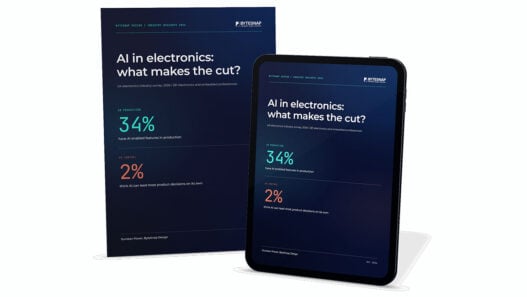
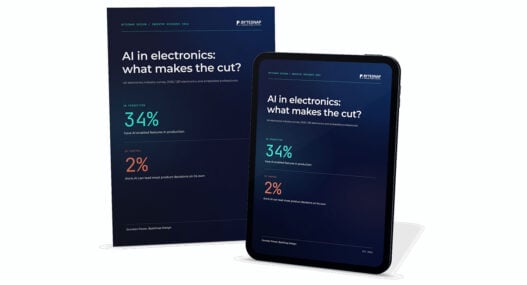
The third annual study also reveals that engineers remain reluctant to hand over control. Just 2% believe AI should lead most product development decisions independently, while 57% say safety, risk acceptance and accountability must remain human-led. Another 43% say verification, validation and engineering sign-off should stay firmly in human hands.
AI adoption is also gathering pace, with 34% of UK electronics organisations already deploying AI-enabled features in production and a further 26% running pilots or limited deployments. Yet only 29% expect AI to become standard across most of their product portfolio, suggesting a selective approach focused on practical benefits.
Computer vision and automated quality inspection lead real-world deployment at 41%, followed by cyber threat detection (39%), and predictive maintenance (37%). The latter has seen particularly strong growth, more than doubling from 14% in 2024.
Barriers to adoption
Despite growing deployment, integrating AI into existing electronics remains a persistent challenge.
For the third consecutive year, technical integration emerged as a leading barrier. Nearly half of respondents (47%) identified integrating AI with existing hardware, legacy electronics, firmware, or control logic as the main obstacle to moving features from concept to production. Integration was also the most frequently cited challenge in the 2024 survey (34%) and the 2025 study (62%).
However, technical integration is only part of the challenge. Building confidence in AI-generated outputs is also becoming increasingly important, particularly in safety-critical and regulated environments.
Customer trust (33.5%) ranks alongside product safety and liability (34%) as a leading concern, ahead of cybersecurity (31%) and regulatory compliance (25%). Deploying AI is therefore not simply about making the technology work, but also ensuring customers have confidence in the decisions it supports.
The findings point to a shift away from the initial excitement surrounding generative AI towards the practical challenges of embedding AI into physical products. In 2024, adoption was heavily associated with tools such as ChatGPT, used by 61% of respondents. By 2026, attention is turning towards deploying AI directly within embedded systems and device architectures.
Dunstan Power, Director of ByteSnap Design, commented: “AI is earning its place one closely supervised feature at a time, but it’s being kept on a short leash. A surprise in this year’s data was how many engineering teams are quietly absorbing extra verification and governance work.
“While AI saves time, someone still has to check the model’s output, judge whether it’s right, and take responsibility for the final decision. Integration remains the ultimate obstacle, and accountability is the true cost.
“Making AI trusted by the end customer is becoming a bigger challenge than making the model itself better.”
The impact on engineering jobs
As AI becomes more embedded in electronics development, its impact on engineering roles is also evolving.
While ByteSnap Design’s 2024 survey found that 52% of respondents were concerned about AI replacing their roles, this year’s findings reveal a greater emphasis on changing responsibilities. Nearly a third (32%) see AI creating demand for new embedded, data, and systems skills. Meanwhile, 12% expressed uncertainty about future roles, and 9% reported little change.
Rather than simply replacing engineering tasks, AI is reshaping engineering work. As routine activities become more automated, engineers are increasingly responsible for validating AI-generated outputs, assessing risks and ensuring decisions meet the standards required for real-world products.
This places greater emphasis on human judgement and accountability, particularly in sectors where safety, reliability, and regulatory requirements are critical.
AI’s ongoing rollout
Almost half (49%) of respondents expect AI to be used selectively over the next three years, rather than becoming standard across entire product ranges. The biggest factors influencing adoption are access to suitable data (42%) and commercial return (40%).