





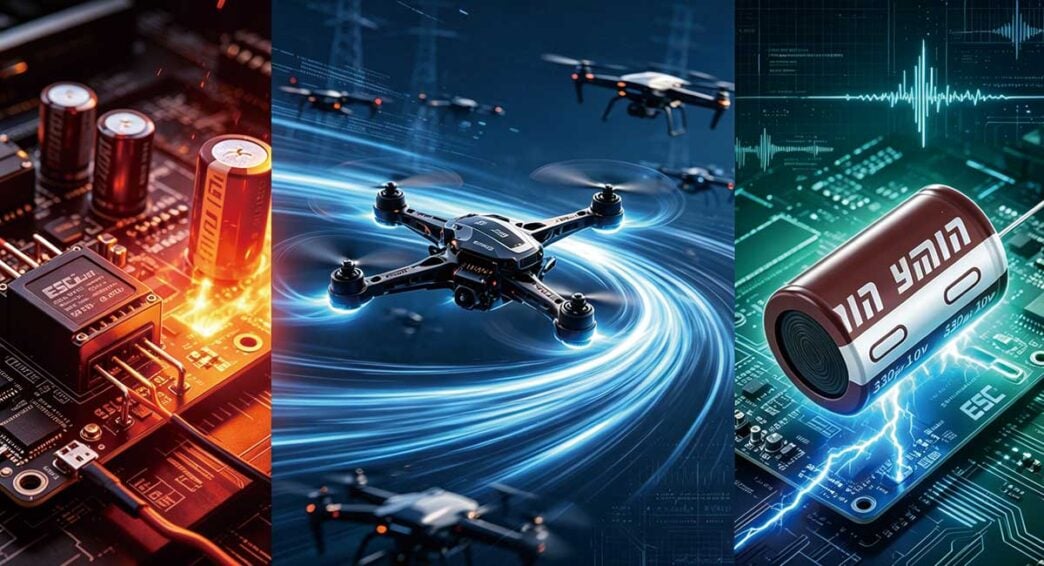
The global drone market, particularly in North America, Europe, and parts of Southeast Asia, is undergoing a significant transition from consumer-focused recreational use to industrial-grade applications. Whether in millisecond-critical racing competitions or professional operations such as agricultural surveying, mapping, security monitoring, and infrastructure inspection, increasingly stringent demands are being placed on flight systems to deliver exceptional manoeuvrability and performance. For drone and RC model power system manufacturers, as well as Electronic Speed Controller (ESC) developers and manufacturers, the input stage of ESC power boards used in high-performance FPV drones, racing drones, and industrial UAVs has become a critical design challenge.
1. Industry pain point: ‘power loss in mid-air’ under extreme manoeuvres
Many hardware design engineers and procurement decision-makers face a recurring hidden challenge: when drones perform extreme manoeuvres during racing or operational missions – such as rapid acceleration, high-speed right-angle turns, and steep-angle climbs – the capacitor lead solder joints or internal terminals at the ESC input can overheat and fail under instantaneous high-current surges. In addition, vibration can cause lead-wire fractures or internal core displacement, creating a potential short-circuit risk. The direct consequence of such failures is sudden ESC shutdown, loss of propulsion, and immediate drone crashes. This not only results in competition failure but can also cause permanent hardware damage, leading to significant after-sales repair costs and reputational risks for manufacturers.
2. Root cause analysis: why conventional solutions fail
At the initial design stage, most engineers suspect that the capacitor’s rated ESR or ripple current capability is insufficient. As a result, they may replace the original component with a liquid aluminium electrolytic capacitor that meets the required ESR and ripple current specifications or even switch to a higher-cost solid capacitor. However, the problem often persists.
From a technical perspective, the root cause is that under extreme instantaneous current surges, the physical structure of the current path becomes the limiting factor. Under severe vibration conditions, structural deformation can occur, leading to performance failure. This is primarily reflected in three critical shortcomings:
- Insufficient current-carrying cross-section
The cross-sectional area of the leads or terminals is unable to support extremely high instantaneous current density, resulting in excessive localised current concentration and causing overheating or fuse-like failure.
- Inadequate connection impedance control
High resistance in the lead materials or internal connection points can generate localised hot spots under high-current surges, leading to excessive temperature rise and initiating thermal failure.
- Lack of vibration-resistant design
In high-frequency vibration and mechanical shock environments, insufficient mechanical strength and structural stability within the capacitor can result in lead fatigue fractures (vibration-induced lead breakage) or internal element displacement, increasing the risk of short circuits.
3. YMIN solution: LKE series — a dual breakthrough in electrical performance and physical design
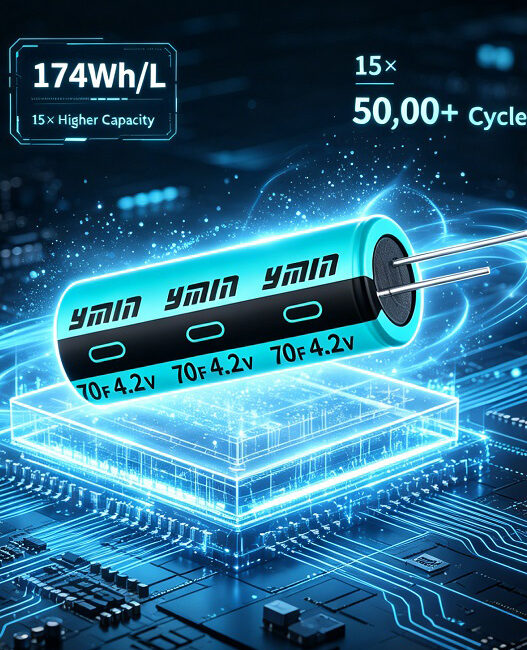
To address these industry challenges, Shanghai YMIN Electronics has introduced the LKE Series Liquid Aluminium Electrolytic Capacitors, providing a design solution that tackles the issues at their source. Rather than simply optimising electrical parameters, the LKE Series systematically redefines the capacitor’s physical load-bearing capability, delivering innovation in both electrical performance and structural design.
Targeted design of the LKE Series:
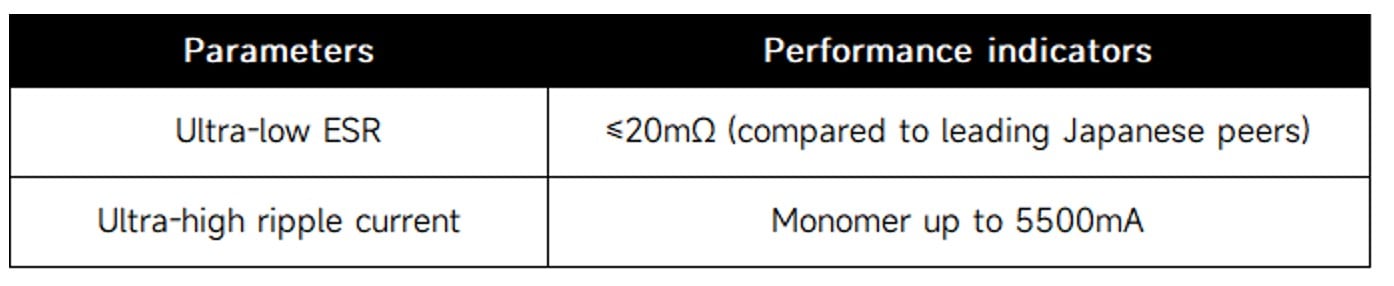
Reinforced structure: significantly increases the cross-sectional area of both internal lead tabs and external terminals to optimise high-current transmission paths. In addition, the capacitor’s internal structure has been strengthened to greatly improve resistance to bending and fatigue, systematically mitigating the risks of lead breakage and internal collision-induced short circuits under high-frequency vibration.
Process enhancement: utilises a low-impedance, high-reliability internal connection process to minimise localised heat generation during current transmission at the manufacturing level.
Coordinated thermal design: optimises the material system and heat dissipation paths to effectively reduce heat accumulation under high-current surge conditions.
The LKE Series delivers aluminium electrolytic capacitors that combine low-ESR electrical performance with high-current structural reliability and vibration resistance. In UAV ESC applications involving instantaneous high-current loads, the series helps prevent terminal and lead-tab fusing, vibration-induced lead failure, and internal core displacement caused by mechanical impact, ensuring flight safety and system stability even under extreme manoeuvring conditions.
Validated by real-world testing: A 120°C reduction in temperature rise eliminates the risk of fuse-like failure comparative testing was conducted under the same – if not more demanding – extreme flight conditions, involving continuous full-throttle acceleration and rapid braking cycles. The results verified the performance advantages of the LKE Series:
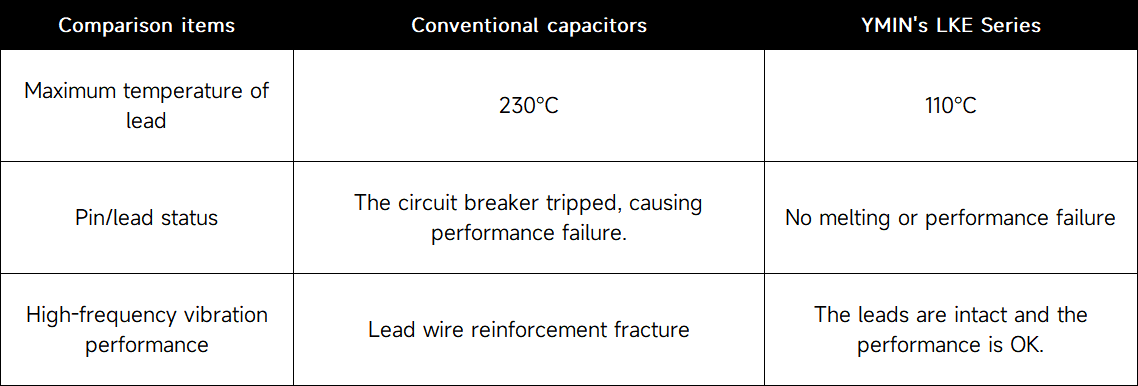
Test conclusion: The LKE Series eliminated physical connection failures caused by overheating, validating its structural reliability under extreme pulse-current conditions. In addition, the leads remained intact under high-frequency vibration, meeting the performance requirements of demanding UAV applications.
4. Why the LKE series deserves immediate evaluation
For UAV and ESC design teams pursuing maximum performance and reliability, adopting the YMIN LKE Series can deliver significant advantages in four critical areas:
- Reduced crash risk
Eliminates capacitor-related in-flight shutdowns at the source, helping protect both the aircraft and its payload.
- Lower after-sales costs
Reduces maintenance, replacement, and logistics expenses associated with hardware failures.
- Enhanced product reputation
Improves stability under extreme operating conditions, helping brands earn the trust of professional and industrial users.
- A reliable second source
As a specialised capacitor manufacturer, YMIN provides fast delivery and cost-effective supply, helping reduce supply chain risks.
5. Dedicated manufacturer support
As an original manufacturer certified to internationally recognised standards such as IATF 16949 and AEC-Q200, Shanghai YMIN Electronics delivers not only high-performance products, but also comprehensive technical support throughout the entire development cycle – from component selection and design evaluation to PCB-level validation.
If you are facing capacitor overheating and fuse-like failure issues in UAV ESC applications or looking to build a more reliable power system for your next-generation products, contact YMIN today to request LKE Series samples and evaluate their performance in your own testing environment.
To learn more about YMIN’s UAV ESC capacitors and request samples, visit the official website: https://www.ymin.cn/ or email ymin-sale@ymin.com.
Let the YMIN LKE Series be the reliable foundation behind your flight safety strategy and your pursuit of next-generation performance standards.