




Physicists at the University of Colorado Boulder have demonstrated a quantum sensing device that can detect acceleration in all three dimensions at once – an achievement that many researchers had not considered possible.
The prototype, described in the journal Science Advances under the title Vector atom accelerometry in an optical lattice, uses a cloud of rubidium atoms cooled to near absolute zero. The team hopes the technology could, in future, enable precise navigation for submarines, spacecraft, cars, and other vehicles without relying solely on GPS.
Kendall Mehling, a graduate student in CU Boulder’s Department of Physics and co-author of the study, explained the motivation: “Traditional atom interferometers can only measure acceleration in a single dimension, but we live within a three-dimensional world. To know where I’m going, and to know where I’ve been, I need to track my acceleration in all three dimensions.”
The research team also included Postdoctoral Researcher Catie LeDesma and Murray Holland, Professor of Physics and Fellow of JILA – a joint institute between CU Boulder and the National Institute of Standards and Technology (NIST).
In 2023, NASA awarded the group $5.5 million via the Quantum Pathways Institute to further develop the sensor.
Atoms as the measuring tool
The device operates as a new form of atom interferometer. Six hair-thin lasers pin a cloud of tens of thousands of atoms in place. Artificial intelligence then coordinates the lasers in complex patterns, enabling the measurement of tiny changes in the atoms’ behaviour caused by acceleration – similar to pressing a car’s accelerator.
According to Mehling: “If you leave a classical sensor out in different environments for years, it will age and decay. The springs in your clock will change and warp. Atoms don’t age.”
Conventional accelerometers in vehicles are electronic devices, often paired with GPS. While the CU Boulder sensor cannot yet match their precision, the team sees potential in the atom-based approach.
How the interferometer works
Interferometers have been used for centuries, whether to send data over optical fibres or detect gravitational waves. They work by splitting a signal – such as light – into two parts, sending them along different paths, and recombining them to detect differences.
In this study, the researchers used atoms rather than light. They cooled the rubidium atoms to just billionths of a degree above absolute zero, creating a Bose-Einstein Condensate (BEC) – a quantum state first achieved at CU Boulder in 2001 by Carl Wieman and Eric Cornell, who were later awarded a Nobel Prize.
The team then applied laser light to ‘split’ each atom into a quantum superposition, allowing it to be in two places at once. The split atoms travelled along separate paths before being recombined.
“Our Bose-Einstein Condensate is a matter-wave pond made of atoms, and we throw stones made of little packets of light into the pond, sending ripples both left and right,” Holland said. “Once the ripples have spread out, we reflect them and bring them back together where they interfere.”
The interference pattern – which Holland likens to a fingerprint – contains data on the acceleration experienced by the atoms: “We can decode that fingerprint and extract the acceleration that the atoms experienced.”
Compact design with AI assistance
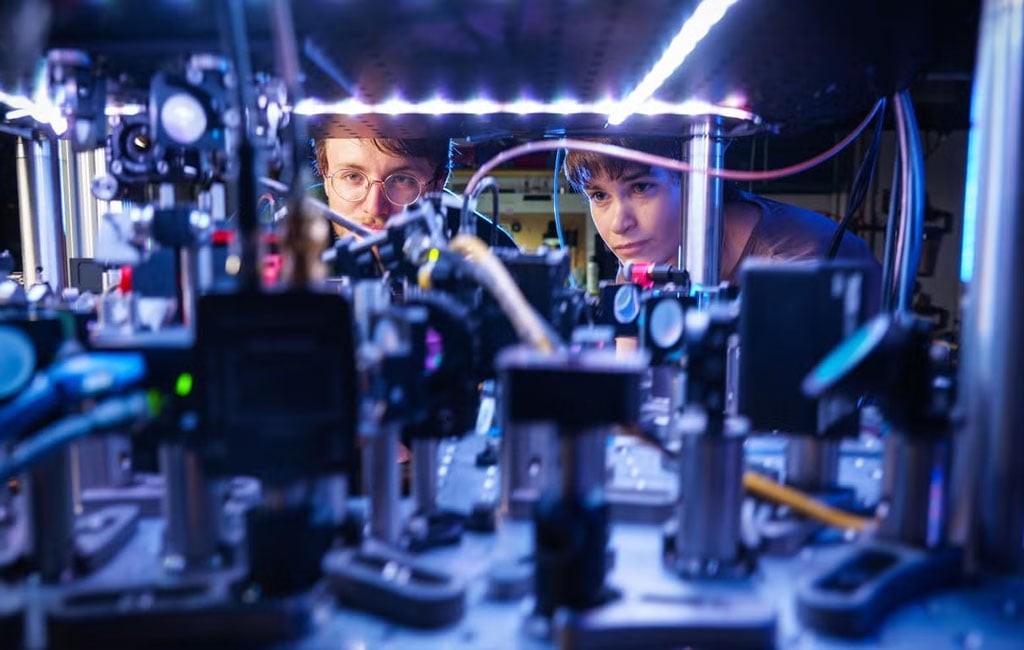
The device currently occupies a bench about the size of an air hockey table, but the researchers believe it could eventually be field-deployable.
“For what it is, the current experimental device is incredibly compact. Even though we have 18 laser beams passing through the vacuum system that contains our atom cloud, the entire experiment is small enough that we could deploy in the field one day,” LeDesma said.
Machine learning has played a role in achieving this compactness. Adjusting the lasers to split and recombine the atoms is a complex process, so the team trained an AI program to plan the necessary steps in advance.
At present, the sensor can measure accelerations several thousand times smaller than Earth’s gravity – but existing commercial devices remain more sensitive. The CU Boulder team aims to improve performance significantly in the coming years.
Holland summed up the broader potential: “We’re not exactly sure of all the possible ramifications of this research, because it opens up a door.”