


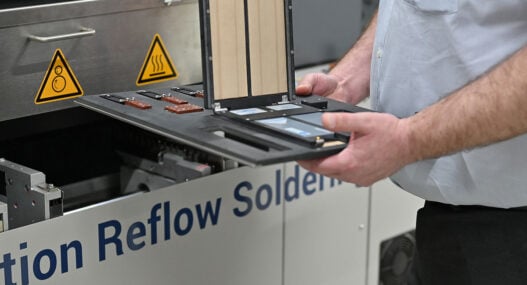
Reflow soldering remains one of the most important processes in electronics manufacturing, where maintaining accurate thermal control is essential for producing reliable solder joints between components and printed circuit boards. However, as assemblies become increasingly complex and production demands continue to rise, process control requirements are changing.
Modern electronics manufacturing now involves far more than simply achieving the correct temperature profile. Device miniaturisation, increased board densities, and the growth of safety-critical electronics in sectors such as automotive and aerospace have introduced additional process considerations that directly influence product quality and long-term reliability.
At the same time, advanced reflow technologies including vacuum reflow systems and inert atmosphere processing are becoming more widely adopted. While these developments offer clear process and quality benefits, they also introduce new variables that manufacturers must understand and control effectively.
The long-established principle that “if you don’t measure it, you can’t manage it” has become increasingly relevant in today’s production environments. Manufacturers are now required to monitor multiple process conditions simultaneously to maintain consistency, minimise defects, and reduce unnecessary production costs.
Accurate measurement
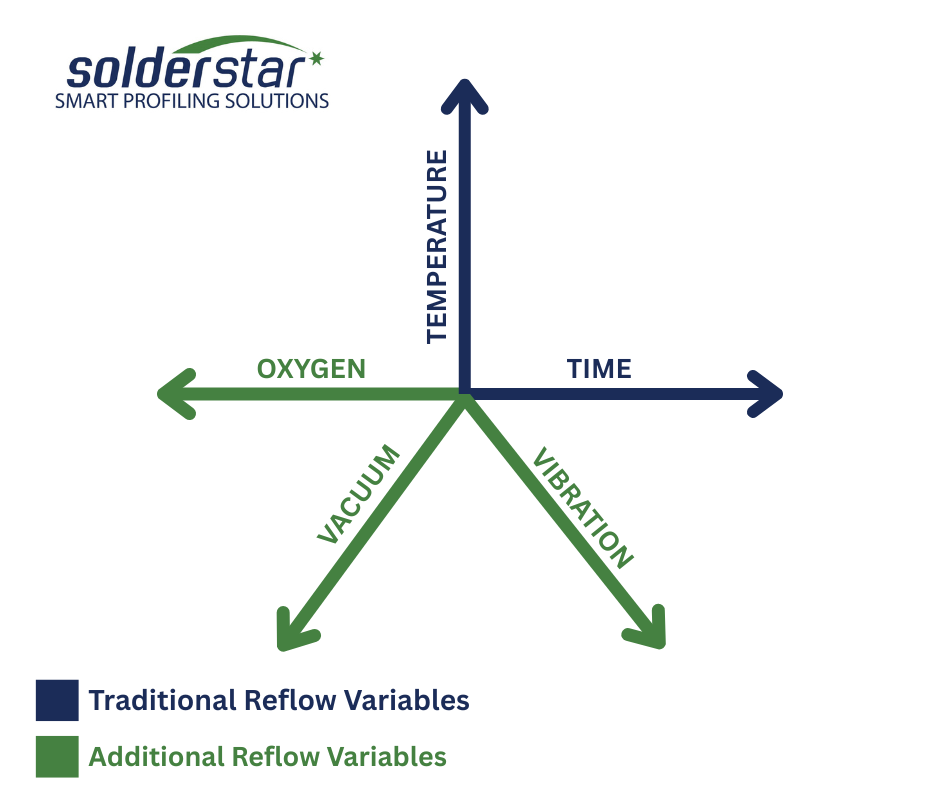
Effective process control always starts with accurate and repeatable measurement. While thermal profiling continues to form the foundation of reflow process verification, temperature alone no longer provides a complete understanding of what is happening inside a modern reflow oven.
Additional variables now play a significant role in determining soldering quality and process stability. These factors interact closely with thermal conditions and can directly influence solder joint formation, defect rates, and overall manufacturing consistency.
Three process variables have become particularly important in advanced reflow environments: oxygen, vacuum, and vibration.
Monitoring these variables alongside temperature provides manufacturers with a more complete picture of process behaviour, enabling more precise optimisation and faster identification of potential issues.
Why oxygen matters
The advantages of soldering within an inert atmosphere are already well established across electronics manufacturing. However, maintaining the correct oxygen concentration throughout the reflow process is essential for balancing both quality and operational efficiency.
If oxygen levels are too high, the full benefits of inert soldering may not be achieved, limiting improvements in solder joint quality and reducing the value of the nitrogen system investment. Conversely, oxygen levels that are unnecessarily low can lead to excessive nitrogen consumption and increased operating costs. In some cases, extremely low oxygen concentrations may also contribute to process defects such as tombstoning.
Tombstoning occurs when uneven heating during reflow causes one side of a component to lift away from the PCB while the opposite side remains attached. The result is an unreliable solder connection that can compromise assembly performance. Maintaining stable oxygen levels helps support consistent heating conditions and reduces the likelihood of this defect occurring.
Traditional oxygen monitoring methods typically rely on a dedicated analyser unit located externally to the oven, with sampled process air continuously drawn across the sensor. While widely used, this approach presents several limitations.
Because the analyser measures oxygen concentration at a single point, conditions across the rest of the oven must effectively be inferred. This makes it difficult to identify localised variations or determine the exact source of issues such as gas leakage. Continuous exposure to process vapours and VOCs can also affect long-term sensor performance.
A more detailed approach involves measuring oxygen concentration throughout the full oven length during a single production pass at operating temperature. This creates a complete oxygen profile across all process zones, allowing manufacturers to compare oven performance over time or benchmark different production lines against one another.
Detailed oxygen profiling can reveal areas where oxygen concentration rises unexpectedly due to leaking seals or other mechanical issues. Maintenance teams can then identify problems earlier, plan repairs more efficiently, and reduce unplanned downtime.
Profiling also helps optimise nitrogen usage by identifying areas where gas consumption may be unnecessarily high or where oxygen levels are not being maintained consistently. The result is improved process consistency, lower running costs, and better overall production reliability.
Target vacuum
Many modern reflow ovens now incorporate vacuum modules as part of the soldering process. These systems introduce an additional conveyor mechanism and vacuum chamber designed to remove trapped gas from molten solder joints.
Vacuum soldering improves solder joint integrity by reducing voiding, helping enhance both mechanical strength and long-term reliability.
Within the vacuum chamber, air is evacuated at a programmable pull-down rate. If vacuum is applied too rapidly, component movement or shifting can occur. To achieve effective void reduction, the process must then maintain a target vacuum level for a specified hold time before air is reintroduced at a controlled release rate.
Each stage of the vacuum cycle influences both product quality and manufacturing throughput. Optimising these settings is therefore essential to achieving consistent process performance without compromising production efficiency.
Measuring the complete vacuum cycle during operation allows engineers to verify pull-down rate, vacuum level, hold time, and release rate under actual production conditions. This information helps identify timing relationships between the thermal profile and the vacuum process itself, ensuring the process remains stable and effective.
Comprehensive vacuum measurement also supports process optimisation by helping manufacturers balance void reduction performance against cycle time and throughput requirements.
Measuring vibration
Mechanical vibration within reflow oven transportation systems can create a significant risk of component movement during soldering, particularly in advanced or vacuum-assisted processes. Identifying the source of these vibrations, however, is often difficult.
In vacuum reflow systems, both the conveyor system and the vacuum process itself may contribute to vibration. Standard conveyor systems can also generate vibration from a wide range of mechanical issues including worn bearings, damaged pallets, tight conveyor links, worn sprockets, motor problems, or partially blocked extraction systems that create resonant airflow.
Measuring vibration throughout the process across multiple axes provides valuable diagnostic information that would otherwise remain difficult to identify.
Monitoring X, Y, and Z axis vibration allows maintenance teams to detect developing mechanical faults before they begin affecting production quality. Early identification supports proactive maintenance planning, enabling repairs to be scheduled before unexpected downtime occurs.
This approach improves equipment reliability while helping maintain consistent process conditions across production.
Process control
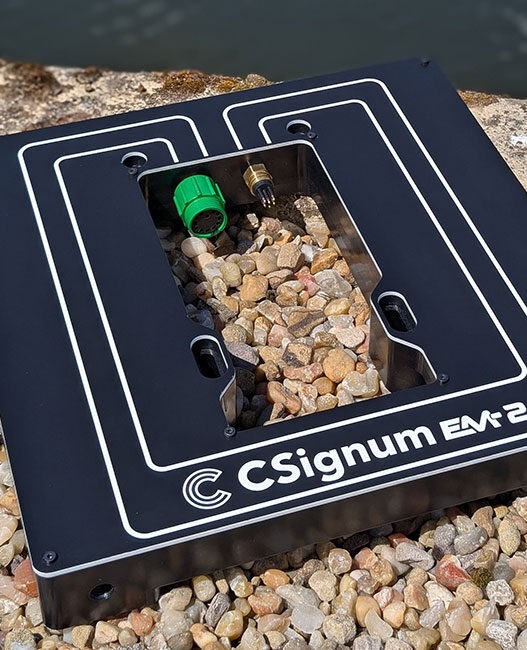
Modern profiling systems are now capable of capturing multiple process parameters during a single pass through the reflow oven under full operating conditions. This allows manufacturers to gain a broader understanding of process performance without interrupting production.
Advanced profiling systems can measure:
- Process top and bottom heating
- Process top and bottom air temperature
- Oxygen PPM profile
- Vacuum profile, including pull-down rate, vacuum level, hold time, and release rate
- Conveyor vibration across X, Y, and Z axes
- Conveyor speed
Combining these measurements provides a far more detailed understanding of overall process behaviour compared with temperature profiling alone.
Benefits of comprehensive profiling
Capturing comprehensive process data across multiple variables provides several operational and quality advantages.
A unified profiling approach allows manufacturers to apply consistent process monitoring across different oven types and production lines, simplifying standardisation and improving return on investment.
Detailed before-and-after comparisons following maintenance activities help identify process deviations more quickly, reducing troubleshooting time and minimising disruption to production.
Full process data also enables performance benchmarking between ovens, helping manufacturers identify process variation and optimise line-to-line consistency.
Monitoring heating efficiency supports early identification of heater or convection failures before solder quality is affected, while full oxygen profiling improves control over the inert atmosphere and helps reduce nitrogen consumption.
Vacuum profiling provides visibility into vacuum performance and process timing, helping balance solder quality with production throughput.
At the same time, vibration monitoring supports preventative maintenance strategies by identifying mechanical faults before they develop into production issues.
Even relatively simple checks such as verifying conveyor speed against programmed process recipes help support repeatability and overall process compliance.
As electronics manufacturing becomes more complex, temperature profiling alone no longer provides a complete picture of reflow performance. Advanced assemblies, vacuum reflow processes, and inert atmosphere soldering all introduce additional variables that can influence solder quality, process consistency, and production efficiency.
Measuring oxygen concentration, vacuum performance, vibration, and thermal behaviour together gives manufacturers a clearer understanding of what is happening throughout the reflow process. This wider process visibility helps improve control, reduce variation, support product reliability, and maintain efficient production across modern electronics manufacturing environments.