







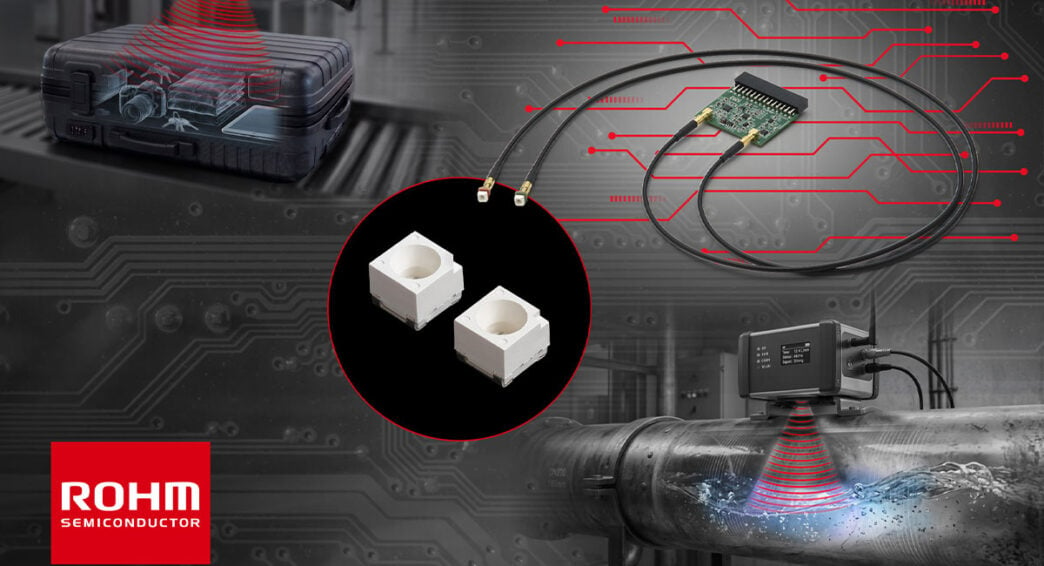
ROHM has developed a 2nd Generation terahertz wave oscillation device using semiconductor elements known as Resonant Tunneling Diodes (RTDs). ROHM is making the device available via the RTD-EVK-G2 Terahertz Wave Device Evaluation Kit, which includes a sample device, cable, and evaluation board. The kit enables companies and research institutions to evaluate THz wave oscillation and detection in a compact development environment.
Occupying the frequency region between radio waves and light, terahertz waves combine the penetrating properties of radio waves with the straight-line propagation of light. Because they exhibit unique absorption characteristics for polymer, moisture, and other substances, they are expected to be used in non-destructive testing without ionizing radiation, medical and healthcare applications, and high-resolution radar sensing. However, conventional terahertz systems require large equipment and high implementation costs, making it difficult for new companies and research institutions to enter the field or pursue commercialisation.
Since the late 2000s, ROHM has engaged in joint research with the Institute of Science Tokyo, Osaka University, and many other universities and research institutions to develop THz wave oscillation and detection devices using RTDs. In 2024, ROHM began offering samples of 1st Generation products, achieving substantial downsizing and cost reduction compared with conventional methods.
To address the growing demand for improved signal quality in application development, ROHM has now developed a 2nd Generation terahertz wave oscillation device. The device maintains the same 0.5 × 0.5mm chip size as the 1st Generation product while adopting an internal structure that enables higher output. As a result, output power has been increased to approximately 4 times that of the 1st Generation product, reaching a maximum of 40µW. The higher output power improves the detectability of THz waves after transmission through or reflecting from target objects – making the device well suited for applications such as sensing and imaging that require high signal quality.
The device is mounted in the same 4.0 × 4.3mm PLCC package, maintaining the industry’s smallest footprint. This enables evaluation environments to be built even in space-constrained settings. In addition, compared with other THz generation methods, the RTD approach generates less heat and consumes less power, reducing application development load at both companies and research institutions.
Sales of the RTD-EVK-G2 evaluation kit, which includes samples of the 2nd Generation wave oscillation device, are planned to begin in August 2026. By enabling evaluation at a lower cost than other methods, the kit supports the development of a wide range of applications, including non-destructive testing; imaging and sensing in the medical and healthcare sectors; material identification; and moisture detection. ROHM will also continue sales of 1st Generation devices for applications that prioritise low power consumption.
Going forward, ROHM will continue to expand the possibilities for THz wave application development and contribute to the early commercialisation and real-world implementation of terahertz technology, accelerating its deployment across a broad range of industries.
Professor Safumi Suzuki, Laboratory for Future Interdisciplinary Research of Science and Technology, Institute of Integrated Research, Institute of Science Tokyo
“Terahertz waves are expected to be applied in a wide range of fields, including non-destructive testing, imaging and sensing, and wireless communications. At the same time, commercialisation continues to face major challenges, such as the need for large-scale equipment and high implementation costs.
The RTD terahertz wave device developed through many years of joint research with ROHM is compact, power saving, and does not require cooling. It can also be introduced at low cost, helping companies and research institutions begin terahertz wave research.
With the launch of the 2nd Generation device featuring significantly improved oscillation output, I expect development of applications requiring higher signal quality to accelerate.”