




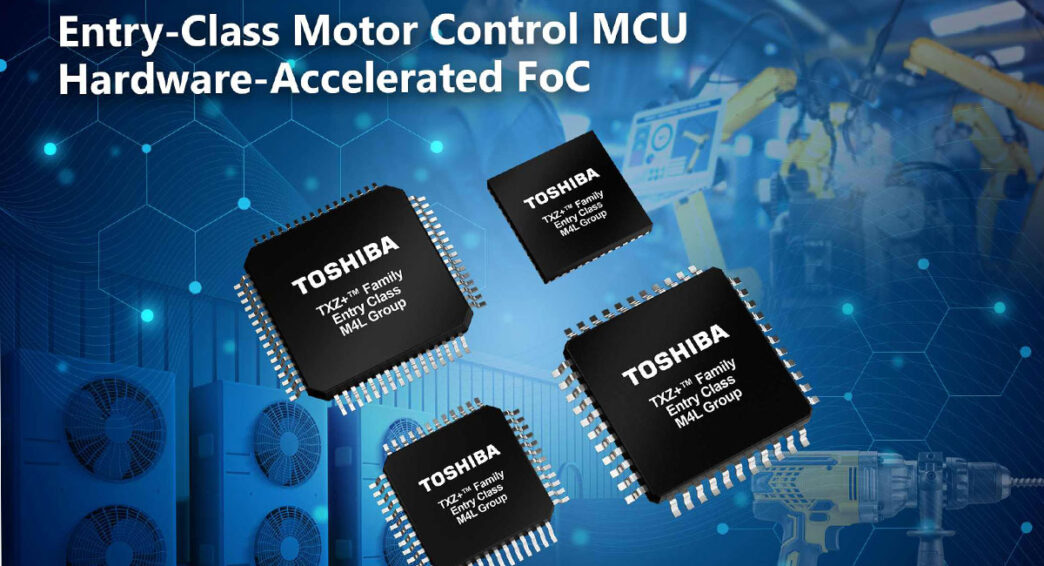
Toshiba Electronics Europe announced the start of mass production of the TXZ+ Family Entry-Class M4L Group, a new series of Arm Cortex-M4 based microcontrollers with a floating-point unit (FPU) operating at up to 80MHz. The devices are available with 128 or 256KB of code flash memory in four compact package options.
Designed to meet the real-time processing requirements of single-motor control applications, the M4L Group combines dedicated motor control hardware, security features, functional safety measures and firmware update support on a single chip. This integration helps reduce external component count, minimise PCB area and simplify system design for a wide range of applications, including industrial equipment, factory automation systems, office equipment, home appliances and consumer products.
The M4L Group incorporates the latest versions of Toshiba’s dedicated motor control hardware, including the Advanced Vector Engine (A-VE2), Advanced Programmable Motor Driver (A-PMD2) and Advanced Encoder (A-ENC2). By offloading computationally intensive motor control tasks from the CPU, these hardware accelerators enable efficient real-time field-oriented control (FoC), reduce processor utilisation and free additional processing resources for application software.
The microcontrollers also integrate security functions, functional safety measures and firmware-over-the-air (FOTA) and remote firmware update capabilities. Security features include Chip Protection (CPRO), Secure Access Memory (SAM) and Non-Rewritable Flash Protection (NRFP). These features help protect against unauthorised access, enforce memory access control and safeguard critical code and data regions. Combined, they provide a hardware-based foundation for securing embedded software and implementing a Root of Trust (RoT). Functional safety features include diagnostic mechanisms for flash memory, RAM, ADCs and clock systems, supporting the development of safety-related applications. Toshiba also provides UL 60730 Class B certified software to assist with the development of home appliance applications.
The devices with 256KB of code flash memory incorporate dual-bank architecture, allowing one flash bank to be reprogrammed while software continues to execute from the other. This enables firmware updates without interrupting system operation and supports FOTA implementation. Devices with 128KB of code flash memory incorporate 64KB of data flash memory for storing configuration information and application data, such as operating logs.
The M4L Group operates from a single supply voltage of 2.7V to 5.5V, enabling compatibility with both 3 and 5V systems. LQFP and VQFN packages with 44 to 64 pins provide flexibility across applications with different sizes and I/O requirements. The devices also integrate a high speed 10MHz oscillator with ±1% accuracy, together with an overcurrent detection comparator that can be used for emergency motor shutdown, helping lower system cost and PCB complexity by reducing the number of external components. A low-power mode is particularly suitable for battery-powered applications.
The M4L Group integrates a range of communication interfaces, including UART, SPI and I²C, as well as a Serial Memory Interface (SMIF) for memory expansion. Other peripherals include 12-bit ADCs, 8-bit DACs, comparators, DMA controllers, CRC calculation hardware and timer functions, enabling direct connection to sensors, actuators, external memories and other system components without requiring additional interface devices.
To facilitate evaluation and product development, Toshiba provides documentation, sample software and peripheral drivers, together with evaluation boards and development environments from Arm ecosystem partners. Developed in collaboration with MIKROE, the Clicker 2 for TMPM4L4A evaluation board provides a cost-effective and easy-to-use platform for exploring BLDC motor control applications. The board is supported by Toshiba’s MCU Motor Studio software available through the Toshiba website.