







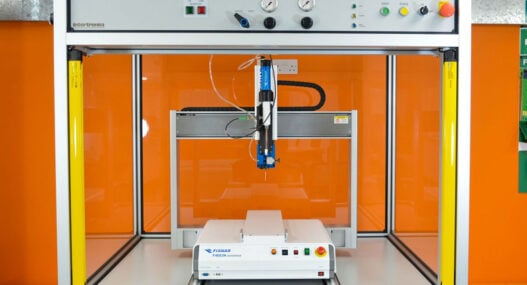
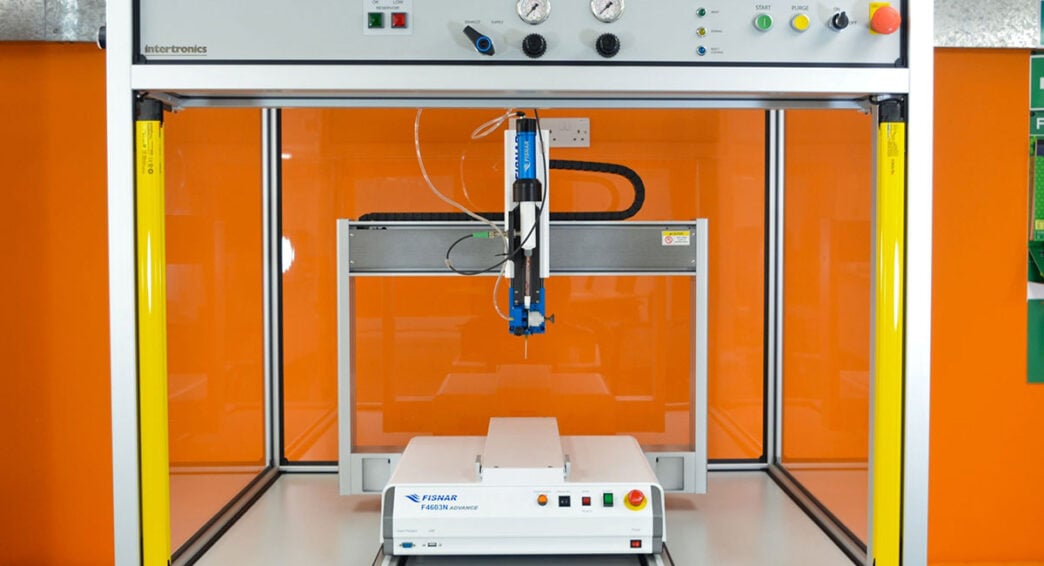
With only 104 robots for every 10,000 employees, the UK robotic systems uptake falls sharply behind that of countries such as Germany and Korea, who, respectively, have 449 and 1,220 robots per 10,000 employees. For many British manufacturers, the biggest obstacle to investing in dispensing robots isn’t cost or complexity – it’s knowing why they should and how to do it. Here, Matt Baseley, Head of Sales at Intertronics, shares eight things first-time investors in dispensing robots should know.
While not every dispensing application demands automation, consistently retaining manual processes may become harder to justify when quality and throughput pressures start to constrain production. At that point, the real question is not simply whether a dispensing robot is affordable, but whether rework, material waste, limited scalability, and operator health and safety are already costing more than the automation investment. For many manufacturers, robotic dispensing provides a route to more resilient production.
1. The right supplier will minimise complexity
A recent PwC survey shows that industrial executives expect the share of factories with highly automated processes to more than double by 2030. Choosing a specialist adhesives and dispensing automation partner, such as Intertronics, can bring advice on installation, programming, and commissioning, and offer training to boost the operating team’s confidence.
2. ROI can come in a surprisingly short time
In dispensing applications, the ROI usually comes from better process control. Improving deposit consistency can cut down on rework and lower reject rates, especially where materials or finished assemblies are expensive. Automation can maintain that performance across different operators, shifts, and production batches, protecting capacity while reducing the need for manual intervention.
Depending on production volume, material cost, and current scrap rates, ROI can be achieved in as little as six months, or up to two years for more complex applications.
3. The upfront cost is lower than you’d expect
Given that manufacturers will be investing in a system that is able to operate continuously across a production line, it may be surprising to hear that prices for entry-level dispensing robots begin at approximately £6,000. For a full installation, which includes enclosures and ancillary equipment, prices sit between £10,000 and £20,000.
4. Robots deliver value even when used selectively
The majority of users do not operate their dispensing robots continuously. The speed and consistency gains, which manual dispensing simply cannot match, are still provided by a robot deployed for periodic batch runs or single shifts.
5. You don’t have to commit before seeing results
A reputable automated dispensing supplier appreciates that manufacturers will perform trials before investing. At Intertronics’ Technology Centre in Oxfordshire, customers are welcome to visit and conduct their own processes on equipment they are considering.
It is also worth remembering that investment in dispensing systems doesn’t mean an entire system overhaul at the very beginning. Incremental implementation can also produce tangible advantages.
6. A dispensing robot isn’t limited to one job
A dispensing robot should not be seen as a single-purpose investment. Modern systems are designed with shifting production needs in mind and can be retooled and redeployed. A system specified for one adhesive application today may be adapted for another product or material tomorrow.
7. Robots help keep your operators safe
With many dispensing robot installations coming with fitted safety enclosures, far from introducing risk, automation helps eliminate it. According to research conducted in 2026 by the IFR, a 4.3% and 3.2% fall in fatality and injury rates were observed across 18 EU countries between 2011 and 2019.
8. Robots increase job satisfaction
Robotic dispensing should not be framed only as a productivity tool. In repetitive bonding, sealing, or potting processes, automation can also improve the operator experience by redirecting their expertise to more specialised application tasks. The 2024 study, An industrial human-robot collaboration case study for workers’ well-being, has found that automated work cells can increase job satisfaction and reduce perceived fatigue.
Check out the following case study on the Intertronics website to find out how automated dispensing helped a motorsports electronics manufacturer to eliminate a costly scrap issue.