






The transition toward 800V electric mobility architecture has established silicon carbide (SiC) as the definitive power semiconductor for maximising range and charging speeds. However, this technological leap has exposed a critical limitation: traditional DC-link capacitors based on conventional polypropylene films cannot withstand the high ambient temperatures and extreme ripple currents generated by high-density SiC inverters. Until now, the only workaround involved adding bulky and expensive cooling systems that ultimately offset the weight and efficiency advantages originally sought by engineers.
To break this thermal bottleneck, Peak Nano and Advanced Conversion have joined forces in a strategic collaboration that redefines passive component design. By combining Peak Nano’s innovative NanoPlex LDF high-performance film with Advanced Conversion’s Power Ring capacitor architecture, they have delivered an optimised solution offering unprecedented thermal stability and ultra-low inductance. This synergy not only allows capacitors to be positioned closer to the power module but also eliminates the need for over-engineered cooling systems, ensuring maximum system efficiency in compact environments.
In an exclusive interview for Electronic Specifier, Mason Wolak at Peak Nano detailed how this technological integration is set to transform not only the automotive sector but also critical applications in AI data centres and renewable energy. Through a focus on next-generation materials and advanced product design, the partnership aims to secure a robust, domestic supply chain that supports OEMs and Tier 1 suppliers in the race toward the next generation of high-voltage mobility platforms.

The thermal barrier: beyond polypropylene limits
For years, the power electronics industry has relied on standard polypropylene films for DC-link capacitors. However, as SiC inverters move toward 800V and higher power densities, these legacy materials have reached their thermal breaking point. Standard films often require excessive de-rating or complex cooling to survive the engine room’s heat, creating a ‘thermal bottleneck’.
According to Wolak, the shift to wide bandgap (WBG) materials demands a parallel evolution in passive components. “Legacy polypropylene reaches its limit at 85°C to 105°C, requiring significant de-rating. NanoPlex LDF changes the equation by maintaining high dielectric strength at operating temperatures up to 125°C and beyond,” he noted during the interview. “Engineers shouldn’t have to derate, oversize, or add cooling infrastructure just to protect a capacitor. We’re ending that compromise through advanced nanolayered capacitor film design.” By solving this temperature gap, engineers can finally leverage the full switching speed of SiC without the weight penalty of additional thermal management hardware.
NanoPlex LDF & Power Ring: a synergistic breakthrough
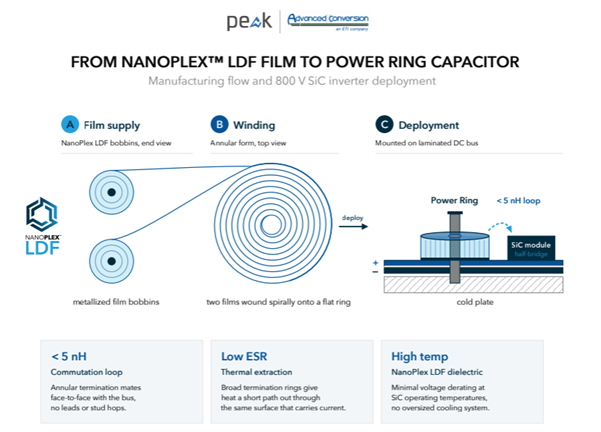
True innovation arises when Peak Nano’s advanced material is integrated into Advanced Conversion’s Power Ring architecture. While conventional capacitors struggle with internal heat management, the Power Ring structure allows for superior thermal contact and minimal Equivalent Series Resistance (ESR). By integrating NanoPlex LDF film, the system not only withstands higher temperatures but does so with a significantly reduced physical footprint.
This synergy enables SiC inverter designers to reach power densities that were previously unattainable. During our discussion, the Peak Nano spokesperson emphasised the importance of this integrated approach: “The combination of NanoPlex LDF with Advanced Conversion’s Power Ring technology allows for a smaller, lighter capacitor that can handle higher ripple currents while operating closer to the heat source. This is a gamechanger for high-voltage power electronics where space is at a premium.”
Beyond size, the key lies in ultra-low inductance enabled by Advanced Conversion’s power ring capacitor architecture. In fast-switching systems like SiC, any parasitic inductance can generate dangerous voltage spikes. The optimised architecture ensures that current flow is as efficient as possible, allowing the inverter to run at its maximum frequency capacity. “By reducing parasitic inductance and improving thermal pathways, we are enabling our customers to push the boundaries of what’s possible in 800V EV platforms and high-efficiency power conversion,” Wolak added.
Securing the supply chain: a domestic strategic advantage
In today’s geopolitical landscape, technological superiority is only half the battle; the ability to deliver is the other. As the demand for electric vehicles and renewable energy infrastructure skyrockets, the stability of the supply chain has become a top priority for OEMs. Peak Nano’s commitment to domestic production provides a critical layer of security for western manufacturers looking to de-risk their procurement strategies.
During the interview, Wolak underscored the strategic value of their localised operations: “This isn’t just a performance story … It’s a supply chain story, too. Our ability to manufacture NanoPlex LDF domestically ensures that our customers aren’t just getting a superior product, but a secure and resilient supply chain. This is particularly vital for sectors like defence and high-stakes automotive manufacturing, where reliability and sovereignty are non-negotiable.”
By keeping the development and production of high-performance film and capacitor assembly within a domestic framework, the partnership minimises logistics risks and accelerates time-to-market for new designs. This localised approach allows for tighter quality control and a more collaborative relationship between the supplier and the engineering teams. “We are providing more than just a component; we are offering a strategic partnership that ensures the next generation of power electronics is built on a foundation of innovation and supply chain certainty,” he concluded.
Conclusion
The collaboration between Peak Nano and Advanced Conversion represents a paradigm shift in power management for the coming decade. By resolving the ‘thermal bottleneck’ with NanoPlex LDF film and optimising electrical performance through the Power Ring architecture, this partnership has established the gold standard for 800V SiC inverters. Designers no longer have to choose between thermal efficiency and compactness; they can now achieve both, driving lighter electric vehicles, faster chargers, and more sustainable data centres.
In a market that demands constant innovation and absolute reliability, having a proven solution backed by a domestic supply chain is an unmatched competitive advantage. As the Peak Nano spokesperson concluded: “We are not just improving capacitors; we are empowering engineers to fully exploit the capabilities of Silicon Carbide technology.” The future of high-voltage power electronics is here, and it is defined by advanced materials and integrated systems engineering.