

Electronic Specifier’s Managing Editor Paige Hookway looks back on a record-breaking week in Munich and the themes that ran through it: AI in real products, components getting ever smaller, the rise of the humanoid, the power demands of the data centre boom, and a supply chain that is busy but braced for what comes next.
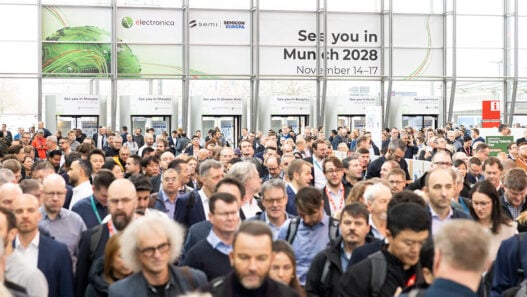
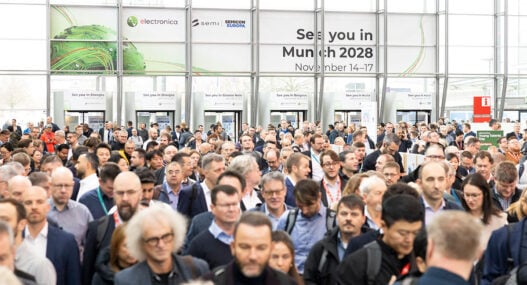
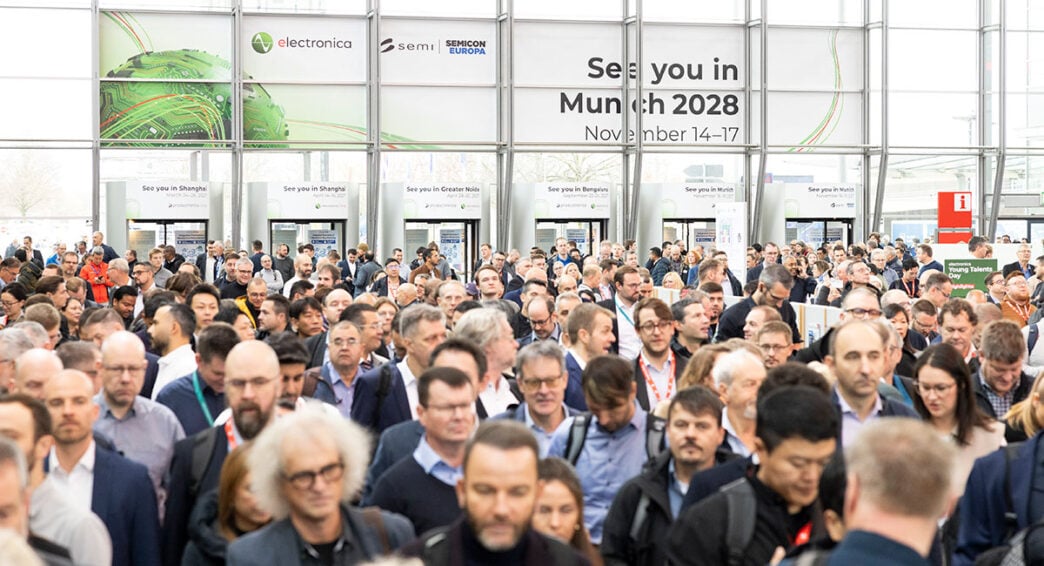
Every electronica has its own vibe, and this year’s was easy to read the moment you walked into the halls: busy, confident, and very much focused on getting things done. The numbers back that up. From 10-13th November, 3,512 exhibitors from 60 countries and regions took over Messe München, 74% of them from outside Germany, and more than 86,000 visitors came through the doors from 107 countries. Some record-breaking numbers there.
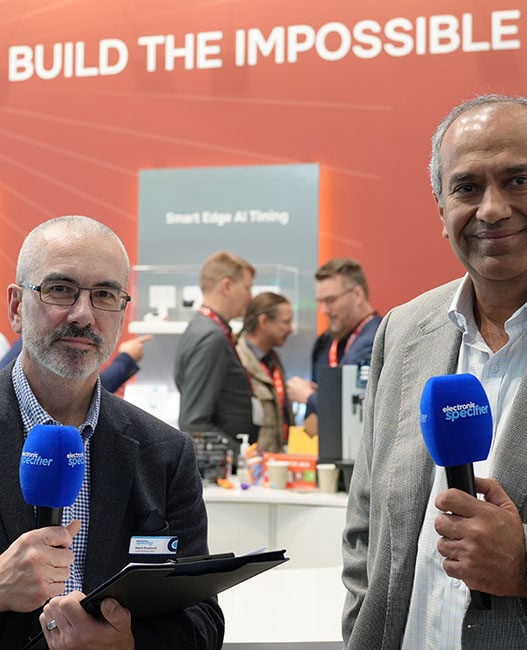
Between the Electronics Excellence Awards, the Women in Tech Forum, and a packed run of interviews on and around our stand, I spent most of the week in conversation with engineers, distributors, suppliers, and executives. Five themes kept coming up. Here are my thoughts on each.
AI has left the lab
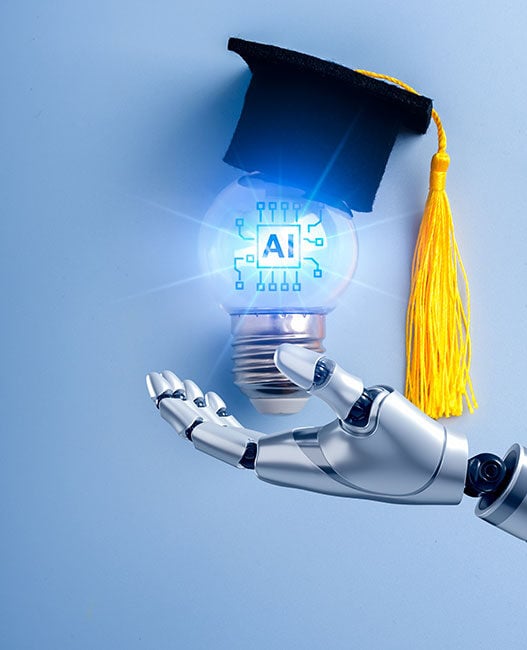
If one word defined electronica 2026, it was AI. That was no surprise. What struck me was how much the conversation has changed. Two years ago, AI on a show floor often meant a concept demo and a lot of talk about potential. This year, the discussions were about deployment, cost, and the practical problems of putting intelligence into real products.
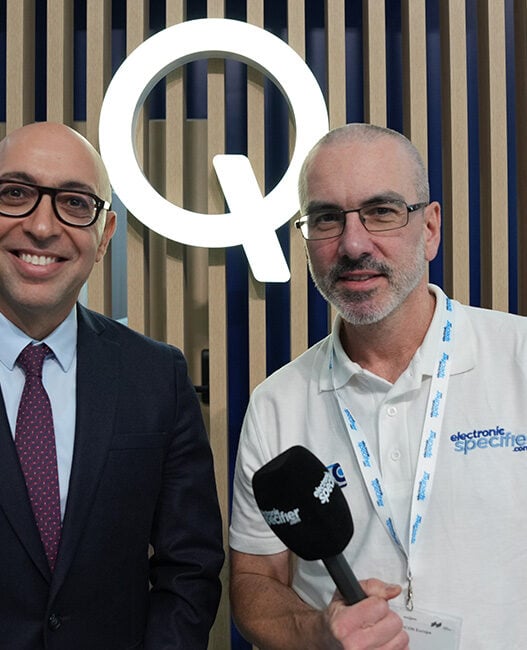
Wassim Chourbaji, SVP and President of Qualcomm EMEA, put it well in his interview with our Contributing Editor Mark Gradwell. He argued that the industry has moved past the experimentation phase and should now be judged on use cases, business outcomes, and total cost of ownership. His view is that AI is moving off the screen and into machines that sense, reason, and act in real time: “We’re entering an era where AI is becoming active in the real world.”
Farnell’s Ankur Tomar made a similar point from the distribution side. He pointed to smart wearables, video doorbells, robot vacuums, and robotic lawnmowers as examples of AI already working in products people use every day, with uses spreading into security, industrial automation, EVs, and medical devices. He was also frank about the barrier: most engineers have never studied AI, and the industry needs to give them tools, development kits, and pre-trained models they can use without becoming data scientists.
You could see that shift towards practical use on the show floor too. The new edge lab LIVE! area drew big crowds all week, because it let visitors see Edge AI running in real applications.
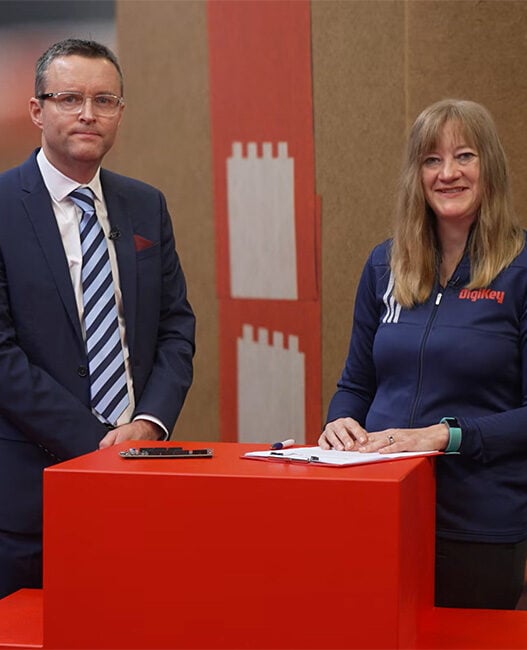
The commercial side is just as clear. When I sat down with DigiKey CEO Dave Doherty on day one, he told me AI is the most exciting thing in DigiKey’s order data. Demand is concentrated among a handful of hyperscalers, but it also reaches infrastructure builders and Edge applications. DigiKey is running at more than 50% revenue growth this year.
Miniaturisation: how small can we go?
The second theme ran quietly underneath a few conversations: everything is getting smaller. Customers want more performance, more connectivity, and more intelligence in less space, using less power. Caroline Pannier, electronica’s Exhibition Director, expects demand for smaller, more efficient, and more sustainable components to continue all the way to the next show in 2028.
The question people were asking was how far we can push this before quality and reliability suffer. Aravindhan Ramachandran of TE Connectivity made an interesting point: designing interconnect for humanoid robots, his team is working at a scale where, in his words, “Every millimetre is valuable. Every gram is valuable.” TE showed a 112Gbps compute interconnect with a footprint of roughly 6.5 × 4.5mm, and a vision connector around 40% smaller than typical miniaturised FAKRA parts.
But he was equally clear that shrinking a part is only half the job. As components get smaller and work harder, signal integrity, heat, mechanical stress, and serviceability all become harder to guarantee. That means new materials, new cable arrangements, and new ways of testing. My sense is that the limit on miniaturisation is no longer just what we can manufacture. It is what we can prove will keep working in the field.
The humanoid is taking shape
My colleague Lucy Barnard and I have been following humanoid robotics closely this year across Electronic Specifier and Automation News, and electronica confirmed something we had both suspected. Humanoids are no longer just a story about a few high-profile robot makers. More component companies are now designing and selling parts for robotic joints, actuation, and motion.
TE’s work is a good example. Ramachandran explained that almost every connector on the market today was designed for a static environment, while a humanoid’s connectors have to keep working while the robot moves. TE is now building test rigs that copy the motion of a humanoid hand or leg, and developing subsystem-specific connectors for vision, power, compute, and actuation. Samples are already in board-level testing, with commercial launches expected soon.
At the system level, Qualcomm’s Chourbaji described robotics as an ecosystem effort that no single company can deliver alone. Qualcomm has agreed to acquire PickNik, the company behind the open-source MoveIt manipulation framework, to strengthen its motion-control capability, and is linking its Arduino prototyping boards to its Dragonwing production silicon with ROS 2 support.
Put those together and you can see a supply chain forming around the humanoid, from motion software and Edge processors down to the connectors in the joints. That is a big step from where we were even a year ago, and I expect it to be one of our biggest themes in 2027.
Powering the data centre boom
Behind much of the AI discussion sat a less glamorous but more pressing question: how do we power all of it? AI’s appetite for compute is driving a wave of data centre building, and that brings serious challenges in power conversion, distribution, cooling, and efficiency.
It is no coincidence that energy efficiency was one of the show’s official key themes, alongside AI and cyber resilience, as a driver of the All Electric Society. Pannier was in no doubt about where things are heading: “the AI and data centre boom – we will still be busy with that in 2028.”
What interests me most is how these two themes feed each other. AI is driving demand for data centres, and the data centres in turn need smarter, more efficient power electronics, which increasingly rely on AI to manage them. Farnell’s Tomar told us power and security are now a major concern in almost every design. Whether you are building a hyperscale facility or a battery-powered Edge device, power is now a first-order design decision rather than an afterthought.
The data centre boom is also reshaping the supply chain, which brings me to the final theme.
Supply chain: positive, but watchful
The mood among distributors and suppliers was, on the whole, upbeat. Demand is strong in most sectors and most regions. But underneath the optimism I picked up a real sense of caution about the next couple of years, driven by two things: geopolitics and memory.
Memory was the shortage everyone wanted to talk about. Speaking to Lucy Barnard, Smith CEO Nick Bedford said AI became the largest buyer of chips in roughly 12 months, and that manufacturers have told him to expect the memory squeeze to be worse in 2027 than in 2026. Smith’s Chief Trading Officer Mike Pursley said some memory parts that once sold for around $135 now go for around $3,000, and that buyers may receive only about half of what they order. Pressure is also building on MLCCs and legacy parts.
When I interviewed James Hill, President and COO of Rand Technology, he agreed that memory will be a challenge, and added that as AI moves towards the Edge and robotics, low-power components could become harder to source too. He described tariffs and geopolitical pressure as “an unending dynamic”, and his outlook for 2027 was busier, more complex, and harder to execute than 2026.
Others were more bullish about the near term. TME’s Mark Burr-Lonnon told me “There’s really not that many parts of the market which are down”, and expects conditions to stay good through most of 2027, though 2028 may look different. TME is growing fast, with sales up around 60% in the US and 87% in China this year, and a new warehouse in Atlanta due to start serving US customers in early 2027.
DigiKey’s Doherty described the market as near a cyclical peak: relatively stable, but no less complex. He also noted that engineers are now looking further upstream, asking where components and their supply chains come from, not just whether parts are in stock.
The German market tells a similar story. According to ZVEI, new orders in the German electro and digital industry rose by almost 13% between January and September. ZVEI President Daniel Hager welcomed the figures but warned they are not enough on their own, calling for better framework conditions so that projects and investments lead to real value creation in Germany.
The advice I heard again and again was consistent: order early, understand your allocations, don’t rely on the spot market, and treat your distributor as part of your team rather than a last resort.
Final thoughts
I left Munich feeling positive about where the industry is heading. AI has moved from promise to products. Components are getting smaller and smarter. Humanoids are building a supply chain of their own. And the investment flowing into data centres is reshaping everything from power design to procurement.
But I also left with the sense that the next two years will still test the industry. Memory constraints, geopolitical uncertainty, and a skills gap that no one has solved yet will all shape what 2027 looks like. The companies that do well will be the ones that plan early, work closely with their partners, and keep investing in people as well as technology.