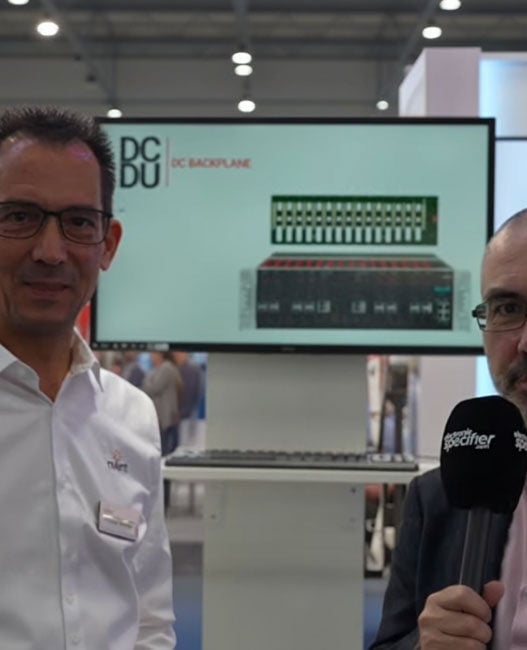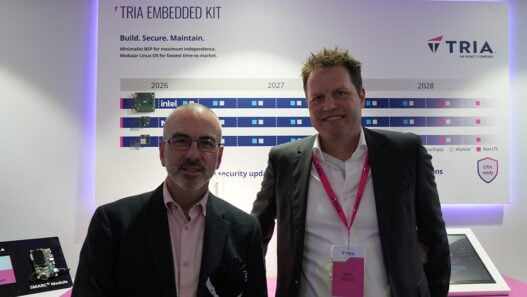


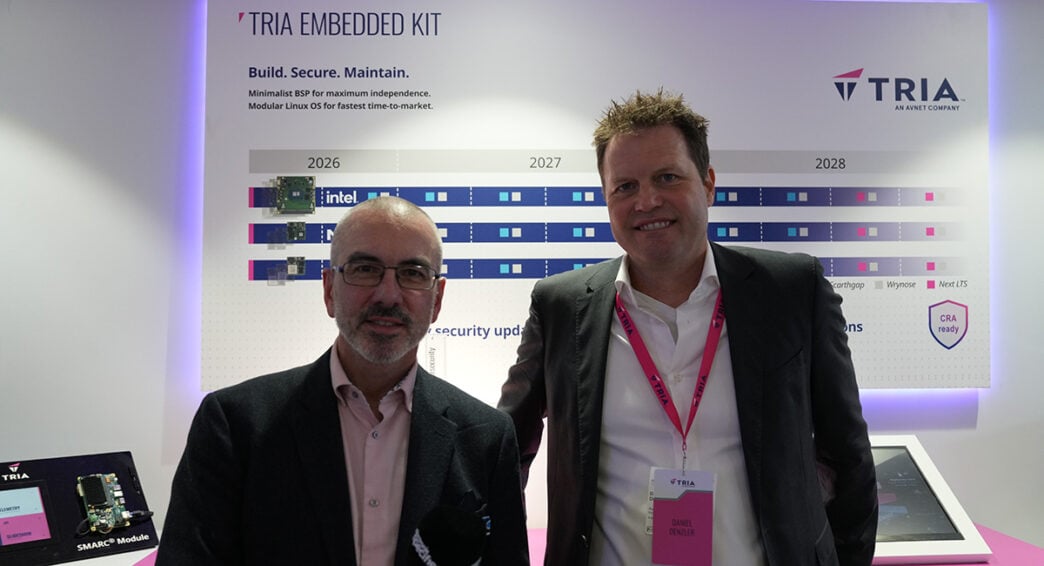
At electronica 2026, Electronic Specifier’s Mark Gradwell spoke with Dr. Daniel N. Denzler, Managing Director of Tria Technologies, about the company’s new Tria Embedded Kit, the four trends fuelling growth in the embedded market, and why the Open Standard Module (OSM) form factor is gaining ground.
The headline for Tria Technologies, an Avnet company specialising in the design and manufacture of embedded compute boards, systems, and HMIs, at this year’s electronica wasn’t a single new board – it was software.
“As usual, we have a lot of new and exciting things for Tria at the show, but I want to emphasise very much that we’ve invested a lot and revamped our software portfolio to support our customers providing secure solutions over a long life cycle,” explained Denzler.
A layered approach to lifecycle software
Denzler introduced the new Tria Embedded Kit, describing it as “a staggered offering across many layers.”
At its foundation is a minimal board support package (BSP), available for Yocto Linux, Android, and Windows. This is typically the go-to point for OEMs that want to build their own operating system. They receive a lifecycle-managed BSP (board support package) from Tria – on the Yocto side, with quarterly Long-term support updates – and can then look after their own operating system and applications over the product’s lifetime.
For customers who want more service and value, the next layer is Tria OS for Linux, a security-hardened Yocto distribution, supported by additional tooling including a CVE (common vulnerabilities and exposures) management tool and fleet management to help customers roll out updates to devices in the field.
At the top of this sits Tria SuperCare, a managed service for customers who want to hand over more of that responsibility and get to market even faster. “Customers basically give us their hardware, we keep it secure for them, we manage all the CVEs and help them [by] doing that security work for them,” said Denzler.
The idea isn’t set to any particular application. “It’s basically to just keep the fundamentals stable and secure,” he said, starting with drivers at BSP (board support package) level and building up through the operating system to the additional services on top. “The higher you go, the more optional it becomes.”
Denzler said that customer feedback had long identified software maintenance as a pain point, and that with rising cybersecurity threats and the EU Cyber Resilience Act (CRA) on the horizon, it is now becoming a critical differentiator, both for customers and for the value of Tria’s modules. The company has invested heavily in the offering over the last two years, and several demos on the stand let visitors try it for themselves.
For companies without the in-house resources to manage the lower layers of the software stack, the benefit is focus: “they can concentrate on their core competencies and they can be very fast to market with a state-of-the-art COM module.”
Four trends shaping the market
Asked what top trends the company was seeing, Denzler said four trends were driving Tria’s growth.
The first is the long-running shift from make to buy, as customers move from chip-down designs to computer-on-module (COM) designs. “Customers do not have the competencies anymore to do these very complex, high bandwidth designs,” he explained, citing the multi-layer routing between DRAM, display interface, and processor.
The second is Arm making big inroads into performance territory once held by x86. “The x86 market for us is alive and kicking, no doubt about that, but the big growth is coming from Arm moving into that performance space.” Because managing Arm devices across Linux, Windows, and Android is more complex than managing x86 devices, customers need additional software support.
Third is that software security and lifecycle management are becoming differentiators in their own right.
The fourth trend is supply chain resilience. Tria offers design capabilities in the European Union, carries out all of its software development in the EU, and draws on Avnet to keep component supply available. “It’s becoming a big differentiator in the market right now to be able to actually supply product,” Denzler said.
OSM: closer to chip-down, without the complexity
On form factors, Denzler noted that while SMARC (smart mobility architecture) has driven much of the growth in recent years, that momentum is now being taken up by OSM (open standard modules). Smaller than SMARC, OSM is a solder-down solution – closer to the chip-down designs it often replaces – and its tighter thermal coupling gives customers more flexibility when replacing legacy designs.
Rather than tackling the time-consuming complexity of a chip-down design, customers can focus on an application-specific carrier board “and just basically solder the OSM module on top,” with Tria providing a stable software baseline.
OSM’s small size and lower thermal footprint make it especially well suited to Arm. With its NXP and Qualcomm portfolio, Tria can now offer performance ranging from typical Arm applications up to what was previously x86 territory. “Especially with the Qualcomm devices … we can now also cover the high end here with a small OSM module,” he said, adding that several new designs on show were proving very popular with customers.
Value moves beyond the hardware
Bringing it back to the Embedded Kit, Denzler noted that the plug-and-play nature of SMARC and the solder-down nature of OSM are shifting the value add away from pure hardware. “Five years ago, we would have spoken about hardware and form factors,” he said. Today, customers are looking for a Tria COM module with the necessary software support.
At a minimum, customers receive a stable BSP across operating systems on which to build their own production-ready OS, but how much more they take on depends on the customer. A large OEM may handle many of the software topics in-house, whereas “a smaller, fast-scaling customer is very happy to find a partner in Tria, where we take a lot of that work out of their hands so that they can concentrate on scaling the actual business.”
Watch the full interview here: