


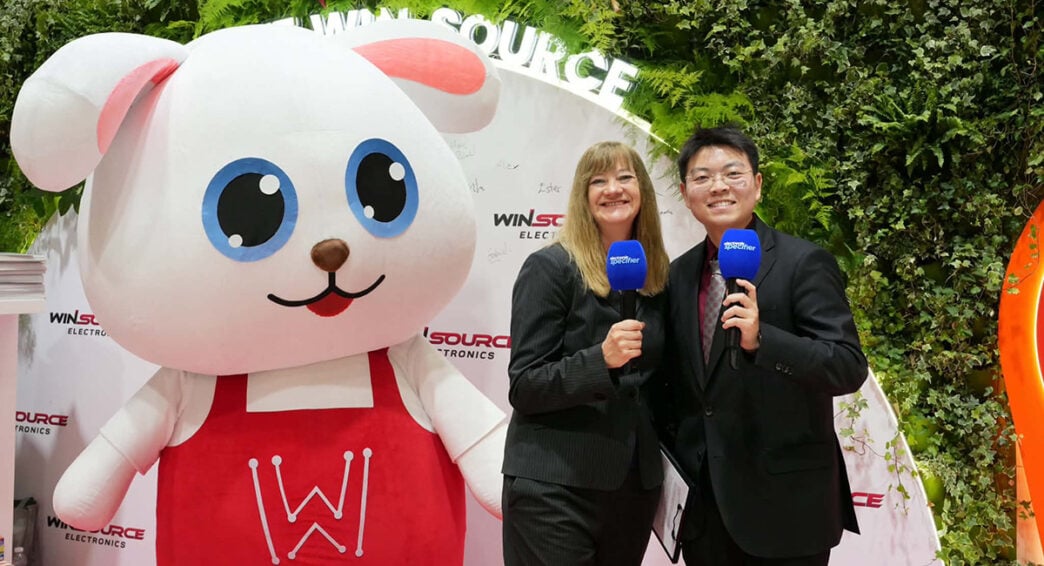
At electronica 2026, Electronic Specifier’s Lucy Barnard caught up with Enrico Hu, Regional Sales Director for Western and Southern Europe at WIN SOURCE. They talked about component shortages and supply chain uncertainty, and about how manufacturers can find and validate alternative parts to keep production running.
Three highlights for 2026
This year, Hu picked out three highlights. The first is a broader service for customers. The company still supplies components, but it also helps with shortages, manages excess inventory, and works to reduce BOM costs. The second is quality, which is backed by an independent laboratory within the group. “Customers don’t need to be worried about the quality more,” he said. The third is NEXUS, WIN SOURCE’s intelligent platform. “You can find the life cycle of the component. You can get the market analysis. You can also find [the] availability of a product,” he said.
The real problem is uncertainty
Speaking on why sourcing is so hard at the moment, Hu said that it comes down to one word. “The main problem is uncertainty. Prices, lead time, product availability, everything changes every day very quickly.”
Manufacturers still have to keep production lines moving, and timing can quickly become a risk. For example, a customer might hold enough stock for three months of production, but qualifying an alternative could take four months or more. In that situation, the gap becomes a real threat to production.
Start with the original part
When a critical component becomes hard to find, WIN SOURCE doesn’t jump straight to an alternative. “Usually we do not recommend to find the alternative directly. We will focus more on the original part number,” Hu said.
The team first works out whether the risk is short-term or long-term. To do that, it checks manufacturer notices, the lifecycle status of each component, and availability and lead times across sourcing channels worldwide. “If it’s only a temporary shortage, so don’t worry, we will try our best to secure, to source for our customer,” he said. Only when the risk looks longer-term does WIN SOURCE propose alternatives, which the customer’s engineering team then evaluates for approval.
More than a datasheet match
Voltage, package, and capacity are the obvious checks, but Hu warned that matching them isn’t enough. Two components can look the same on paper and still behave very differently once they’re on the board. Pin layout, start-up behaviour, and operating temperature can all differ.
“We couldn’t provide the customer the alternative part with only one or two specifications,” he said. “We must let them … try.” That’s why WIN SOURCE supplies datasheets, samples, technical information, and technical support.
Why acting early matters
For manufacturers that aren’t facing a shortage yet, Hu’s advice was to plan ahead without spreading resources too thin. Rather than finding alternatives for every part on the BOM, he recommends focusing on the critical ones, for example, parts with only one or two approved sources, and parts heading towards obsolescence. “For critical parts, we must have alternative plan B,” he said.
Watch the full video interview here: